



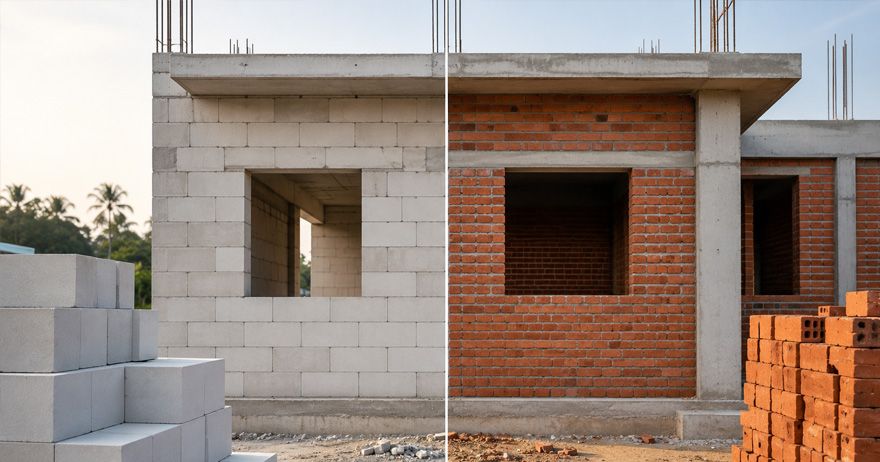
The debate around AAC blocks vs red bricks has become more common as homeowners and builders look for materials that improve construction quality while reducing long-term costs. AAC blocks and red bricks are two of the most commonly used wall construction materials in residential buildings.
While traditional red bricks are known for their durability and familiarity, AAC (Autoclaved Aerated Concrete) blocks offer advantages such as lighter weight, better thermal insulation, faster construction, and reduced structural load. Choosing between AAC blocks and red bricks depends on factors such as cost, strength requirements, climate conditions, construction speed, and long-term energy efficiency goals.
What Are AAC Blocks?
AAC (Autoclaved Aerated Concrete) blocks are lightweight building blocks made using cement, lime, fly ash, gypsum, water, and a small amount of aluminium powder. During manufacturing, tiny air pockets are created inside the block, so it is much lighter than traditional bricks.
Today, AAC blocks for house construction are widely used because they improve thermal insulation, reduce the overall weight of the building, and make masonry work more efficient.
What Are Red Bricks?
Red bricks are one of the oldest and most widely used construction materials in India. They are manufactured by moulding natural clay and firing it at high temperatures until it becomes hard and durable.
They are heavier than AAC blocks and require more mortar during construction. Their quality can also vary depending on the manufacturing process and the type of clay used.
AAC Blocks vs Red Bricks: Key Differences
When you ask, AAC blocks vs red bricks which is better. Both materials can produce strong and durable homes, but they perform differently in several important areas.
Weight Comparison
AAC blocks are nearly three times lighter than conventional clay bricks. It reduces the overall dead load on the building, which is especially beneficial for multi-storey construction.
Red bricks, on the other hand, are much heavier. Although this has never prevented them from being widely used, the additional weight increases the load carried by the structure.
Strength Comparison
When comparing which is stronger AAC block or red brick, it is important to understand the type of strength being measured. Red bricks generally have higher compressive strength when individual units are tested.
AAC blocks are engineered materials manufactured under controlled factory conditions. They provide consistent quality and sufficient strength for most residential buildings.
Thermal Insulation Performance
The tiny air pockets inside AAC blocks slow down heat transfer and homes require less air conditioning, which can reduce electricity consumption over time. These AAC block construction benefits make them particularly suitable for regions with hot climates.
Red bricks also provide insulation, but they absorb and transfer heat much faster than AAC blocks. As a result, indoor temperatures may rise more quickly during peak summer afternoons.
Sound Insulation Performance
AAC blocks perform better at reducing sound transmission because of their cellular structure. The trapped air inside the blocks helps absorb sound vibrations before they pass through the wall.
Red brick walls also reduce noise effectively when constructed with sufficient thickness, but AAC blocks generally provide better acoustic performance for walls of similar dimensions.
Construction Speed
AAC blocks are larger than traditional bricks, which means fewer units are needed to complete a wall. It is one of the biggest advantages highlighted in every AAC blocks vs clay bricks comparison. Faster installation not only saves labour costs but also helps complete projects sooner.
Red bricks require more individual units, more mortar joints, and additional alignment work, making construction comparatively slower.
Water Absorption
AAC blocks absorb water differently from red bricks because of their porous structure. Before plastering, proper surface preparation is necessary to ensure good bonding between the block and mortar.
Red bricks also absorb water and usually require soaking before construction to prevent them from drawing moisture out of the cement mortar.
Durability and Lifespan
Red bricks have a long history of durability, with many older buildings still standing today. They can withstand harsh weather conditions when manufactured using quality clay and proper firing methods.
AAC blocks are also durable. They do not rot, attract termites, or support fungal growth. They offer consistent quality throughout the project.
Environmental Impact
AAC blocks are often considered a greener alternative because they are manufactured using industrial by-products like fly ash. Since fewer raw materials are used and construction generates less waste, AAC blocks support more sustainable building practices.
Traditional red bricks, on the other hand, require natural clay and high-temperature firing. The manufacturing process consumes more energy and can contribute to soil depletion when clay is sourced extensively.
Cost Comparison
The red bricks vs AAC blocks cost comparison in the Indian market is given below.
| Cost Factor | AAC Blocks | Red Bricks |
|---|---|---|
| Material cost per unit | ₹35 to ₹55 per block (600×200×200 mm) | ₹8 to ₹14 per brick (230×115×75 mm) |
| Equivalent wall area cost (material only) | ₹180 to ₹260 per sq ft (200 mm wall) | ₹140 to ₹220 per sq ft (230 mm wall) |
| Mortar consumption | Low with thin-bed joints (2 to 3 mm) | High with standard joints (10 mm) |
| Plastering cost | Lower | Standard |
| Labour cost per sq ft | ₹30 to ₹45 (faster laying speed) | ₹45 to ₹70 (slower laying speed) |
| Structural savings (RCC) | Yes lighter wall reduces column beam and foundation load | No structural savings from wall weight reduction |
Advantages of AAC Blocks
- Superior thermal insulation: AAC block walls keep rooms 2°C to 4°C cooler than equivalent red brick walls in peak Indian summer conditions.
- Lighter structural load: 40 to 50 percent lighter than red brick walls and enables savings in structural steel, concrete, and foundation dimensions.
- Faster construction: Compressing the masonry programme and reducing labour cost per square metre of wall.
- Dimensional consistency: Machine-manufactured AAC blocks have tight dimensional tolerances, reducing plastering material and labour.
- Ease of cutting and shaping: AAC blocks can be cut precisely with a hand saw or band saw to any size or angle.
- Fire resistance: A 200mm AAC block wall provides 4 to 6 hours of fire resistance better than standard red brick of equivalent thickness.
- Reduced construction waste: The precision of AAC block cutting produces less material waste than brick construction.
Advantages of Red Bricks
- Universal familiarity: Every mason in India knows how to lay red bricks.
- Wide availability: Red bricks are available across virtually every location in India, including remote areas far from manufacturing centres.
- Lower material unit cost: Red bricks cost less per unit than AAC blocks.
- Better acoustic performance: Higher mass gives red brick walls better baseline sound attenuation.
- Long-term track record: Red bricks have a centuries-long performance record in Indian construction conditions.
- Load-bearing construction compatibility: They are the established material for traditional load-bearing wall construction without an RCC frame.
AAC Blocks vs Red Bricks: Which Is Better for Indian Homes?
As red bricks have both pros and cons, AAC block advantages and disadvantages are normal. Choosing the best material for wall construction depends on your project requirements rather than simply following tradition.
- If your priority is faster construction, lower structural load, improved thermal comfort, and better energy efficiency, go for AAC blocks. They reduce indoor heat, can improve comfort and lower electricity bills. AAC blocks for residential construction are a perfect choice.
- If you value traditional construction methods, have access to quality clay bricks, or are working on a smaller project where labour is already experienced with brick masonry, red bricks continue to be a practical option.
Common Construction Mistakes When Using AAC Blocks
- Using standard cement mortar instead of thin-bed mortar: Using standard 10mm cement-sand mortar with AAC blocks wastes material, increases wall weight, and reduces the thermal performance.
- Not wetting AAC blocks before laying: Blocks should be sufficiently dampened to control moisture absorption from the mortar bed.
- Inadequate curing of mortar joints: Rushing subsequent construction loads before the mortar has set properly can crack joints.
- Leaving AAC walls unplastered through monsoon season: Exposed AAC block walls absorb significant moisture during prolonged rain.
- Not specifying block grade correctly: Using lower-grade blocks in applications that require higher strength is a specification error that can compromise wall performance.
- Improper lintel design over openings: Lintels over door and window openings in AAC block walls must be properly designed and installed.
Factors to Consider Before Choosing Wall Materials
Whether you are choosing brick vs block for home building, making an informed decision today can improve your home's comfort and performance for decades.
Consider the factors such as local climate, construction type, construction speed, structural efficiency, noise reduction needs, thermal insulation, labour availability and familiarity, material availability, and budget priority. Consult your structural engineer before making a final call.