



Brickwork forms the foundation of strong, durable, and long-lasting walls. However, brickwork defects in buildings can lead to cracks, moisture problems, poor load distribution, and reduced structural performance.
Issues such as improper mortar mixing, uneven joints, poor alignment, inadequate curing, and low-quality materials can significantly affect the strength and appearance of a building. Understanding common brickwork mistakes helps homeowners ensure better construction quality and avoid expensive repairs in the future.
In this blog, we will look into 10 common brick masonry mistakes to avoid.
Why Quality Brickwork Matters
Despite other options being present, most homes are still built with brick and mortar. Brickwork carries the whole weight of your walls and transfers that load down to the foundation. If it is not done properly, your home will develop cracks, let in water, and may even become unsafe over time.
Brick wall construction errors cannot be spotted once plastering is done. We may think everything is alright, but no. It’s not. So, being careful and spotting the mistakes during brick wall construction is recommended, as it is far cheaper and easier than fixing them after the building is complete.
The following are the 10 common brickwork mistakes people often commit.
Mistake #1: Using Poor-Quality Bricks
As per IS 1077:1992, the minimum compressive strength for common burnt clay bricks used in residential construction is 3.5 N/mm². Anything less than the given value is not of good quality.
Bricks must not absorb more than 20% of their weight in water after 24 hours of soaking. Low-quality bricks are often underfired, which makes them too porous and weak.
A good brick should have sharp edges, a uniform red colour, and produce a ringing sound when knocked with your knuckle.
Mistake #2: Incorrect Mortar Mix Ratios
The standard cement-to-sand ratio for normal brickwork is 1:6. For load-bearing walls or areas exposed to moisture, a 1: 4 mix is used. Too much sand weakens the bond between bricks, while too much cement makes the mortar crack as it dries. This is one of the most common brickwork mistakes you think of.
Mistake #3: Inadequate Soaking of Bricks
A dry brick pulls moisture out of fresh mortar before the cement has had time to set. This weakens the bond between the brick and the mortar. Bricks should be soaked in water for at least one hour before laying. After soaking, the surface should feel damp but not dripping wet.
Mistake #4: Uneven Mortar Joints
The standard mortar joint thickness for brickwork is 10mm, with an acceptable range of 10 to 12 mm as per IS 2212. Joints that are too thick reduce the load-bearing capacity of the wall and increase mortar consumption. Also, joints that vary in thickness create stress concentration points and allow rainwater to seep in. So, every joint should be kept uniform throughout the wall.
Mistake #5: Poor Wall Alignment
A wall must be perfectly vertical (plumb) and perfectly horizontal (level). Even a small lean changes how the load is distributed and leads to cracks along the mortar joints. Walls that are visibly tilted or door frames that are not square are signs that alignment was not checked during construction. These are common wall construction mistakes.
In multi-storey homes, even a slight deviation at the ground floor gets amplified as the wall rises, making the problem much worse by the top floor.
Mistake #6: Insufficient Curing
Curing means keeping newly laid brickwork moist so that the cement in the mortar gains its full strength. Freshly laid brickwork should be watered twice a day for a minimum of 7 days. In hot and dry climates, 14 days of curing is recommended. Without it, the mortar dries too fast, shrinks, and develops hairline cracks that grow wider over time. Proper curing can increase mortar strength by 25 to 30%.
Mistake #7: Improper Bonding Patterns
Bricks must be laid so that no two vertical joints are directly above each other. This staggered arrangement is called a bonding pattern. The English bond, where courses of full-length bricks and sideways bricks alternate, is the strongest pattern for load-bearing walls. When bricks are stacked directly above each other without any offset, the wall has no lateral strength and splits under load or seismic movement.
Mistake #8: Ignoring Verticality and Level Checks
Many masons rely on their eye to judge whether a wall is straight, but this causes errors to accumulate course by course. A plumb bob checks whether the wall is vertical, and a spirit level confirms each house is horizontal. Both tools must be used after every 3 to 5 brick courses. Errors caught at 5 courses can be corrected in minutes. Errors found after 20 courses mean tearing the wall down.
Mistake #9: Leaving Gaps Around Openings
Every door and window opening needs a lintel, a horizontal beam placed above the opening, to carry the weight of the wall above it. The brickwork on all sides of the opening must stay tight against the lintel with no empty spaces. Gaps between doors and window frames and the surrounding brickwork let in water and insects. They also leave sections of wall unsupported, which causes cracks to form at the corners of every opening.
Mistake #10: Lack of Quality Inspections
Checking should be done when bricks are delivered to the site, while brickwork is actively being laid, and after the curing period is complete. Checking during the laying stage lets you catch wrong mortar mixes, dry bricks, and poor alignment before they become permanent parts of your wall.
Make sure to avoid these brickwork mistakes for a stronger building.
How to Check Brickwork Quality on Site
Here is how to do the brick masonry quality checks by yourself.
- Knock a brick with your knuckle. A good brick gives a clear ringing sound, while an underfired or weak brick gives a dull thud. This is the first step to tick off in the brickwork quality checklist.
- Try scratching the brick face with your fingernail. If it does not crumble or flake off, it is a good brick.
- Press your fingernail into set mortar 24 hours after it is laid. If it is hard and does not scrape out, it is a good brick.
- Hold a spirit level flat against the wall surface. If it bulges outward, it is not good brickwork. This is how to identify bad brickwork.
- The poor brickwork quality signs require keen observance.
Warning Signs of Poor Brick Masonry
Here are some of the warning signs of brickwork mistakes.
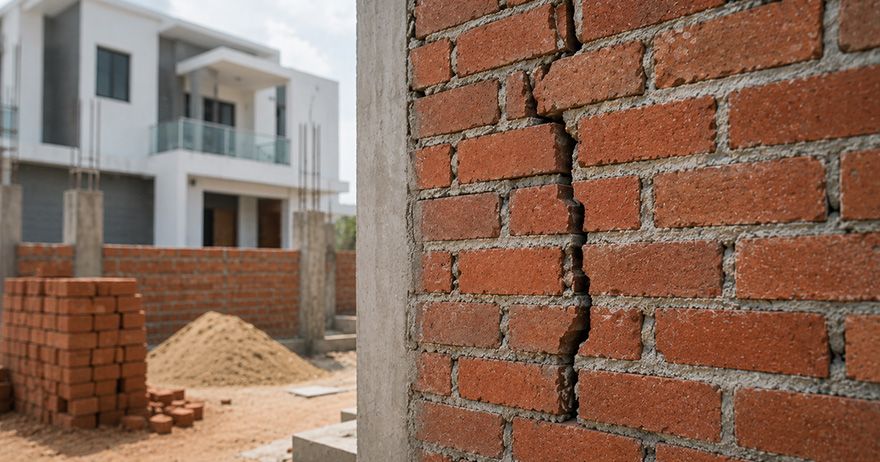
- If the staircase-pattern cracks run along mortar joints, it means that the wall has settled unevenly.
- If you spot horizontal cracks near the base of a wall, it means water damage or foundation movement.
- If there are powdery deposits on the brick surface (efflorescence), it means that water is travelling through the wall and bringing dissolved salts to the surface.
- If the wall leans, bulges, or bows outward, it points to serious structural concerns and must be checked by a civil engineer without any delay.
Best Practices for Durable Brick Construction
Here are some of the best practices for durable brick construction.
- Use IS 1077-certified bricks from a reliable supplier.
- Always measure mortar mix proportions using a fixed ratio, and never by guessing.
- Soak bricks before use and make sure the surface is damp at the time of laying.
- Ask your mason to use a spirit level and plumb bob regularly.
- Insist on water curing for at least 7 days after each section of wall is complete.
- If you are building during peak summer months, extend curing to 14 days and keep walls shaded during the hottest part of the day.
- Visit the site while brickwork is in progress. Visiting after plastering is done is of no use.
- Make sure all gaps around door and window frames are completely packed with mortar before any finishing work begins.