



Why Structural Construction Quality Matters?
Building a home is one of the biggest financial decisions a family can make. So, if you are not keen on what’s happening, a single structural construction mistake can compromise a building’s safety, durability, and long-term performance. It is far more expensive to fix after construction than to prevent during it.
Errors made during foundation work, reinforcement placement, concrete pouring, waterproofing, or structural design can lead to cracks, settlement, water damage, and costly repairs.
While some defects become visible immediately, others may take years to appear. Understanding the most common structural construction mistakes helps homeowners, builders, and project managers ensure better construction quality and avoid expensive future problems.
10 Common Structural Construction Mistakes
Here are the 10 common structural construction mistakes that should be avoided.
Mistake #1: Skipping Soil Testing
Every plot has a different type of soil. Some soils are soft and cannot handle heavy loads, while others are hard and stable. A soil test can tell you the bearing capacity of your plot, its water conditions, how deep your foundation needs to go, and what type of foundation design suits the site. Building on a plot without soil testing leads to cracks in walls, structural stress, and uneven settlement.
Mistake #2: Poor Foundation Construction
The foundation transfers your building’s entire weight into the ground. Getting it wrong affects every wall, beam, and column above it. This is one of the mistakes that weaken a building structure.
It is advisable to avoid common errors such as digging at the wrong depth, failing to compact the soil before laying concrete, and choosing the wrong foundation type. If your plot has soft or loose soil, a simple isolated fitting is not enough. A raft or pile foundation may be needed.
Mistake #3: Incorrect Reinforcement Placement
Steel bars inside concrete, called TMT bars or rebars, give your structure the strength to carry loads without cracking. Placing them incorrectly weakens the structure, even when everything looks fine from the outside.
Two common RCC construction mistakes are using the wrong bar diameter and not maintaining proper cover.
Cover is the minimum gap between the outer concrete surface and the steel bar inside. As per IS 456:2000, the cover for column longitudinal bars must be less than 40 mm, and for slabs under moderate exposure, it must be at least 20 mm to 30 mm.
When the cover is insufficient, moisture reaches the steel, which then rusts, expands, and cracks the concrete from the inside. This is called spalling. Small concrete spacers known as cover blocks are placed under steel bars before casting to maintain the correct distance.
Mistake #4: Using Low-Quality Construction Materials
Low-quality materials may look the same as certified ones but give poor results under load and over the years of use. It is one of the important house construction mistakes to avoid.
Use only BIS-marked (ISI-marked) materials. For cement, OPC 43 Grade, OPC 53 Grade, or PPC are the right choices. For steel, use Fe415 or Fe500D TMT bars with mill test certificates.
For sand, use river sand or M-sand meeting IS 383 standards. Beach sand and soil-mixed sand must never be used. Always ask for material test certificates before accepting any delivery to your site.
Mistake #5: Improper Concrete Mixing And Curing
Adding too much water to concrete is the most common foundation construction mistakes. It makes the mix easier to pour but drastically reduces its final strength.
For M20 concrete, the water-cement ratio should not exceed 0.55. A higher ratio produces weak and porous concrete. After casting, the concrete must be kept wet for at least 7 days for OPC cement, and 10 days for PPC or blended cement. This is called curing. Stopping it early causes the concrete to dry too fast, crack, and lose its designed strength.
Mistake #6: Inadequate Waterproofing
Water causes more long-term structural damage than almost any other factor. Terraces, bathrooms, kitchens, and basement walls are the most vulnerable areas.
Waterproofing is not just a surface coating. It involves proper membrane layers, correct terrace slopes for drainage, and sealing all joints and edges where water enters. A terrace without proper waterproofing lets water seep into the concrete slab, rust the steel inside, and weaken the structure silently over years.
Mistake #7: Removing Formwork Too Early
Framework is the temporary wooden or metal frame used to hold concrete in shape until gains enough strength.
As per IS 456:2000, props under slabs must stay for at least 14 days for spans up to 4.5 metres, and 21 days for longer spans.
Props under beams must remain for 14 to 21 days depending on the span. Side shuttering for columns and walls can come off after 16 to 24 hours, but the props underneath must not be removed before concrete has cured fully.
Early removal can cause slabs to slag, crack, or collapse. This is one of the common building construction errors.
Mistake #8: Ignoring Structural Drawings
A structural drawing is prepared by a licensed structural engineer and shows the exact sizes, placement, and specifications of every structural element in your building. It specifies column sizes, beam depths, slab thickness, and reinforcement details.
Any change to these without recalculation can cause structural problems in house construction. Structural drawings are not the same as the architectural plan, which only shows room sizes and layouts.
Mistake #9: Poor Beam And Column Execution
Beams and columns are the skeleton of any reinforced concrete building. Errors in their construction directly affect how much load the structure can carry.
Avoid problems like wrong column dimensions, incorrect stirrup spacing, and insufficient lap length. Lap length is the overlap distance when two steel bars are joined. As per IS 456: 2000, this must be at least 45 to 60 times the bar diameter, depending on the steel and concrete grade. The junction where a beam meets a column must always be cast as one unit, never separately.
Mistake #10: Lack Of Construction Quality Checks
Even the best structural design fails if it is not executed correctly on site. Check on construction quality issues in homes confirm the design is being followed.
Standard checks include a slump test to verify concrete workability, cube tests to confirm strength at 7 and 28 days, and inspection of steel placement before every casting. These are standard but frequently skipped. Unless you ask for written test reports, most contractors do not conduct them.
These are the 10 structural construction mistakes that should be avoided at any cost.
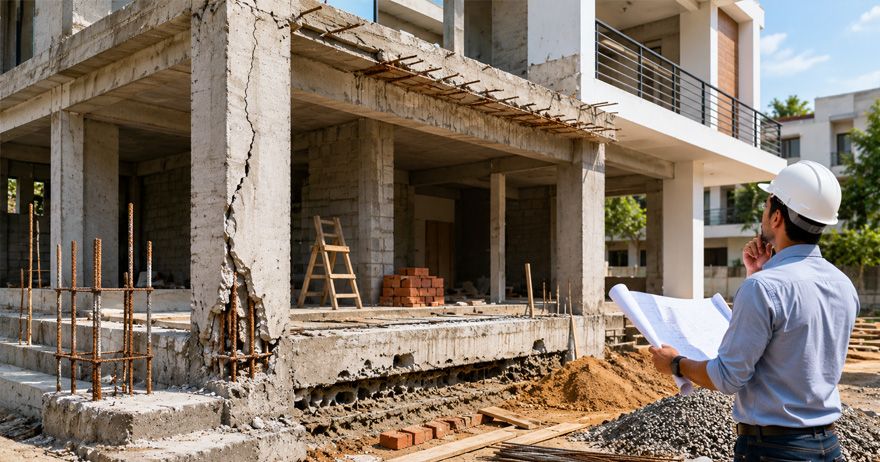
Warning Signs Of Structural Defects In Buildings
Watch for these in your home or a property you plan to buy.
- Diagonal cracks at the corners of doors and windows
- Cracks running along or across beams or columns
- Water seeping through the roof slab, ceiling, or internal walls
- Floors that feel uneven or appear to be sinking
- Doors or windows that stick or no longer close properly.
None of these is cosmetic issues. Each one needs inspection by a licensed structural engineer without delay.
How To Ensure Better Construction Quality
To ensure better construction quality hire a licensed structural engineer before construction begins and keep their drawing on site at all times. Insist on ISI-marked materials with test certificates. Visit the site regularly, especially before concrete is poured. Never allow extra water in the mix, and never allow formwork to be removed before IS 456:2000 timelines.
Structural Inspection Checklist For Homeowners
This is how to avoid structural construction mistakes by having a checklist.
- You have obtained the soil test report before foundation design is finalised.
- Foundation type matches the structural engineer’s approved drawing.
- TMT bars are FE415 or Fe500D with valid mill test certificates.
- Cover blocks placed correctly before any concrete casting begins.
- Water-cement ratio maintained as per the structural design mix.
- Concrete cube tests done at 7 days and 28 days for every pour.
- Waterproofing applied at the terrace, bathrooms, and all wet areas.
- Formwork and props not removed before the timelines in IS 456:2000.
- Structural drawings available on site and followed during execution.
- Third-party quality inspection completed at key construction stages.