


Next time you notice air leakage, water leakage from window frame, dust coming through window gaps, or noise coming through closed windows, it is not because of the window quality, but because of poor installation.
Incorrectly installed windows can reduce comfort, increase maintenance, and even damage your interiors over time. So, it is better to understand the warning signs early to fix the problem before it becomes more expensive and harder to manage.
If you are wondering how to tell if windows are installed properly, a good installation leaves no drafts, no dust entry, no noise gaps, and no water ingress after rain. In this blog, let’s explore some of the window installation problems and how to rectify them before it burns a hole in your pocket.
What Happens When Windows Are Installed Incorrectly
A window needs to fit tightly into the wall opening. There should be no gaps at all. Proper installation means uniform sealing, a level frame, and a drainage slope that sends rainwater outward rather than into your wall.
Window installation problems won’t show up immediately when any of these steps goes wrong. Some appear within weeks, others take a monsoon season or two as water stains creep down the wall. By the time the damage is obvious, the fix is almost always more expensive than it would have been earlier.
Common Signs Of Poor Window Installation
Here are the signs windows are not sealed properly.
| Sign | What does it tell you |
|---|---|
| Air leakage from windows problem | Frame not sealed properly against the wall |
| Dust on sills despite closed windows | Gaps in frame or wall packing incomplete |
| Condensation inside the glass | Double-glazed unit seal has failed |
| Water stains or damp patches on walls below window | No drainage slope or waterproofing missing |
| Noise louder than expected | Weak or incomplete sealing around frame |
| Window hard to open or close | Frame installed out of level or alignment |
| Window feels loose or shakes | Frame not fixed firmly into the wall opening |
Why Bad Window Installation Causes Dust, Noise, And Leaks
All three window installation problems- dust, noise and leaks- share the same root cause, that is, gaps and poor sealing.
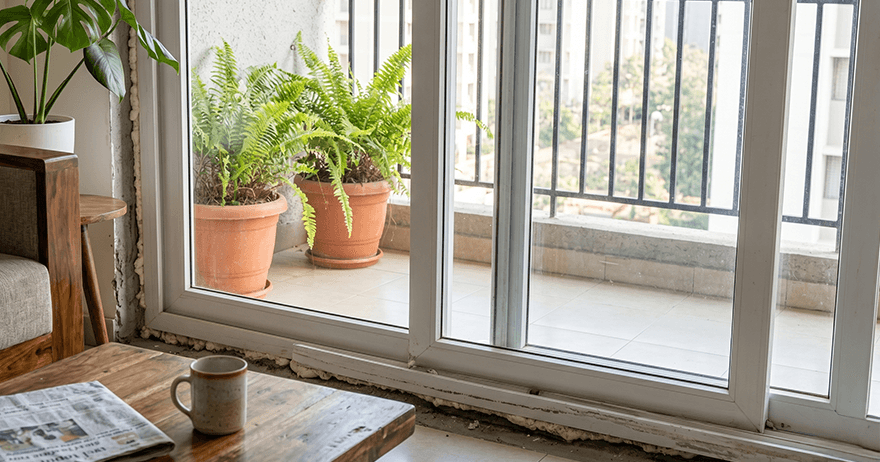
Dust near window edges: This happens when the gap between the frame and the wall is not packed and sealed properly. Fine dust, especially in cities during summer and peak construction months, travels through these channels and settles in the same spots every time. Though regular cleaning helps temporarily, the dust returns because the entry point is still open.
Noise coming through closed windows: This points to weak or incomplete sealing around the frame. A properly installed window reduces outside sound noticeably. If traffic noise or conversations outside the home are clearly audible, the seal is either missing in sections or was applied incorrectly and has since peeled away.
Water leakage from the frame: This is the most damaging outcome. It happens when the outer sill has no drainage slope, when the frame-to-wall junction is not waterproofed, or when silicone sealant was applied over a dusty or damp surface and did not bond. Over time, this water works into the wall and causes paint to bubble, plaster to crack, and in serious cases, mould to develop inside the wall.
How To Fix Poorly Installed Windows
Based on how serious the problem is, issues can be resolved.
Re-sealing the frame: If sealant around the outside has cracked or peeled, scrape it clean and apply fresh silicone. Make sure the surface is dry, dust-free, and clean before applying.
If you are wondering how to fix window sealing problems, this is the one. It resolves most minor air and water leakage.
Replacing weather strips and gaskets: The rubber gaskets inside the frame compress over time. Replacing them improves airtightness and noise reduction without touching the frame or wall.
Repacking the frame gap: If the gap between the frame and wall was poorly filled, a professional can inject fresh expanding foam or apply mortar packing and then reseal the outer edge. Thai fixes dust infiltration and structural rattles.
Alignment correction: Windows that stick or do not close flush often just need hinge or hardware adjustment. Most uPVC window hardware allows three-dimensional adjustment with a basic hex key.
If you are dealing with multiple problems, quick fixes are unlikely to hold. In that case, resintallation is the more reliable long-term solution.
Repair Vs Replace: What Should You Do?
Repair works when the problem is limited to sealing, gaskets, or hardware alignment. If the frame is warped, badly out of level, or leaking despite repeated resealing, reinstallation is the better call.
Here is the repair and window replacement cost India.
- Basic resealing and gap filling: ₹500 to ₹2000 per window
- Alignment correction: ₹1000 to ₹3000 per window
- Full reinstallation: ₹3000 to ₹8000 per window, depending on size and wall work needed
- Full window replacement (uPVC): ₹500 to ₹1200 per sq ft.
When you buy your windows from the best window installation company like IndiFrame, we do a site visit before quoting, measure the wall opening precisely, use manufacturer-approved fixing and sealing methods, and offer a written warranty on both the product and the workmanship.