



Soil testing before construction is a critical step because it determines the strength, composition, and load-bearing capacity of the ground on which a building will be constructed. The results help engineers design safe foundations, prevent structural issues, reduce construction risks, and avoid costly repairs in the future.
Whether you're building a house, villa, or commercial structure, a proper soil investigation ensures the site is suitable for construction and supports long-term structural stability.
In this blog, we will discuss what soil testing is, the importance of soil testing before construction, types of soil testing, problems caused by skipping soil testing, cost of soil testing, etc.
What Is Soil Testing For House Construction?
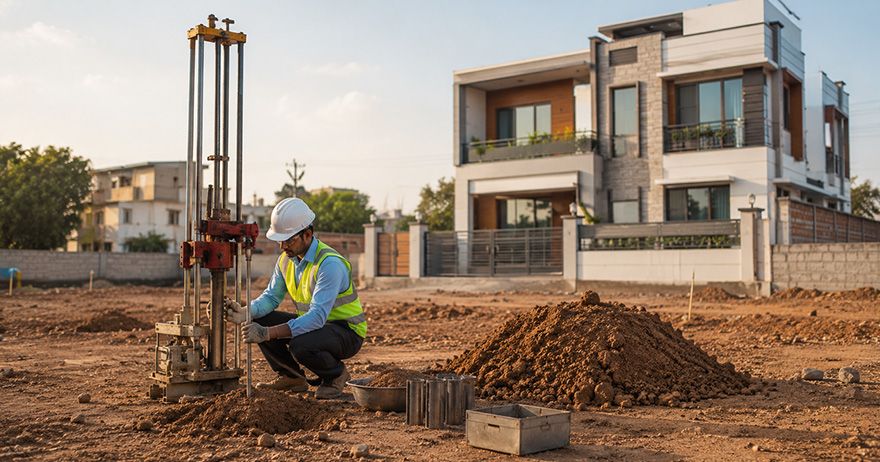
Soil testing is the process of checking the soil at your construction site before you build anything. Engineers take samples from different depths and test them in a lab to find out how strong the soil is, how much weight it can carry, and what foundation your building needs.
Why Soil Testing Before Construction Is Important?
If you are wondering why soil testing is important before building a house, your entire building rests on the soil beneath it. If that soil is weak or uneven, the structure can crack, tilt, or sink over time.
Soil testing tells you what the ground can handle before a brick is laid. This helps you pick the right foundation, avoid costly repairs later, and confirm whether your land is fit for construction.
How Soil Testing Affects Foundation Design
The foundation i what that holds your entire building. So, it should be laid on a proper soil.
Strong, rocky soil can support a simple shallow foundation. Soft or loose soil may need a deeper foundation, added reinforcement, or piles that go down until they reach a strong layer.
Without soil test results, a structural engineer cannot calculate the right size or depth of the foundation. So, architects ask for the soil test report before finalising plans.
What Is Soil Bearing Capacity Test For Construction?
Soil bearing capacity is the maximum load the soil can safely support without sinking, shifting, or failing. It is measured in tonnes/sq m. Sandy, clay, and rocky soil all carry weight differently, even under the same load.
If the building is built on low-bearing-capacity soil, without proper design changes, the foundation can settle unevenly and damage the structure above it. Soil testing is the only way to find this exact number for your plot.
Types of Soil Tests Used in Construction
Here are a few standard soil tests that are usually run before construction begins. Most of the projects need more than just one.
Standard Penetration Test (SPT)
Standard Penetration Test (SPT) is the most widely used soil test in construction. A hammer weighing 63.5 kg is dropped from a fixed height to drive a sampling tube into the ground. The number of blows needed gives the soil’s N- value.
A higher N-value means stronger soil, and a lower one means soft soil. The test repeats at regular depths inside a borehole, showing how soil strength changes deeper down.
Plate Load Test
Plate load test checks the bearing capacity of soil directly at the site. A steel plate is placed on the ground, and load is applied in steps while engineers measure how much the soil settles.
This gives a real, field-based measure of safe bearing capacity, instead of relying only on lab results. Plate load tests are common for larger buildings, where foundation accuracy matters more.
Moisture Content Test
The moisture content test measures how much water is present in the soil. Moisture levels affect soil behaviour a lot, especially in clay soils, which expand when wet and shrink when dry. This can damage a foundation over time if not accounted for during design.
For the moisture content test, the soil sample is weighed, dried in an oven, then weighed again to find the water it held.
Compaction Test
The compaction test is also called the Proctor’s test. It finds the moisture level at which soil packs together most tightly for maximum density. It matters most when soil needs filling or levelling before construction, such as on loose or uneven plots.
Properly compacted soil reduces the chance of the building settling unevenly later.
Chemical Analysis of Soil
Chemical analysis of soil involves checking the chemical content of the soil, including sulphates, chlorides, and pH level. High levels of these can corrode concrete and steel reinforcement over the years.
This matters more near coastal areas, industrial zones, or land previously used for farming with heavy fertiliser. The results help engineers decide if extra protective measures are needed.
Problems Caused by Skipping Soil Testing
Here are some foundation problems caused by poor soil and skipping soil testing.
Foundation Settlement
When soil is weaker than expected, it compresses unevenly under the building’s weight. This is called differential settlement. It causes part of the building to sink more than others, stressing walls and beams.
Structural Cracks
Cracks in ceilings, walls, and beams are signs of soil-related foundation problems. These usually show months or years after construction. Once the building has settled into unstable ground, fixing the issue is far more difficult and expensive than proper soil testing would have been.
Water Drainage Issues
Soil testing shows how well water drains through the ground. Soil with poor drainage holds water close to the foundation, weakening it over time and causing dampness, seepage, or waterlogging during heavy rain.
Increased Construction Costs
Skipping soil testing might save a small amount upfront, but it usually costs far more later. Foundation repairs and structural fixes after construction can run into lakhs of rupees, much higher than the cost of a proper soil test.
When Should Soil Testing Be Conducted?
Soil testing should happen before you finalise the land purchase, and definitely before purchasing the building plan. Testing early lets you not buy a bad plot or adjust your design before spending on architecture and approvals.
If you already own the land, it is better to do soil testing before construction or before applying for building permission or a loan, since most authorities and banks ask for this report first.
Soil Testing Process Explained
Here is the construction site soil testing guide.
The soil testing process starts with a site visit. There, engineers decide how many test points are needed based on plot size and building height. Boreholes or test pits are then dug at these points, and soil samples are collected at different depths, along with SPT readings, before going to a lab for testing.
The final report includes the soil profile, bearing capacity, and a clear recommendation for the foundation type. The full process usually takes three days to two weeks, depending on project size.
How Much Does Soil Testing Cost?
Here is the soil testing cost for house construction.
- For a regular individual house, soil testing using test pits can cost around INR 5,000 to INR 15,000.
- Larger homes or buildings needing formal borehole testing with SPT usually fall between INR 25,000 and INR 75,000, depending on the number of boreholes, their depth, and your city.
- Multi-storey buildings or tricky soil, such as coastal or rocky land, can cost more due to extra tests and deeper drilling.
Soil Testing Checklist for Homeowners
Here is the soil testing checklist for homeowners.
- Do a soil test before buying a plot, not after construction has started.
- Along with soil testing, also do a geotechnical investigation before construction.
- Choose a lab that is NABL-accredited or approved by your local development authority.
- Ask how many test points or boreholes are planned for your plot size and building height.
- Request the full written soil report, not just a verbal summary, and keep a copy.
- Check if the report includes a bearing capacity value and a clear foundation recommendation.
- Share the report with your structural engineer before the building design is finalised.
- Do not skip soil testing to save money; it is small compared to repairing a damaged foundation.