



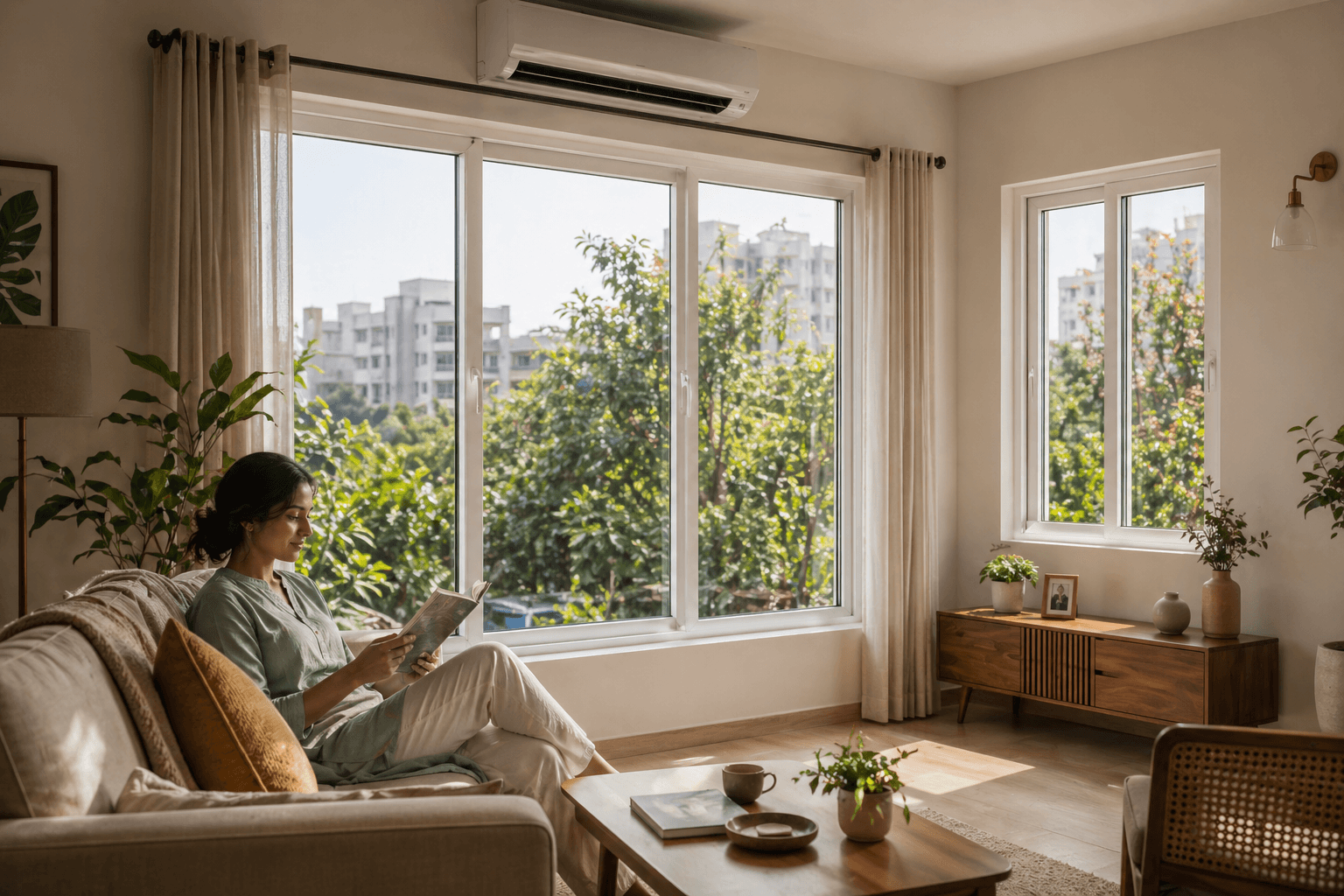
If you live in Hyderabad, during peak summers, your electricity bill is probably one of your biggest monthly grievances. Though you set the thermostat and the compressor runs nonstop, the bill hikes. This is because the heat keeps getting back in through your windows.
But if you use uPVC double-glazed windows instead of single-glazed aluminium windows, the electricity bill can be reduced by 15 to 30%. For instance, if you own a 3 BHK apartment in Hyderabad, with uPVC windows, you can save roughly up to ₹7600 to ₹10900 every year. For a 2 BHK, it works out to ₹5000 to ₹6700 annually. The payback period on installation typically falls between 3 and 5 years. After that, the savings continue for 20 or more years.
If you are wondering how uPVC windows electricity bill savings hold up across different climates, it comes down to the frame and glass working together as a system.
How Much Do uPVC Windows Reduce Electricity Bills In India?
If the AC usage is moderate, you might see around 15% reduction in electricity bills. With regular usage and proper double glazing, the numbers move closer to 20 to 25%. In ideal conditions, with good installation and advanced glass like Low-E (a heat reflecting coat), savings can go up to 30%.
Why uPVC Windows Lower Your AC Bill- 4 Mechanisms
Thermal conductivity: Aluminium conducts heat extremely efficiently, which is great for cookware but terrible for window frames. uPVC conducts heat far less than aluminium, which means the frame itself is not acting like a radiator pushing outdoor heat indoors.
The air gap in double glazing: A double-glazed unit has two panes of glass with a sealed layer of air (or inert gas like argon) between them. This gap is a surprisingly effective thermal barrier. The heat has to cross two panes and a still air layer to get inside, which slows down the heat transfer.
Solar heat gain control: Standard clear glass lets a large portion of solar radiation pass straight through. Double-glazed uPVC windows, especially the ones fitted with Low-E (low-emissivity) glass, reflect a significant portion of infrared radiation before it enters the room. This matters most on west-and south-facing windows in the afternoon.
Air-tight seals: Single-glazed windows, particularly older aluminium sliding units, have gaps where conditioned air leaks out and hot air seeps in. uPVC frames use precision-fitted rubber gaskets that cut air infiltration significantly.
Savings By Home Type: 1BHK, 2BHK, 3BHK, Villa
Based on a national average electricity tariff of ₹7/unit, AC usage of 8 hours/day during the early and peak summers, and a 20 to 25% reduction in cooling load, the uPVC windows electricity bill savings are calculated below.
| Home Type | Windows (approx) | Monthly AC Saving | Annual Saving (₹7/unit) |
|---|---|---|---|
| 1 BHK | 4 to 5 | 30 to 40 units | ₹2500 to ₹3400 |
| 2 BHK | 6 to 8 | 60 to 80 units | ₹5000 to ₹6700 |
| 3 BHK | 8 to 12 | 90 to 130 units | ₹7600 to ₹10900 |
| Villa | 14 to 20 | 140 to 200 units | ₹11800 to ₹16800 |
*The number of windows, their orientation, the hours of AC usage pattern, and the location all affect the final figure.
Single Glazing Vs Double Glazing: Which Saves More?
Looking at double glazed windows vs single glazed electricity costs, the differences are quite clear. Single-glazed windows, whether uPVC or aluminium, are cheaper upfront, but the performance gap is significant.
- Single-glazed uPVC is better than single-glazed aluminium due to the frame, but since it comes with one layer of glass with no air gap, it provides limited insulation.
- Double-glazed uPVC windows improve thermal resistance considerably over single-pane glass, and are suitable for India’s mix of extreme summer and cold. It’s because they create a buffer between the outside heat and the indoor space.
- Double-glazed uPVC windows with Low-E glass work the best, especially for rooms with heavy afternoon sun.
How Long Before uPVC Windows Pay For Themselves?
The installation cost for double-glazed uPVC windows in India typically ranges from ₹800 to ₹1500 per sq ft, depending on the profile, glass type, and the city. For a 2BHK with roughly 60 to 70 sq ft of window area, the total cost might be ₹50000 to ₹90000.
At an annual saving of ₹5000 to 6700, the payback period might be 7 to 15 years at the lower savings end, and 3 to 5 years if you stay in a city where you use AC heavily.
After that point, uPVC windows electricity bill savings keep adding up for 20+ years with virtually no maintenance cost, unlike wooden frames that need repairing or aluminium frames that can corrode near the coast.
When Will You NOT Save 30%?
The 15 to 30% range is real, but it depends. You will likely see savings at the lower end if,
- Your existing windows are already reasonably well-sealed.
- You use AC sparingly for less than 2 to 4 hours a day, so the baseline cooling cost is low.
- You live in a mild climate like coastal Karnataka or the hills, where outdoor temperatures rarely push past 30C.
- Your windows face north, where solar heat gain is naturally lower.
uPVC Vs Aluminium Vs Wood: Electricity Cost Comparison
| Feature | uPVC (Double-Glazed) | Aluminium (Single-Glazed) | Wood (Single-Glazed) |
|---|---|---|---|
| Thermal conductivity | Very low | Very high | Low to medium |
| Air leakage | Minimal | Moderate to high | Moderate |
| Solar heat blocking | High (With Low-E glass) | Low | Low |
| Maintenance | Very low | Low | High |
| Estimated AC savings | 15 to 30% | Baseline | 5 to 10% |
| Lifespan | 20 to 30 years | 20 to 25 years | 10 to 15 years |
When it comes to uPVC vs aluminium windows energy saving, the gap is not subtle. Aluminium frames are strong and slim, but the metal’s higher thermal conductivity makes it a poor insulator, especially for cities, where AC runs throughout the day, reflecting directly on the electricity bills. So, uPVC is the clear winner.
Wood performs better thermally than aluminium, but requires significant maintenance and is not ideal for humid or coastal regions.
Tips To Maximise Savings After Installation
If you are searching for the best windows to reduce AC bill India, double-glazed uPVC is the one. Installing them is a big step. Here are a few ways to maximise savings after installation.
- Use curtains or blinds on west-facing windows in the afternoon.
uPVC frames and double-glazing windows reduce heat gain significantly, but heavy solar radiation through glass still adds heat. A light reflective blind cuts this further.
- Keep windows closed when the AC is running.
This sounds obvious, but the tightest seal in the world doesn’t help if the window is open for ventilation while the AC is on.
- Ensure proper installation.
uPVC windows need to be installed with correct sealing around the frame, not just the glass unit. A poorly fitted frame regates a significant portion of the thermal benefit.
- Consider Low-E glass for south-and west-facing rooms.
If you are retrofitting selectively, prioritise rooms that get direct afternoon sun.