



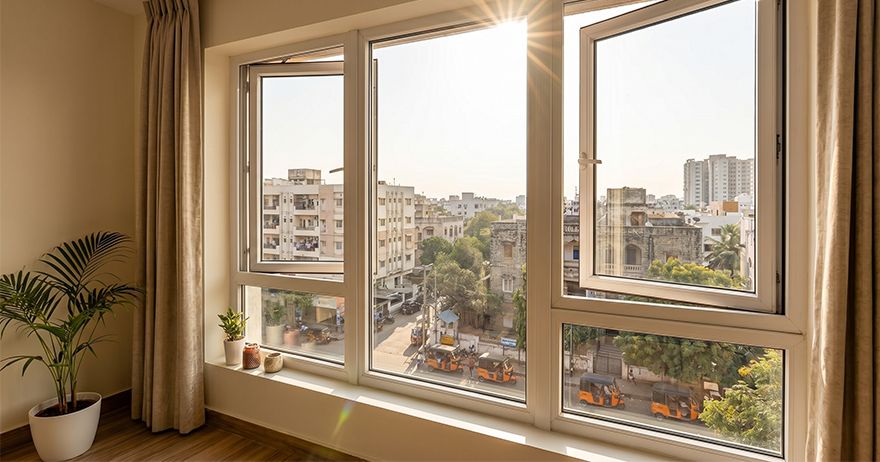
If you are from Hyderabad, you know how brutal the summer is. The city deals with extreme heat and high UV exposure. A lot of heat that makes your room uncomfortable comes in through the windows. That is why a few specifications matter more than the window brand itself.
If you are searching for the best uPVC window for Hyderabad weather, understanding these specs will make a bigger difference than any brand comparison. In this blog, we will explore the uPVC windows Hyderabad specs that matter in 40 °C heat.
SHGC, or Solar Heat Gain Coefficient, tells you how much heat from sunlight enters your room. This matters most when your window gets direct sun, especially in the afternoon. For west-facing windows here, it should be below 0.25, especially since UV levels stay high from March to September.
Then comes the U-value. It tells you how easily outside heat passes through the window. This matters even when there is no direct sunlight, because the outside air itself is hot. Lower values help keep outside heat from entering.
The frame also plays an important role. A 5-chamber uPVC profile chamber with double glazing helps reduce indoor heat by 3 to 4°C, even without relying fully on AC.
Over time, constant sun exposure also affects the material, so UV stabilisation is crucial to prevent the frame from yellowing or warping.
What is SHGC, and why does it matter most in Hyderabad?
SHGC stands for Solar Heat Gain Coefficient. It tells you how much of the sun’s heat passes through the glass and into your room.
For anyone comparing the uPVC window SHGC rating India, this is the most critical metric in hot climates. The scale runs from 0 to 1, and lower is better.
For instance, if the SHGC is 0.5, roughly half the heat hitting your window ends up inside, which is 0.25.
In Hyderabad, west-facing windows take direct afternoon sun for 4 to 5 hours a day from March to September. The UV index during this period regularly hits 12. Even with your AC on, a high-SHGC window lets in enough heat to make your room uncomfortable.
So, for west-facing windows, look for an SHGC glass of 0.25 or below. For east and north-facing windows, 0.30 to 0.35 is acceptable since they receive far less direct sun.
If you get this one spec right, you will feel the difference daily.
U-value Explained and the Right Number for a 40 °C Climate
U-value measures how easily heat travels through the full window, glass and frame together. Again, lower is better.
In colder countries, people want a low U-value so indoor warmth does not escape. But in Hyderabad, your concern is the opposite. You want to keep outdoor heat from getting in.
If you are looking for U-value uPVC windows India, a range between 1.5 and 2.0 W/m2K is a practical target for this climate. Double-glazed windows with a 5-chamber frame typically land between 1.6 and 1.8, which works well here.
If you are wondering what the difference is between SHGC and U-value, SHGC blocks the sun’s radiation, and U-value blocks the general heat that builds up outside your walls. Both must work together.
Profile Chambers: How Many Do You Actually Need?
If you look at a cross-section of a uPVC window frame, you will see hollow compartments inside. These are called chambers. Each one traps air, and trapped air is a good insulator.
If you are wondering how many chambers uPVC window India actually needs, here is a brief explanation.
A 3-chamber profile is the entry-level option. But for a hotter city like Hyderabad, a 5-chamber profile is the practical option. It reduces heat transfer through the frame by around 20 to 25 per cent compared to a 3-chambered profile.
You may come across 6 or 7-chamber profiles marketed as premium. But the additional benefits beyond the 5 chambers are very few.
Double Glazing Vs Single Glazing: The Honest Answer For Hyderabad
Single glazing is one pane of glass, while double glazing is two panes with a sealed gap of 12 to 16 mm between them. The gap is usually filled with air or argon gas.
Single-glazed uPVC windows create only a thin barrier and conduct heat easily from outside. You will need to use AC more. But double glazing uPVC Hyderabad windows cut the heat transfer significantly. When combined with low SHGC glass, it makes your room even cooler.
So, double glazing it recommended for the Hyderabad heat.
Low-E Glass: Worth the Extra Cost In South India?
Low-E stands for low emissivity. It is a thin metallic coating applied to the glass that reflects heat and a portion of UV radiation.
Looking into some of the best uPVC window specs hot climate India, Low-E coating is one of the few upgrades that delivers measurable comfort. For west-facing windows in Hyderabad, the coating pays back through lower AC usage within 2 to 3 years.
For north-facing windows or windows that are largely shaded, standard double glazing without Low-E is usually enough. There is no need to spend more where sunlight is not the main issue.
West-Facing Vs East-Facing Windows: Specs Change By Orientation
West-facing windows get harsh afternoon sun from noon to sunset. They need SHGC below 0.25, Low-E glass, and a double-glazing base.
East-facing windows get gentler morning sun. An SHGC of 0.30 to 0.35 with standard double-glazing is reasonable here.
South-facing windows in Hyderabad receive direct midday sun and should be treated closer to west-facing specs. North-facing windows are the least demanding and rarely need Low-E glass.
Adjusting specs by orientation helps you spend where it matters and save where it does not.
Monsoon-Proofing: What Drainage Tracks And EPDM Gaskets Actually Do
Hyderabad receives heavy and often sideways rain during the monsoon. August alone averages 179 mm. So, if your windows are not sealed and drained properly, water will seep in.
If you are planning to buy uPVC monsoon proof windows Hyderabad, drainage tracks and EPDM gaskets are non-negotiable.
Drainage tracks are built into the window frame to guide rainwater outward. For this to work, the track needs at least a 5-degree slope, so water flows out rather than pooling inside the frame. When looking at a window, check that the drainage holes are clear and face outward.
EPDM gaskets are the rubber seals around the glass and along frame joints. When the window closes, they compress and create a tight seal against water and air. The reason it matters is that generic PVC seals harden and crack within a couple of years, but EPDM holds up in heat and lasts longer.
UV Stabilisation: Why Cheap uPVC Yellows And Warps in 3 Years
uPVC is not naturally resistant to UV. Without the right additives mixed in during manufacturing, prolonged sun exposure causes it to yellow, become brittle, and eventually warp.
In Hyderabad, with a UV index of 10 to 12 for much of the year, poor-quality uPVC can visibly deteriorate within two to three years. You may not notice it at first, but the colour shifts and the frame starts to weaken structurally.
Good quality uPVC profiles have UV stabilisers built in and typically carry a 10-year colour stability warranty. Before you confirm an order, ask the supplier directly whether the profile is UV stabilised and whether that comes with a written warranty.
Steel Reinforcement: When Do You Need It And When You Don’t
Steel inserts can be placed inside the uPVC profile to add structural strength. The frame looks the same from outside, but the steel inside helps it hold its shape under load.
You need reinforcement when your window is wider than 1.2 metres, when it is a sliding window with a large span, or when it is installed at a height where wind pressure is a factor. Without reinforcement, wide frames can slowly bow over time, which affects both the seal and how smoothly the window operates.
For smaller fixed or casement windows below 1 metre wide, reinforcement is not essential. Just confirm if the steel being used is galvanised or not. Non-galvanised steel can rust inside the profile, which is invisible from outside but causes staining and weakens the frame over 5 to 7 years.
The Spec Checklist Before You Buy
Here is the checklist for the uPVC window specs 40 degree heat India.
| Specifications | Good Value For Hyderabad | Priority |
|---|---|---|
| SHGC | Below 0.25 for west-facing homes; rooms | Very high |
| U-value | 1.5 to 2.0 W/m2K | High |
| Profile Chambers | 5 chambers minimum | High |
| Glazing | Double glazing | High |
| Low-E Glass | Worth it for west-facing homes | Medium |
| EPDM Gaskets | Required for monsoon | High |
| Drainage tracks | 5-degree minimum | High |
| UV Stabilisation | Ask for certification | High |
| Steel Reinforcement | For windows wider than 1.2 m | Medium |