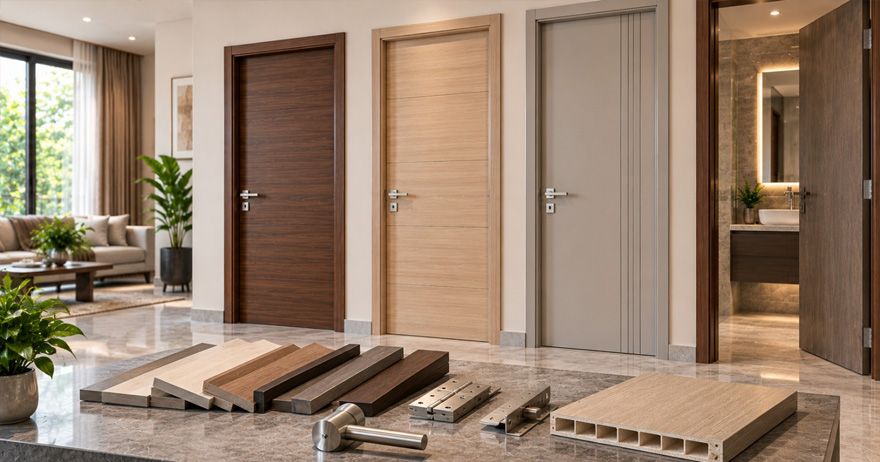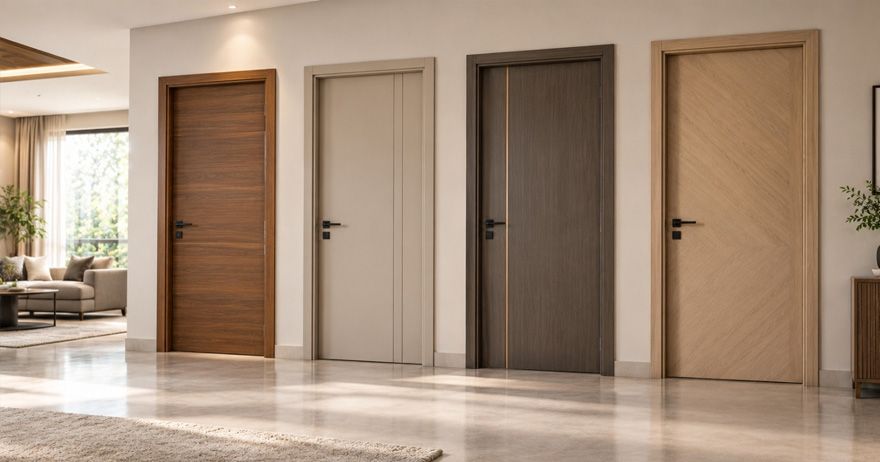
ABS doors are made using acrylonitrile butadiene styrene, a thermoplastic material known for its impact resistance and relatively low moisture absorption. They are increasingly used in spaces where easy maintenance and resistance to everyday moisture matter. However, performance depends on the door's construction, quality and installation. This guide explains what ABS doors are, their key benefits and limitations, common applications, maintenance considerations, and the factors homeowners should consider before choosing them for bedrooms, bathrooms, or utility areas.
What Is an ABS Door?
ABS is an opaque, impact-resistant thermoplastic polymer widely used in manufacturing and 3D printing. Each element in this polymer plays a key role -
A - Acrylonitrile: Provides chemical resistance, rigidity, and surface hardness.
B - Butadiene: Adds toughness, flexibility, and high impact resistance (dent and shock resistance).
S - Styrene: Provides a smooth, glossy finish and structural stability.
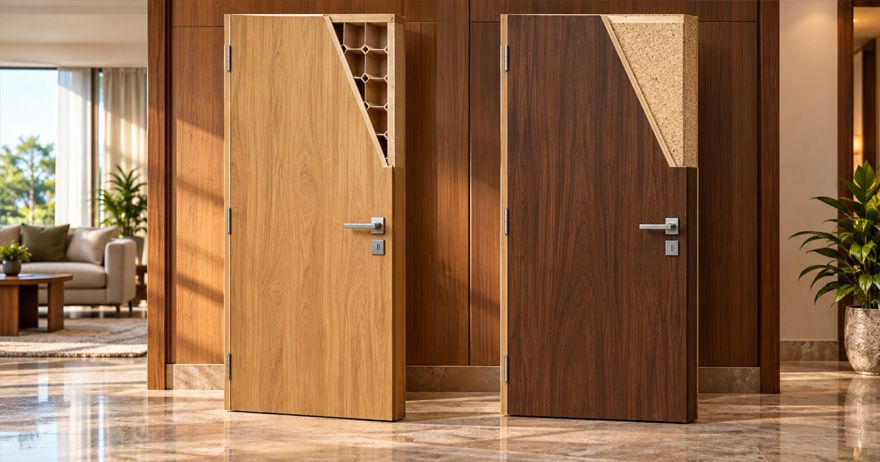
An ABS door is a modern interior or exterior door made from this polymer layer, bonded to a rigid internal core such as wood or aluminium honeycomb, tubular wood, or timber framing.
ABS Door Composition and Construction
- Surface Skins (The ABS Face): The door's exterior face and back consist of two vacuum-formed or hot-pressed ABS sheets (typically 1.35 mm to 1.5 mm thick). These sheets can be embossed with realistic wood-grain textures or laminated with decorative films to achieve the final aesthetic.
- Internal Perimeter Frame (The Stile & Rail): A rigid structural border made of Laminated Veneer Lumber (LVL) or foamed PVC bars runs along the top, bottom, and side edges. This provides the door with its primary structural stability and prevents twisting.
- Hardware Reinforcements (Lock & Hinge Blocks): Extra blocks of LVL timber or high-density PVC are integrated inside the perimeter frame at specific heights. This ensures maximum screw-holding strength where hinges and locksets are anchored.
- Inner Core Infill: The hollow space between the two ABS skins is filled with a load-distributing material to provide impact resistance and soundproofing. This is typically:
- Paper or Aluminium Honeycomb: For a lightweight door with excellent pressure distribution.
- Tubular Core (Extruded Infill): For a heavier, higher-impact door with superior acoustic insulation.
- Industrial Bonding Layer: The ABS skins, perimeter frame, and inner core are permanently fused under high pressure with a moisture-resistant polyurethane (PUR) or hot-melt adhesive to prevent delamination.
- Matching ABS Edge Banding: The exposed outer edges of the door leaf are sealed with matching ABS or PVC edge banding, making the entire panel airtight and 100% moisture-proof.
ABS Door Benefits
- Waterproof & Moisture-Proof: ABS plastic does not absorb water or swell, making these doors ideal for high-humidity areas like bathrooms, kitchens, and coastal regions.
- Termite & Pest Immunity: Unlike traditional wooden doors, ABS materials are completely resistant to termites and fungal decay.
- High Impact Resistance & Strength: Built with a rigid inner core (such as a honeycomb or tubular structure) and tough thermoplastic skins, they withstand heavy daily use and resist dents or scratches.
- Dimensionally Stable: They maintain their shape and won't warp, twist, or crack during seasonal changes in temperature and humidity.
- Lightweight Construction: Despite their strength, ABS doors are lightweight, reducing stress on hinges and making them easy to transport and install.
- Zero or Low Maintenance: They come pre-finished with decorative films, so you never need to sand, paint, or polish them—just wipe them clean with a damp cloth.
- Eco-Friendly & Non-Toxic: ABS is recyclable, free of heavy metals like lead and mercury, and has a low toxicity index for healthier indoor air.
- Better Sound Insulation: The internal honeycomb or tubular infill dampens sound better than hollow or thin panel doors.
Where ABS Doors Are Commonly Used
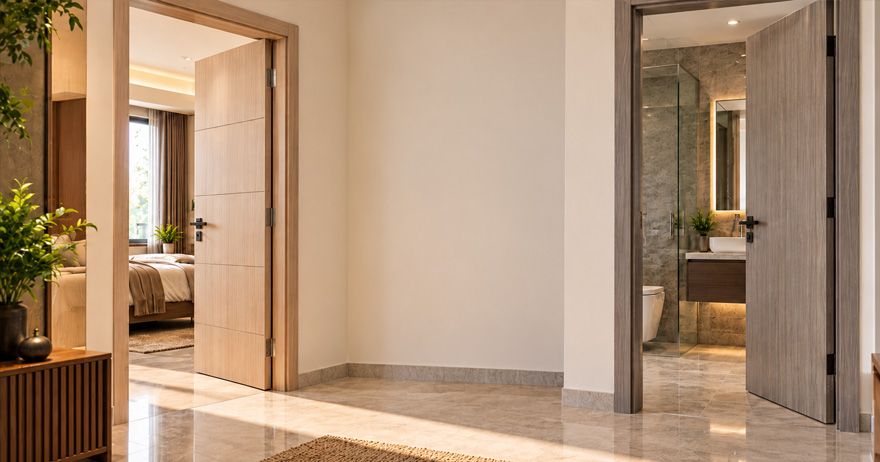
- Bathrooms and Toilets: Ideal because they are waterproof, termite-proof, and won't swell, crack, or warp from continuous exposure to high humidity and steam.
- Kitchens and Utility Rooms: Resistant to water splashes, grease, and general wear, and easy to clean with a damp cloth.
- Bedrooms and Interior Rooms: Used as stylish interior doors—often featuring a wood-grain or laminated finish—that provide good sound insulation through internal honeycomb or tubular cores.
- Closets and Storage Spaces: Lightweight and dimensionally stable, ensuring smooth opening and closing year-round without sagging.
- Hospitals and Laboratories: Favoured in healthcare environments due to their hygienic, impact-resistant, and moisture-proof surfaces.
- Offices and Commercial Spaces: Deployed in high-traffic commercial buildings and retail environments because they resist dents, scratches, and heavy daily use without needing repainting
Limitations of ABS Doors to Consider
ABS doors have distinct structural and material limitations that make them best suited for specific indoor roles rather than heavy-duty or exterior use. Even for interior use and aesthetics, ABS doors have limitations. Consider the following:
- Vulnerability to Sunlight and UV Degradation: ABS plastic degrades, discolours, and becomes brittle when exposed to direct sunlight or ultraviolet (UV) radiation, making it unsuitable for exterior main doors or areas with intense natural light.
- Core Moisture Vulnerability: While the outer ABS sheet skin is waterproof or highly moisture-resistant, the internal core (often MDF or other wood-based materials) is not waterproof. Direct submersion in water or continuous moisture leakage can damage the inner core.
- Low Fire Resistance and Flammability: ABS is a combustible thermoplastic that tends to melt and burn when exposed to fire, potentially releasing thick smoke or toxic fumes unless treated with specific flame retardants.
- Limited Heavy Impact Resistance: Because many ABS doors use lightweight internal structures like honeycomb or tubular cores, they feel less solid than heavy timber and resist hard, concentrated impacts less well.
- Design and Aesthetic Constraints: The outer ABS skin does not easily support deep CNC carving, heavy embossing, or intricate traditional wood-moulding patterns, resulting in a simpler, more utilitarian look.
- Heat Deflection Threshold: Standard ABS grades typically have a heat deflection or softening temperature of 80°C to 100°C, meaning they can warp or lose dimensional stability under severe, prolonged heat exposure.
ABS vs Flush Door
| Parameter | ABS Doors | Conventional Flush Doors |
|---|---|---|
| Material | Acrylonitrile Butadiene Styrene (ABS) thermoplastic | Timber frame with plywood facing and a solid; hollow; cellular or blockboard core |
| Core Construction | ABS door construction | Solid-core; hollow-core; cellular-core or blockboard |
| Water Resistance | Highly resistant to water and moisture | Plywood-faced doors require edge sealing to limit moisture penetration |
| Termite Resistance | Resistant to termite attacks | Wooden components are susceptible to termite attacks without protection |
| Durability | Resistant to moisture; impact and everyday wear | Solid-core doors offer greater sturdiness; hollow-core doors are less resistant to heavy impact |
| Weight | Lightweight | Hollow-core and cellular-core doors are lightweight; solid-core doors are heavy |
| Sound Insulation | Limited sound insulation in lightweight constructions | Solid-core doors provide better sound insulation than hollow-core doors |
| Screw-Holding Strength | Requires designated reinforcement or hardware-fixing points | Blockboard and solid-core doors provide better screw-holding support |
| Maintenance | Easy to clean with a damp cloth | Laminated surfaces are easy to clean; exposed wooden edges require protection from moisture |
| Appearance | Available in standard colours and moulded finishes | Available in laminates; natural wood veneers; paint and decorative finishes |
| Customisation | Available in standard sizes; colours and designs | Can be customised with different sizes; core types; veneers and laminates |
| Cost | Generally economical for standard utility-door applications | Hollow-core doors are economical; solid-core doors generally cost more |
| Suitable Applications | Bathrooms; toilets; laundry rooms and utility areas | Hollow-core: low-traffic interiors; cellular-core: general interior use; solid-core: bedrooms and main entrances; blockboard: doors requiring strong hardware fixing |
Maintenance and Cleaning ABS Doors
Regular Dusting: Wipe the door surface weekly with a soft cloth (dry or slightly damp microfiber) to remove dust and fingerprints.
Mild Soap Solution: For stubborn smudges or dirt, a dampened (with warm water) soft cloth dampened and a small amount of mild dish soap or gentle detergent will work.
Rinse and Dry: Clear off any soap residue with a clean, damp cloth, and use a soft towel to dry the surface, preventing water spots.
Never use harsh chemicals, abrasive scrubbers, steel wool, acetone, ammonia, bleach, or solvent-based cleaners, as these can scratch, dull, or chemically melt the ABS plastic finish.
How to Choose an ABS Door? Final Buying Checklist
Core Construction:
Look for a solid, tubular, or honeycomb inner core rather than a completely hollow layout.
Check for LVL (Laminated Veneer Lumber) reinforcement blocks at the hinge and lock locations to prevent screws from stripping or loosening over time.
Thickness and Skin Quality:
Ensure the outer ABS sheet (skin) is roughly 1.35 mm to 1.5 mm thick for adequate dent and impact resistance.
Apply a thermally bonded PVC decorative film or wood-grain layer if you want a natural wood or matte appearance without painting.