Solid core and hollow core flush doors look similar from the outside but differ substantially in construction, weight, sound insulation, durability and cost. Solid-core flush doors generally feel denser and more substantial, while hollow-core flush doors are lighter and suit applications where lower weight and cost matter. The right choice depends on the room's function, desired performance, frame strength, and budget. This guide compares solid- and hollow-core flush doors and explains where each type may be appropriate in an Indian home.
Solid Core vs Hollow Core: Basic Difference
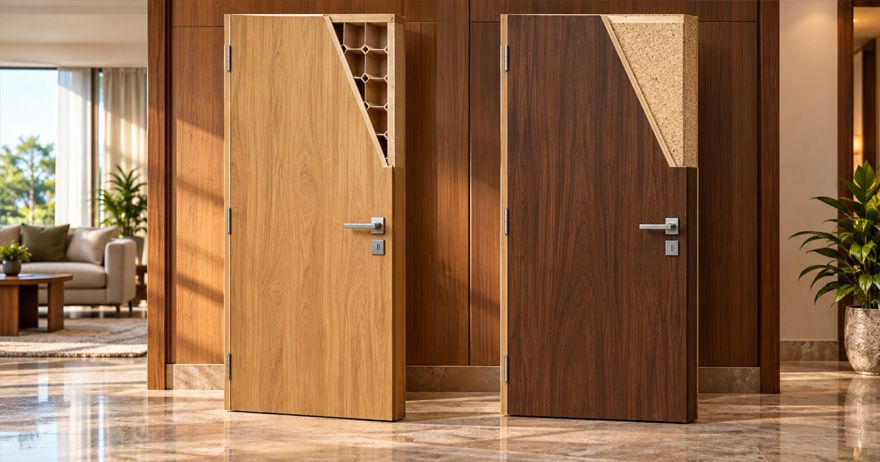
A solid core flush door is an interior or light-commercial door built with a dense interior material, such as compressed particleboard or pine batten, wrapped in an outer wood veneer. This heavy-duty design provides excellent sound insulation, structural durability, and the substantial feel of a 100% solid wood door at a lower price point.
A hollow core flush door is a lightweight interior door with two outer face sheets (hardboard, plywood, or wood veneer) separated by a cellular or honeycomb internal framework, typically made of cardboard, plastic, wood, or aluminium, or tubular board surrounded by an empty air space. They are affordable, easy to install because they're lightweight, and commonly used for budget-conscious interior closets and bedrooms.
The main difference is their internal density and performance. Solid core flush doors are heavy and tightly packed with wood composites to block sound and resist impacts. In contrast, hollow core flush doors are mostly empty inside, making them lighter, moderately durable, and far less effective at blocking noise.
Solid Core vs Hollow Core Flush Doors: How Each Door Is Constructed
A solid core door is constructed around a heavy, continuous internal core. Workers fill the entire interior edge to edge with a dense composite material, such as particleboard or pine batten. A sturdy wood frame of stiles on all 4 sides reinforces this heavy centre, providing structural integrity and allowing hardware to screw directly into solid material. The entire assembly is then wrapped in wood veneer, hardboard, or a moulded composite skin, creating a finished product that mimics the weight, feel, and soundproofing of 100% solid wood.
In contrast, manufacturing a hollow core door begins with a basic perimeter frame made of lightweight timber. To keep the door light and cost-effective, manufacturers fill the large open space inside this frame with a lattice grid, such as tubular board or a honeycomb-like network made of rigid cardboard or aluminium. Manufacturers strategically embed a small, solid block of wood inside the frame where the handle and lock will eventually be installed to ensure structural support for the hardware. Finally, manufacturers apply heavy pressure to glue thin outer skins, usually made of plywood, hardboard, or moulded medium-density fiberboard (MDF), to both sides of the frame.
Comparison: Solid Core vs Hollow Core Flush Doors
| Parameter | Solid Core Flush Doors | Hollow Core Flush Doors |
|---|---|---|
| Strength and Durability | Stronger; more impact-resistant and suitable for high-use areas. | Less impact-resistant; best for light to moderate indoor use. |
| Sound Insulation and Privacy | Better sound reduction due to higher density. | Lower sound insulation because of its lightweight construction. |
| Weight and Hardware Requirements | Heavy; requires sturdy hinges and secure frame fixing. | Lightweight; handle and lock must be fixed to the designated solid block. |
| Cost and Installation Considerations | More expensive; requiring careful handling and installation. | More affordable; easier to transport and quicker to install. |
| Use Case | Bedrooms; home offices; study rooms and media rooms. | Wardrobes; storage rooms and interior partitions. |
How to Choose Between Solid Core vs Hollow Core Flush Doors
Choose a solid core flush door for spaces where durability, sound insulation and privacy matter, such as bedrooms and home offices. Its heavier construction also supports door hardware better.
A hollow core flush door is ideal when affordability and easy installation are priorities, especially for wardrobes and interior spaces that don't require much sound insulation.