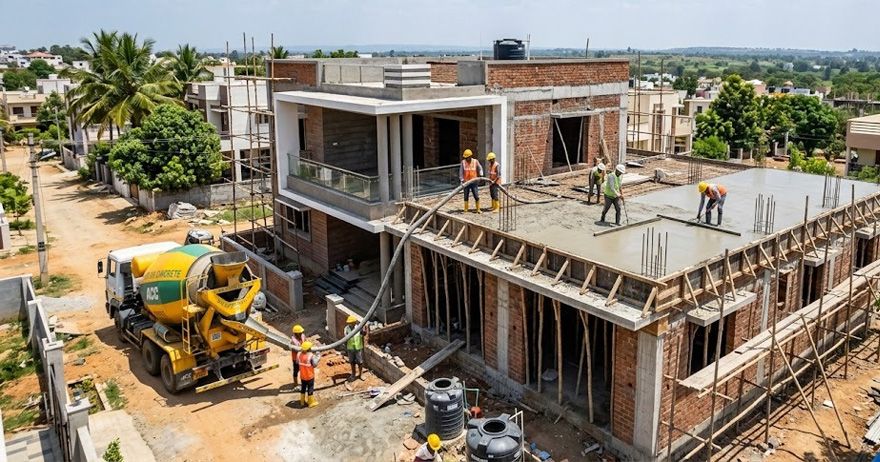




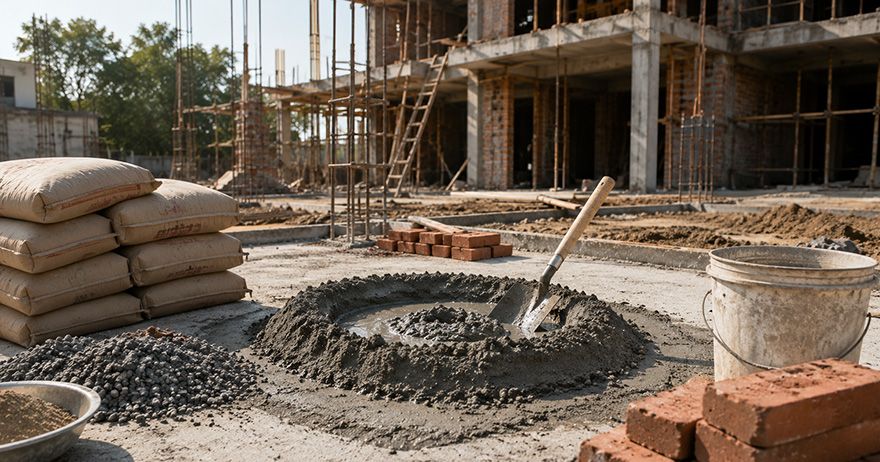
Cement quantity calculation is an essential part of construction planning and material estimation. Whether you're preparing concrete, plastering walls, laying bricks, or casting slabs, knowing the correct amount of cement helps reduce wastage, control costs, and ensure quality construction. Cement requirements are calculated based on the volume of work, mix ratio, and dry volume factor. Understanding the basic formulas allows homeowners, contractors, and engineers to estimate materials accurately before starting a project.
Why Cement Quantity Calculation Matters?
One of the most common questions during construction is how much cement is required for construction activities like foundations, slabs, brickwork, and plastering. Accurate cement quantity calculation plays a crucial role in every construction project.
Benefits include:
- Better budget planning
- Reduced material wastage
- Accurate procurement
- Improved construction quality
- Efficient project scheduling
It is also an important part of overall construction material quantity calculation, helping builders estimate sand, aggregates, steel, and other materials.
Basic Formula for Cement Quantity Calculation
The basic formula used to calculate cement is:
- Step 1: Calculate the wet volume of the work (length × width × thickness for slabs and plaster; volume of concrete for structural elements).
- Step 2: Convert wet volume to dry volume by multiplying by the dry volume factor (1.54 for concrete; 1.30 for mortar used in plastering and brickwork).
- Step 3: Determine the proportion of cement in the mix ratio.
- Step 4: Multiply dry volume by the cement proportion fraction to get cement volume in cubic metres.
- Step 5: Convert cement volume to bags by dividing by 0.0347 (the volume of one 50 kg bag of cement = 0.0347 m³).
Cement Bags = (Wet Volume × Dry Volume Factor × Cement Ratio Fraction) ÷ 0.0347
This is the most commonly used cement quantity calculation formula in residential and commercial construction projects.
Understanding Dry Volume and Wet Volume
Before calculating cement, it's important to understand the difference between wet and dry volume.
Wet Volume
Wet volume is the actual volume of the finished concrete or mortar after all the ingredients have been mixed with water. It is the actual space you are filling.
Dry Volume
Dry volume is the volume of the dry mixed ingredients before water is added. When cement, sand, and aggregate are mixed dry, they exist as loose particles with voids between them. When water is added and the mix consolidates, those voids are partially filled and the overall volume reduces.
Common Dry Volume Factors
| Work Type | Dry Volume Factor |
|---|---|
| Concrete | 1.54 |
| Mortar for Brickwork | 1.33 |
| Plastering | 1.27 |
Ignoring the dry volume factor is one of the most common mistakes in cement quantity calculation.
Cement Quantity Calculation for Concrete
Concrete is a mix of cement, sand (fine aggregate), and coarse aggregate in a defined ratio, combined with water. The cement quantity calculation for concrete follows the standard formula, with 1.54 as the dry volume factor.
Example for PCC (Plain Cement Concrete)
Plain Cement Concrete is used for foundation bedding, flooring base layers, and non-structural fills.
Assume we need to cast a PCC bed of 5m × 4m × 0.1m thickness.
Wet Volume = 5 × 4 × 0.1 = 2.0 m³
Dry Volume = 2.0 × 1.54 = 3.08 m³
Total parts in mix = 1 + 2 + 4 = 7 parts
Cement fraction = 1/7
Cement volume = 3.08 × (1/7) = 0.44 m³
Cement in bags = 0.44 ÷ 0.0347 = 12.68 ≈ 13 bags (50 kg each)
So for 2 cubic metres of M15 PCC work, you need approximately 13 bags of cement. This is a standard cement quantity calculation for concrete widely used in construction.
Example for RCC (Reinforced Cement Concrete)
RCC is used for structural slabs, beams, columns, and footings.
Assume an RCC column of 0.3m × 0.3m cross-section and 3m height.
Wet Volume = 0.3 × 0.3 × 3.0 = 0.27 m³
Dry Volume = 0.27 × 1.54 = 0.4158 m³
Total parts in mix = 1 + 1.5 + 3 = 5.5 parts
Cement fraction = 1/5.5
Cement volume = 0.4158 × (1/5.5) = 0.0756 m³
Cement in bags = 0.0756 ÷ 0.0347 = 2.18 ≈ 3 bags (50 kg each)
For one 0.3m × 0.3m × 3m RCC column in M20 grade concrete, approximately 3 bags of cement are required. This method is commonly used for cement calculation for slab construction and structural RCC work.
Cement Quantity Calculation for Plastering
Cement quantity calculation for plastering uses mortar which is a mixture of cement and sand without coarse aggregate.
Assume we need to plaster a wall area of 10m × 3m at 12mm thickness (standard internal plaster thickness).
Area = 10 × 3 = 30 m²
Wet Volume = 30 × 0.012 = 0.36 m³
Dry Volume = 0.36 × 1.30 = 0.468 m³
Total parts (1:6) = 1 + 6 = 7 parts
Cement fraction = 1/7
Cement volume = 0.468 × (1/7) = 0.0669 m³
Cement in bags = 0.0669 ÷ 0.0347 = 1.93 ≈ 2 bags (50 kg each)
For 30 square metres of 12mm internal plaster in a 1:6 mix, approximately 2 bags of cement are required.
Cement Quantity Calculation for Brickwork
Cement calculation for brickwork uses mortar to fill the joints between bricks.
Assume a 230mm thick brick wall of 5m length and 3m height, using a 1:6 mortar mix.
Wall volume = 5 × 3 × 0.23 = 3.45 m³
Mortar volume = 3.45 × 0.30 = 1.035 m³ (30% of wall volume)
Dry volume = 1.035 × 1.30 = 1.345 m³
Total parts (1:6) = 1 + 6 = 7 parts
Cement fraction = 1/7
Cement volume = 1.345 × (1/7) = 0.192 m³
Cement in bags = 0.192 ÷ 0.0347 = 5.54 ≈ 6 bags (50 kg each)
For a 230mm thick brick wall of 15 square metres in a 1:6 mortar mix, approximately 6 bags of cement are required.
Cement Quantity Calculation for Slabs
Cement slabs consume significant concrete volume and errors in estimation have a direct bearing on both cost and structural continuity.
Assume a roof slab of 8m × 6m at 125mm (0.125m) thickness.
Wet Volume = 8 × 6 × 0.125 = 6.0 m³
Dry Volume = 6.0 × 1.54 = 9.24 m³
Total parts (1:1.5:3) = 1 + 1.5 + 3 = 5.5 parts
Cement fraction = 1/5.5
Cement volume = 9.24 × (1/5.5) = 1.68 m³
Cement in bags = 1.68 ÷ 0.0347 = 48.41 ≈ 49 bags (50 kg each)
For a 48 square metre RCC roof slab at 125mm thickness in M20 concrete, approximately 49 bags of cement are required.
Common Concrete Mix Ratios Explained
Understanding the concrete mix ratio cement calculation helps determine material requirements accurately.
1:2:4 Mix Ratio
The 1:2:4 mix ratio means 1 part cement, 2 parts sand, and 4 parts coarse aggregate by volume. Total parts = 7. Cement fraction = 1/7 = 0.143.
It is the standard mix for PCC work in residential foundations and ground floor slabs. It produces concrete with a characteristic compressive strength of 15 N/mm² at 28 days.
1:1.5:3 Mix Ratio
The 1:1.5:3 mix ratio means 1 part cement, 1.5 parts sand, and 3 parts coarse aggregate by volume. Total parts = 5.5. Cement fraction = 1/5.5 = 0.182.
It is used for roof slabs, beams, columns, staircases, and footings. It produces concrete with a characteristic strength of 20 N/mm² at 28 days.
1:3:6 Mix Ratio
The 1:3:6 mix ratio is a lean concrete mix with a lower cement content relative to aggregate. Total parts = 10. Cement fraction = 1/10 = 0.10.
It is used for blinding layers beneath foundations, levelling courses, and non-structural mass fills where compressive strength requirements are low.
Common Cement Calculation Mistakes
Many homeowners and contractors make avoidable estimation errors.
Common mistakes include:
- Ignoring dry volume factors
- Using incorrect mix ratios
- Not accounting for wastage
- Confusing wet and dry volumes
- Incorrect unit conversions
- Forgetting deductions for openings
- Not accounting for multiple coat plaster
How to Reduce Material Wastage
Reducing wastage improves both efficiency. Proper planning ensures accurate cement estimation for house construction and reduces unnecessary expenses.
Best Practices:
- Store cement in dry areas
- Use proper measuring methods
- Avoid over-ordering
- Follow approved mix ratios
Avoid reworking concrete
Train labour teams on material handling
Cement Estimation Tips for House Construction
When estimating cement requirements for a house always add 5% to 10% for wastage and estimate Stage-Wise. Following the table below to know how to calculate cement quantity accurately for residential projects.
| Work Type | Mix Ratio | Dry Volume Factor | Approximate Bags/m³ | Application |
|---|---|---|---|---|
| PCC (M15) | 1:2:4 | 1.54 | 6.3 bags/m³ | Foundation bed and ground floor base |
| RCC (M20) | 1:1.5:3 | 1.54 | 8.07 bags/m³ | Slabs beams columns and footings |
| Internal Plaster (1:6) | 1:6 | 1.30 | 3 bags per 10 m² | Internal walls with 12 mm thickness |
| External Plaster (1:4) | 1:4 | 1.30 | 4.5 bags per 10 m² | External walls with 15 to 20 mm thickness |
| Brickwork (1:6) | 1:6 | 1.30 | 1.7 bags/m³ | 230 mm brick walls and internal non-structural walls |
| Brickwork (1:4) | 1:4 | 1.30 | 2.6 bags/m³ | 115 mm external or load-bearing brick walls |
| Floor tiling adhesive mortar (1:3) | 1:3 | 1.30 | 5 bags/m³ | Tile bedding with 20 to 25 mm mortar bed |