



gruha Pravesh — also written as Gruhapravesam, Gruhapravesham, Graha Pravesh or Grih Pravesh — is the ceremony performed when a family enters a new home for the first time. Choosing the right muhurat, the auspicious window of time for the ritual, is considered essential, because the day and hour are believed to set the tone for everything that follows in that house.
Looking for a date soon? August, September and October 2026 have no muhurat at all. The next open window begins on 11 November 2026. January 2026 is also blocked. The months with the widest choice are February, March, November and December 2026, and February, March and May 2027.
This guide lists the gruha pravesh muhurat dates for 2026 and 2027 month by month, explains why certain months have no dates at all, and covers the rituals, vastu points and practical checks worth completing before you move in.
Please note: these dates follow the general Hindu Panchang and are indicative. Muhurats shift by city, because sunrise and sunset differ, and regional calendars vary — a date in the Telugu or Tamil panchang may not match the North Indian one. A priest will also usually check the timing against the family's horoscope. Confirm your date with your own pandit before fixing the ceremony.
What Is gruha Pravesh?
gruha Pravesh is a Vedic ritual of entering and consecrating a home. It usually involves a Ganapati puja, a havan, boiling milk in the new kitchen, and prayers for the wellbeing of everyone who will live there.
There are three recognised types:
- Apoorva gruha Pravesh — entering a newly built house for the first time, on land newly occupied.
- Sapoorva gruha Pravesh — returning to a home you already own after a long absence.
- Dwandwah gruha Pravesh — re-entering after major renovation, rebuilding, or repair following damage.
Why the Muhurat Matters
A muhurat is a short, favourable period calculated from the Panchang. Five elements decide it: the tithi (lunar day), the nakshatra (constellation), the vara (weekday), the yoga and the karana.
Certain nakshatras are traditionally considered favourable for entering a home, and certain tithis are avoided. Families who follow this closely also have the muhurat checked against the horoscope of the head of the household, which is why two families may be given different dates in the same month.
For most people, the practical value is simple. The ceremony brings family together, marks the beginning properly, and gives a fixed date to work towards while finishing the house.
Best Weekdays and Nakshatras for gruha Pravesh
Two questions come up before the date itself.
Which weekdays are favoured? Monday, Wednesday, Thursday and Friday are generally preferred. Tuesday and Saturday are usually avoided, and many families avoid Sunday as well.
Which nakshatras are considered best? Rohini is treated as the strongest for house entry, followed by Mrigashira, Uttara Phalguni, Uttara Ashadha, Uttara Bhadrapada, Hasta, Pushya, Chitra, Anuradha and Revati.
Nakshatras generally avoided for gruha pravesh include Bharani, Krittika, Ashlesha, Magha, Moola and Jyeshtha.
The tithis usually preferred are Dwitiya, Tritiya, Panchami, Dashami and Ekadashi. Amavasya and Chaturdashi are avoided.
gruha Pravesh Muhurat Dates 2026
| Date | Day | Muhurat timing |
|---|---|---|
| 11 November | Wednesday | 06:40 AM to 11:38 AM |
| 14 November | Saturday | 08:24 AM to 11:23 AM |
| 20 November | Friday | 06:56 AM to 06:31 AM (21 Nov) |
| 21 November | Saturday | 04:56 AM to 05:54 AM (22 Nov) |
| 25 November | Wednesday | 06:52 AM to 06:52 AM (26 Nov) |
| 26 November | Thursday | 06:52 AM to 05:47 PM |
| Date | Day | Muhurat timing |
|---|---|---|
| 2 December | Wednesday | 10:51 PM to 06:58 AM (3 Dec) |
| 3 December | Thursday | 06:58 AM to 09:23 AM |
| 4 December | Friday | 10:22 AM to 11:44 PM |
| 11 December | Friday | 03:04 AM to 07:04 AM (12 Dec) |
| 12 December | Saturday | 07:04 AM to 02:06 PM |
| 18 December | Friday | 11:14 PM to 07:09 AM (19 Dec) |
| 19 December | Saturday | 07:09 AM to 03:58 PM |
| 30 December | Wednesday | 07:13 AM to 12:36 PM |
gruha Pravesh Muhurat Dates 2027
| Date | Day | Muhurat timing |
|---|---|---|
| 9 January | Saturday | 04:34 AM to 07:13 AM |
| 14 January | Thursday | 01:59 PM to 11:18 PM |
| 18 January | Monday | 09:05 PM to 07:14 AM (19 Jan) |
| 20 January | Wednesday | 07:13 AM to 04:17 PM |
| Date | Day | Muhurat timing |
|---|---|---|
| 11 February | Thursday | 03:05 AM to 04:56 AM |
| 15 February | Monday | 10:44 PM to 07:02 AM (16 Feb) |
| Date | Day | Muhurat timing |
|---|---|---|
| 10 March | Wednesday | 06:44 AM to 10:52 AM |
| 15 March | Monday | 06:39 AM to 10:51 AM |
| 22 March | Monday | 06:33 AM to 04:13 PM |
| Date | Day | Muhurat timing |
|---|---|---|
| 20 April | Tuesday | 04:51 AM to 06:06 AM |
| Date | Day | Muhurat timing |
|---|---|---|
| 7 May | Friday | 11:42 PM to 05:53 AM (8 May) |
| 17 May | Monday | 04:28 PM to 05:48 AM (18 May) |
| 20 May | Thursday | 01:20 PM to 04:29 PM |
| Date | Day | Muhurat timing |
|---|---|---|
| 14 June | Monday | 05:44 AM to 05:28 PM |
| 16 June | Wednesday | 07:44 PM to 03:20 AM (17 Jun) |
| Date | Day | Muhurat timing |
|---|---|---|
| 9 July | Friday | 02:04 PM to 11:15 PM |
| 14 July | Wednesday | 05:53 AM to 01:10 PM |
| Date | Day | Muhurat timing |
|---|---|---|
| 6 August | Friday | 02:27 AM to 07:33 AM |
| 11 August | Wednesday | 06:05 AM to 09:13 AM |
| Date | Day | Muhurat timing |
|---|---|---|
| 1 September | Wednesday | 07:50 PM to 05:36 PM (2 Sep) |
| 6 September | Monday | 02:59 PM to 06:14 AM (7 Sep) |
| 10 September | Friday | 11:50 PM to 06:15 AM (11 Sep) |
| Date | Day | Muhurat timing |
|---|---|---|
| 1 October | Friday | 05:35 AM to 12:49 AM (2 Oct) |
| 4 October | Monday | 06:23 AM to 12:43 AM (5 Oct) |
| 14 October | Thursday | 06:49 PM to 10:30 PM |
| Date | Day | Muhurat timing |
|---|---|---|
| 1 November | Monday | 06:35 AM to 09:57 AM |
| 4 November | Thursday | 09:38 PM to 06:19 PM (5 Nov) |
| 10 November | Wednesday | 06:40 AM to 09:11 AM |
| Date | Day | Muhurat timing |
|---|---|---|
| 2 December | Thursday | 01:44 PM to 02:29 AM (3 Dec) |
| 8 December | Wednesday | 06:59 AM to 04:12 PM |
| 13 December | Monday | 07:02 AM to 09:38 PM |
| 29 December | Wednesday | 07:25 AM to 10:06 AM (30 Dec) |
Festivals Considered Auspicious for gruha Pravesh
Some days are treated as self-auspicious — abujh or swayam-siddha muhurat — meaning they do not need a separate muhurat calculation. Families often choose these when a panchang date does not suit.
- Dhanteras — Friday, 6 November 2026. Widely used for buying property, gold and household items just before a gruha pravesh.
- Vasant Panchami — Thursday, 11 February 2027. Falls in an open month, so it is a clean choice.
- Ugadi / Gudi Padwa — Wednesday, 7 April 2027. One of the swayam-siddha muhurats, and the New Year for Telugu, Kannada, Marathi and Konkani families.
- Akshaya Tritiya — Sunday, 9 May 2027. Traditionally associated with lasting prosperity.
- Dussehra / Vijayadashami — Monday, 19 October 2026. Self-auspicious, but it falls inside Chaturmas this year, so many families still wait for November. Check with your pandit.
Basant Panchami, Akshaya Tritiya and Vijayadashami are the three days most often cited as needing no separate muhurat.
Regional Differences: Telugu, Tamil and Other Panchangams
The dates above follow the general North Indian Panchang. Regional calendars do not always agree, and the ceremony has different names across the country — gruhapravesam or gruhapravesham in Telugu and Tamil households, gruha pravesham in Kannada, and vastu shanti in Maharashtra, where the puja rather than the entry is the focus.
Three things cause the variation:
- Sunrise and sunset differ by city, and muhurats are calculated from sunrise. A timing published for Delhi will be a few minutes out in Hyderabad, Bengaluru or Chennai.
- Amanta and Purnimanta calendars end the lunar month on different days, which shifts which tithi falls where. Telugu, Kannada, Marathi and Gujarati communities follow Amanta; most of North India follows Purnimanta.
- Community practice varies. Even within Telangana and Andhra Pradesh, different Telugu communities observe different dates.
If you follow the Telugu, Tamil, Kannada, Malayalam or Bengali calendar, treat this list as a starting point and have your family purohit confirm the muhurtham for your city.
Why Some Months Have No gruha Pravesh Dates
You will notice gaps in the lists above, particularly in 2026. This is not an oversight.
Two planetary conditions block most of them. Shukra Tara Asta is the period when Venus is combust and not visible, and Guru Tara Asta is the same for Jupiter. Texts such as Muhurta Chintamani and Dharmasindhu hold that entry into a new home should not be performed while either is set. This is why January 2026 has no dates at all.
The second reason is Chaturmas, the four-month period from Devshayani Ekadashi to Prabodhini Ekadashi, when Lord Vishnu is believed to be in yogic sleep and ceremonies such as gruha pravesh, weddings and upanayanam are postponed.
In 2026 these overlap. Jupiter sets around mid-July, Chaturmas follows, and Venus sets again in October, which is why August, September and October have no dates before November reopens.
Two further periods are avoided: Adhik Maas, the extra lunar month, and Pitru Paksha, the fortnight for ancestral rites.
If your home is ready during one of these periods, families usually either wait for the next favourable window, or perform a simple Ganapati puja and shift in, holding the full ceremony later.
Rituals and the Order of the Day
The sequence varies by region and community, but the common structure is this:
- The family bathes early and wears fresh, usually traditional clothes.
- A kalash — a pot of water with mango leaves and a coconut — is carried in.
- The family enters right foot first, with an idol or image of Lord Ganesha going in ahead of them.
- Ganapati puja is performed, followed by a Vastu Shanti havan to purify the space.
- Milk is boiled in the new kitchen and allowed to overflow, which signifies abundance.
- The first meal is cooked and shared, and prasad is distributed.
Dos and Don'ts of gruha Pravesh
Do
- Enter carrying something auspicious — never empty-handed.
- Complete the puja before bringing in heavy furniture, where possible.
- Keep the house clean and clear of construction debris beforehand.
- Light a lamp in the pooja space on the first evening.
- Stay the night in the house after the ceremony rather than locking it up.
Don't
- Do not hold the ceremony during Chaturmas or other inauspicious periods without consulting a priest.
- Do not argue or raise voices during the ritual.
- Do not leave the new house unoccupied for several days immediately after.
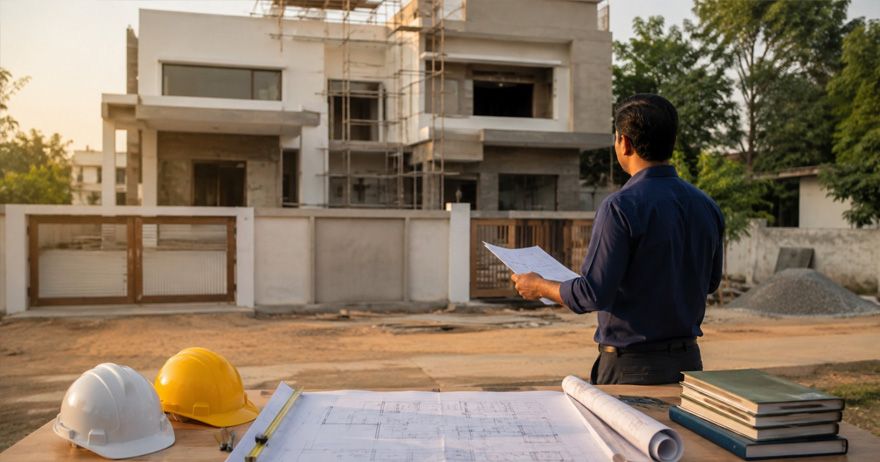
- Do not schedule it while major work is still going on. A half-finished house makes for a rushed ceremony.
Vastu Tips for Your New Home
The main entrance is best facing north, east or north-east.
- The pooja room is traditionally placed in the north-east.
- The havan kund is set up in the south-east, the direction associated with fire.
- The kalash is placed at the threshold before entry.
- On the first night, sleep with your head towards the south.
- Keep windows open through the ceremony so light and air move through every room.
Decoration Ideas for the Day
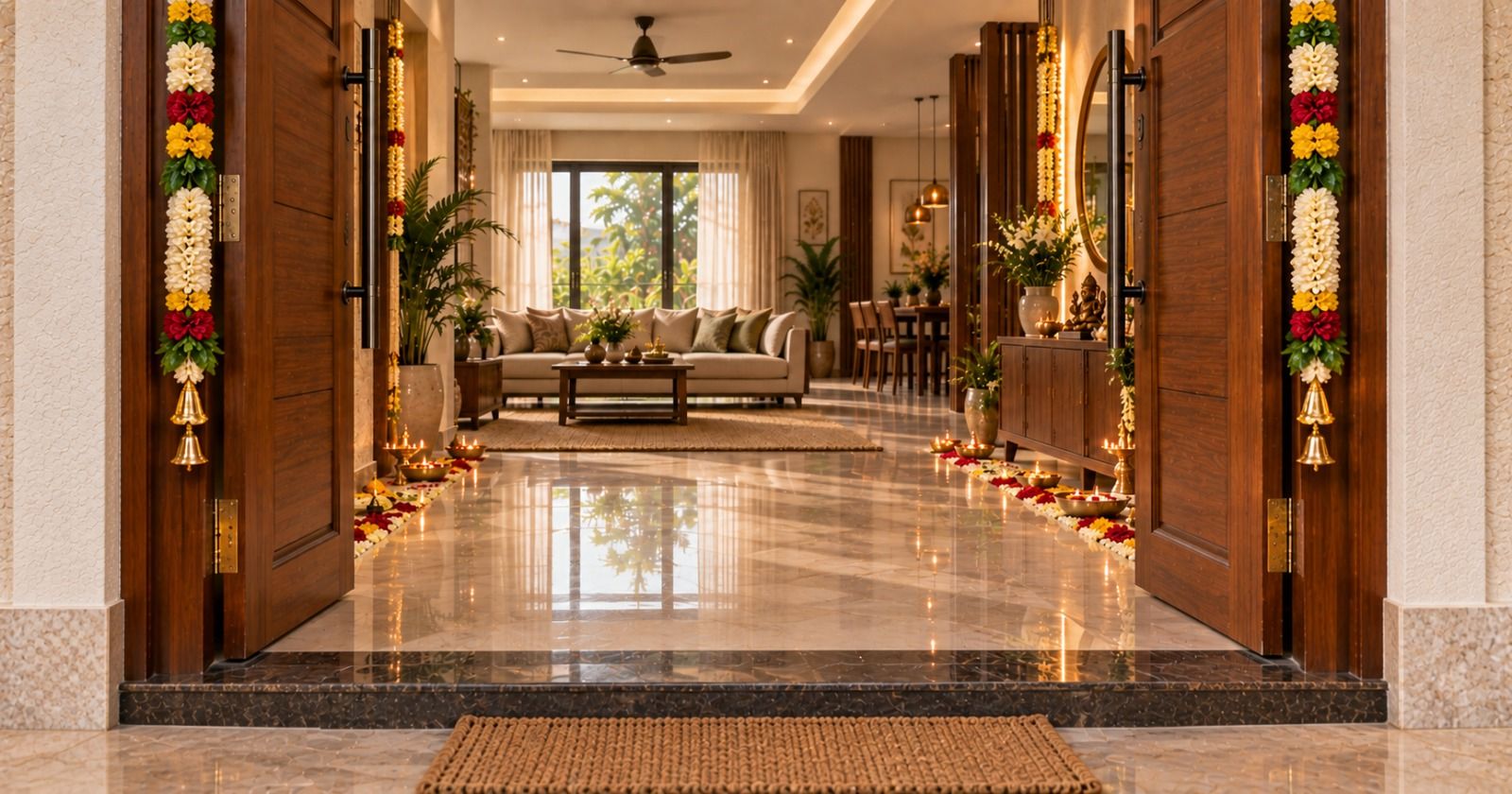
- Toran at the main door, in mango leaves or marigold.
- Rangoli at the entrance and in the foyer, traditionally to welcome Goddess Lakshmi.
- Diyas along the entrance and around the pooja area.
- Fresh flowers — marigold, jasmine or roses — on the threshold, kalash and pooja table.
- Clear the entrance of shoes, cartons and packing material so the doorway is open and clean.
Getting Your Home Ready Before gruha Pravesh
Once the date is fixed, everything works backwards from it. A few things are worth finishing early, because they are difficult to do with a house full of guests.
- Windows and doors installed and cleaned. These usually come late in the finishing schedule, and a delay here pushes everything else.
- Deep clean done, including cement marks on glass and floors, which set hard if left.
- Water, power and the kitchen working, since milk has to be boiled on the day.
- Pooja space ready in its intended position, not improvised in a corner.
- Main entrance complete — door, handle, lock, bell, and a nameplate if you want one.
- Curtains up, which take a room from "under construction" to "lived in" faster than anything else.
Plan window and door work at least three to four weeks before the muhurat. Measurement, fabrication and installation each take time, and this is the one item most families underestimate. IndiFrame manufactures and installs uPVC windows and doors end to end, with a site survey before production, so the timeline can be worked backwards from your ceremony date rather than hoped for.
Final Thoughts
Fix the muhurat first, then plan the finishing work around it. Families who do it the other way round usually end up either rushing the last two weeks or moving the ceremony.
Confirm your chosen date with your family priest, since regional calendars differ and horoscope matching can shift the timing. And remember that the ceremony is meant to be a happy occasion — a calm, unhurried gruha pravesh in a home that is genuinely ready is worth more than a perfect date in a house still full of workmen.