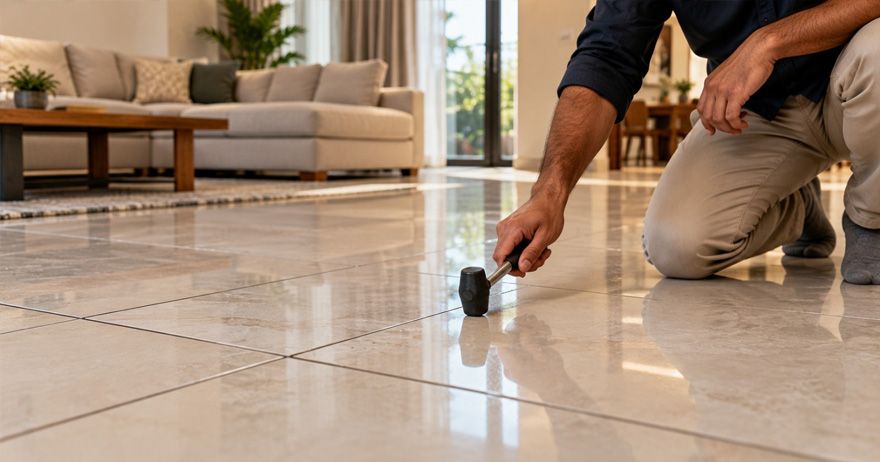
If you are hearing a hollow sound when you tap on a tile or notice any movement underfoot, it can be an early sign of a loose tile. While a hollow sound does not always mean that a tile is about to fail, it may lead to some gaps beneath the tile, poor adhesive coverage, an uneven surface, moisture intrusion, or installation issues.
Ignoring those loose tiles may eventually lead to cracking up, broken tiles, water penetration, or further debonding. The right solution depends on whether the problem is isolated or widespread and what caused the tile to lose proper contact with the substrate.
In this guide, we explain what hollow-sounding tiles mean, the common causes, warning signs, repair options, and ways to prevent tiles from becoming loose.
What Does a Hollow Sound From a Tile Mean?
A well-installed tile should have a solid surface beneath it. When you tap a tile, the sound is usually very solid because the tile is supported by the substrate and adhesive.
A hollow sound can emerge when there is an air gap between the tile and the surface below it. This may happen because the adhesive is not evenly spread out, the substrate was not prepared properly, or the tile has started to separate from the adhesive.
However, a hollow sound alone does not necessarily mean that a tile is loose. Some tiles can produce a slightly hollow sound because of their size, shape, installation method, or the type of substrate beneath them.
One essential thing is to look for other warning signs, such as movement, cracked grout, or visible gaps.
Is Every Hollow-Sounding Tile a Problem?
Not necessarily. A tile can sound hollow without having an immediate structural or functional problem.
For example, large-format tiles may have areas where complete contact was not achieved during installation. If the tile is stable, the grout is intact, and there are no signs of cracking or movement, immediate replacement may not always be necessary.
However, hollow sounds should not be ignored when they occur together with other symptoms.
Look for:
- Movement in tiles when stepping on them
- Cracked or crumbling grout
- Cracked tile
- Gaps around tile edges
- A tile that feels different from the surrounding tiles
- Water appearance around tiles
- A tile that makes a louder hollow sound
- Several neighbouring tiles becoming loose
These signs can indicate that the tile is losing its bond with the substrate.
Common Causes of Loose and Hollow-Sounding Tiles
Loose floor tiles and wall tiles can develop for several reasons. The problem is often related to installation, movement, moisture, or the condition of the surface beneath the tile.
Poor Adhesive Coverage
One of the most common causes is inadequate adhesive coverage.
Tile adhesive needs to create sufficient contact between the tile and substrate. If adhesive is applied only in a few spots instead of being spread evenly, empty spaces can remain under the tile.
These gaps can produce a hollow sound and reduce the tile's support.
Large tiles require particular care because their size makes proper adhesive coverage more important.
Incorrect Tile Installation
Installation mistakes can lead to loose tiles even when good-quality materials are used.
Common problems include:
- Applying too little adhesive
- Using the wrong adhesive for the surface
- Applying adhesive unevenly
- Installing tiles over dusty surfaces
- Not pressing tiles properly into the adhesive
- Allowing adhesive to sit on the skin over before placing the tile
- Using an incorrect trowel size
- Failing to follow the manufacturer's instructions
- Proper installation is therefore just as important as choosing good tiles.
Uneven or Improperly Prepared Subfloors
Tiles depend on the surface beneath them for support. If the floor or wall is uneven, dirty, damp, or unstable, the tile may not bond properly.
Dust, loose particles, old adhesive, paint, grease, and other contaminants can interfere with adhesion.
An uneven surface can also create empty areas beneath the tile. When someone walks over the tile, pressure is concentrated on unsupported sections. Over time, this can contribute to cracking or debonding.
Before installation, the substrate should be clean, stable, and appropriately prepared.
Moisture, Temperature Changes and Tile Movement
Moisture can cause tiles to become loose, especially in areas like bathrooms, kitchens, balconies, terraces, and other places that are frequently exposed to water. When water penetrates damaged grout or joints, it can reach the layers beneath the tiles.
Continuous exposure to moisture can deteriorate the adhesive or the substrate underneath. Additionally, temperature fluctuations can cause building materials to expand and contract. If proper movement joints are not installed, stress can accumulate within the tiled surface.
This is particularly important for large tiled areas and surfaces that experience significant temperature changes.
Signs That a Hollow Tile Is Becoming Loose
A hollow sound is more concerning when it is accompanied by visible or physical changes.
Watch for these warning signs:
- Movement: If the tile moves slightly when you press or step on it, its bond may have failed.
- Cracked grout: Cracks around the edges of a tile can indicate movement.
- Broken tile: A poorly supported tile can be more vulnerable to cracking under pressure.
- Raised edges: A tile that appears higher than surrounding tiles may be affected by movement beneath it.
- Gaps: Spaces appearing between the tile and neighbouring surfaces may indicate separation.
- Water penetration: Persistent moisture around joints can contribute to further damage.
If several of these signs appear together, the tile should be inspected rather than simply ignored.
How to Fix a Loose or Hollow-Sounding Tile
The correct repair depends on the severity of the problem.
Rebond a Suitable Tile
In some cases, a professional may be able to repair an isolated tile without replacing the entire tiled surface.
The area may need to be assessed to determine whether the tile has adequate support and whether the adhesive beneath it has failed.
If the tile itself remains intact, an appropriate repair method may restore its bond.
Remove and Reinstall the Tile
If a tile has become significantly loose, removing it and preparing the surface properly is often more reliable than simply trying to add adhesive around the edges.
The usual process involves:
- Carefully removing the damaged or loose tile.
- Removing old adhesive from the substrate.
- Cleaning and preparing the surface.
- Checking the substrate for damage or moisture.
- Applying suitable tile adhesive.
- Installing the tile with adequate coverage.
- Allowing the adhesive to cure according to the manufacturer's instructions.
- Regrouting the joints after appropriate curing.
- The replacement tile should be properly aligned with the surrounding tiles.
Repair a Larger Area
If many tiles sound hollow or several tiles are moving, the problem may not be limited to individual tiles.
Widespread hollow sounds can indicate an installation or substrate problem. Removing only one or two tiles may not solve the underlying issue.
A professional should analyse the area and determine whether the tiles, adhesive layer, substrate, or moisture protection needs attention.
How to Prevent Loose Tiles During Installation
Preventing loose tiles starts with proper preparation and installation.
Prepare the surface
The substrate should be clean, stable, dry where required, and appropriately levelled before tiling begins.
Use the right adhesive
Choose an adhesive suitable for the tile type, substrate, location, and expected conditions. Large-format tiles and areas exposed to moisture may have specific installation requirements.
Ensure adequate coverage
Apply adhesive evenly using the appropriate notched trowel. The tile should be properly bedded into the adhesive rather than resting on isolated spots.
Do not rush installation
Adhesive should be used within its recommended working time. If it has begun to skin over, proper bonding may not occur.
Allow proper curing
Do not put heavy loads or excessive moisture on newly installed tiles before the adhesive has adequately cured.
Use movement joints where required
Large areas and surfaces subject to movement or temperature changes may require appropriately designed movement joints.
Check tiles during installation
Installers should periodically lift a newly placed tile to check adhesive coverage, particularly when working with large-format tiles.
Final Thoughts on Hollow and Loose Tiles
A hollow sound from a tile is not always a sign of immediate failure, but it can be an important warning when combined with movement, cracked grout, damaged tiles, or moisture problems.
The most common causes include poor adhesive coverage, improper surface preparation, unsuitable installation methods, moisture, substrate movement, and temperature-related stresses.
For widespread loose tiles, the priority should be identifying the underlying cause rather than repeatedly replacing individual tiles. Proper substrate preparation, suitable adhesive, adequate coverage, correct installation, and appropriate movement joints can significantly reduce the risk of loose tiles.