Knowing how many bricks are required per square foot is extremely important for calculating how much material you need. Factors such as the size of the bricks, wall thickness, mortar joint width, and overall area of the wall will affect the amount of bricks required.
Whether you are building a partition, boundary, or exterior wall, calculating the brick quantity correctly can help you reduce wastage and avoid unnecessary expenses. Since brick sizes can vary across India, always check the dimensions of the bricks you plan to use before estimating the total requirement.
This guide explains how to calculate bricks per square foot, with simple formulas and practical examples for different wall types.
What Does Bricks Per Square Foot Mean?
Bricks per square foot means the number of bricks that you need to build one square foot of wall. It helps in estimating how many bricks you will need for your construction project and plan your budget. Also, the amount of bricks you need will depend on how big the bricks are, how thick your wall is, and how much space between the bricks there is to fill with mortar.
Factors That Affect the Number of Bricks Required
There are several factors that affect the number of bricks required for a certain project, such as:
- The size of the bricks
- The thickness of the wall
- The mortar used between them
- The total wall area
- Any openings for doors and windows
Standard Brick Sizes Used in India
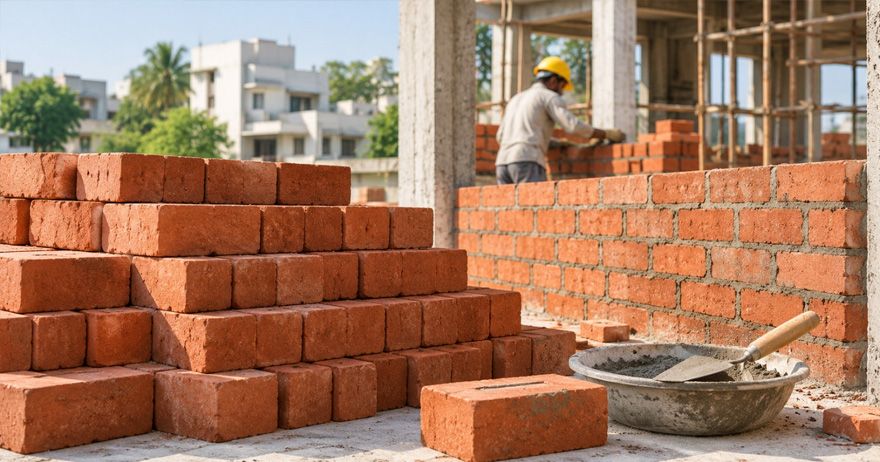
The size of standard modular bricks in India is 190 mm × 90 mm × 90 mm. The nominal size of the brick with mortar joints is 200 mm × 100 mm × 100 mm. However, this is not uniform throughout the country, as traditional bricks are available in various sizes based on the region and company.
How to Calculate Bricks Per Square Foot?
If you want to calculate bricks per square foot, then you need to know the size of the bricks and the thickness of the wall. Follow the steps for an exact calculation:
- First, measure your wall area in square feet.
- Calculate how many bricks you will need to cover the area (adding on any extra space between the bricks, which are filled in with mortar).
- Multiply this number by the number of square feet of your wall to give an approximate number of bricks needed.
- Allow a few extra bricks in case you break some during construction.
Bricks Required for 4.5-Inch and 9-Inch Walls
The quantity of bricks needed is determined by how thick the wall is. If the wall has a thickness of only 4.5 inches, then only one layer of bricks is usually utilized, whereas if the wall thickness is 9 inches, more bricks will have to be put in place. In the case of standard modular bricks along with mortar joints, you can use the following estimates:
- 4.5-inch wall: Around 4–5 bricks per square foot.
- 9-inch wall: Around 8–10 bricks per square foot.
Example: Calculating Bricks for a Complete Wall
To understand the calculation of bricks for a complete wall, you can check the example below:
Let’s suppose you want to build a wall that is 5 feet long and 10 feet high.
Then we need to start with the calculation of the total wall area:
Wall area = Length × Height
Wall area = 5 × 10 = 50 square feet
And for a wall that is 4.5 inches thick, assuming 4.5 bricks per square foot:
Total Bricks we will need = 50 × 4.5 = 225 bricks
And for a 9-inch-thick wall, assuming 9 bricks per square foot:
Total Bricks we will need = 50 × 9 = 450 bricks
How Mortar Joints Affect Brick Quantity?
The mortar is between the bricks and is made up of cement and sand. How big the gaps between the bricks are determines how many bricks will be needed for the wall. As there is a bigger gap between the bricks,s then there will be fewer bricks needed. Mortar joints are usually 10mm thick. Therefore, keeping the mortar the same thickness will make the brick wall stronger, neater, and make it easier to know how many bricks you will need.
How to Calculate Bricks Per Square Meter?
To calculate bricks per square meter, you need to know the brick dimensions and the thickness of your wall. You also need to include the mortar joints when calculating the space occupied by each brick.
Standard modular bricks in India measure 190 × 90 × 90 mm. Including the space for mortar, you will need approximately 50 bricks per square meter for a half-brick-thick wall and around 100 bricks per square meter for a one-brick-thick wall. A thicker wall needs more bricks because it uses more layers of brickwork.
Multiply the area of the wall by the amount of bricks required per square meter. If you have a 10m2 wall and require 50 bricks per m2 you will need approximately 500 bricks. It is best to buy an additional 5-10% to allow for any broken bricks and wastage.
Common Mistakes When Estimating Brick Quantity
Most homeowners make these common mistakes when estimating the brick quantity:
- Ignoring the thickness of the wall.
- Using the wrong brick size for the wall.
- Not including mortar joints while calculating the quantity.
- Not accounting for doors and windows.
- Ignoring breakage and wastage
- Making calculations without measuring the wall
How Much Extra Brick Quantity Should You Order?
It is a good idea to order 5–10% extra bricks to cover breakage, damage during transportation, and wastage during construction. The exact amount depends on the quality of the bricks, how they are handled, and the complexity of the work.
For example, if your wall requires 1,000 bricks, you should order an additional 50–100 bricks. This brings the total quantity to 1,050–1,100 bricks. Keeping some extra bricks on-site helps prevent delays if you need replacements during construction.
Conclusion
Getting an accurate number of bricks will help to keep your build on track and reduce any waste. You will need to measure the length and height of your walls. Take into consideration the size of your bricks, the thickness of the walls, and allow for the mortar joints. Once you know how many bricks are needed, you will need to take away the area of doors and windows. It is also a good idea to add 5-10% to your total number for breakages and waste.