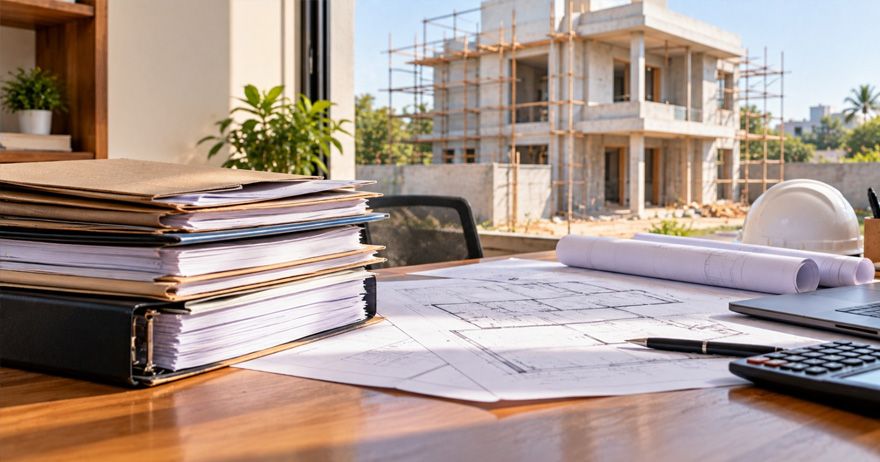
Building a home involves more than drawings, materials, and on-site work. Keeping the right documents organised throughout the project can help homeowners track approvals, costs, contracts, specifications, changes, inspections, and warranties.
A detailed construction documents checklist makes it easier to know which papers should be collected before construction begins and which records should be maintained until the project is completed. Important documents may include approved building plans, land and ownership records, contractor agreements, structural drawings, payment receipts, material invoices, inspection reports, and completion-related paperwork.
Maintaining both physical and digital copies can also make future repairs, renovations, resale, or warranty claims much easier. Good documentation provides a clear record of how the home was planned and built and can save you considerable time when you need to verify a detail years later.
Why is Documentation Important During Home Construction?
Construction documents create a written record of the decisions, approvals, expenses, and work carried out during your project.
A properly maintained home construction file checklist can help you:
- Verify that required approvals have been obtained
- Track project costs and payments
- Understand the agreed scope of work
- Check material specifications
- Record changes made during construction
- Keep inspection and testing records
- Make warranty claims easier
- Plan future repairs and renovations
- Provide useful information to future owners
Documentation is particularly important when several professionals are involved, such as architects, structural engineers, contractors, electricians, plumbers, and interior designers.
Land, Ownership, and Property Documents to Keep
Before construction begins, make sure important property-related records are properly organised.
Depending on the property and local requirements, your file may include:
- Sale deed or title documents
- Property ownership records
- Land documents
- Mutation or property records, where applicable
- Property tax records
- Encumbrance-related documents, where applicable
- Site measurements and survey documents
- Property identification documents
- Relevant agreements with the developer or previous owner
These records establish information about the property on which the house is being constructed.
Keep the original documents safely and maintain working copies for project-related use. Requirements can vary depending on the location and type of property, so homeowners should confirm the applicable requirements with the relevant local authority or professional.
Building Approval and Permission Documents
Obtaining the necessary permissions is an important part of the construction process.
Your building approval documents may include:
- Sanctioned building plan
- Building permission or approval
- Site plan
- Approved floor plans
- Relevant development permissions
- NOCs or clearances, where applicable
- Commencement-related permissions
- Other local authority approvals
Do not rely only on informal communication about approvals. Keep copies of the actual documents, approval numbers, drawings, and correspondence.
If a revised plan is approved later, preserve both the earlier and revised versions along with the date and reason for the change.
Architectural, Structural, and MEP Drawings
Drawings are among the most valuable house construction documents to preserve after the project is completed.
Your construction file may include:
Architectural Drawings
- Floor plans
- Elevations
- Sections
- Site plans
- Door and window schedules
- Furniture layouts
- Detailed architectural drawings
Structural Drawings
- Foundation plans
- Column layouts
- Beam layouts
- Slab drawings
- Reinforcement details
- Structural specifications
MEP Drawings
MEP refers to mechanical, electrical, and plumbing systems.
Keep relevant drawings showing:
- Electrical layouts
- Lighting points
- Switch locations
- Plumbing lines
- Water supply routes
- Drainage layouts
- HVAC provisions
- Other service installations
These drawings can become extremely useful when you drill into a wall, install a new fixture, repair a pipe, or plan a renovation several years later.
Contractor Agreements and Construction Contracts
A written construction agreement helps establish what the contractor has agreed to provide.
Your construction contract documents should clearly record important terms such as:
- Scope of work
- Project specifications
- Labour responsibilities
- Material responsibilities
- Estimated project cost
- Payment schedule
- Construction timeline
- Quality requirements
- Change-order procedures
- Delay provisions
- Defect rectification responsibilities
- Warranty terms
- Termination conditions
Avoid relying entirely on verbal promises, particularly for expensive or technically important work.
Any major commitments or changes should ideally be documented and acknowledged by the relevant parties.
Material Specifications, Estimates, and Bills
Construction involves hundreds of material-related decisions, from cement and steel to tiles, sanitaryware, electrical fittings, doors, windows, and hardware.
Keep records of:
- Material specifications
- Approved brands
- Product codes
- Quantity estimates
- Bills of quantities, where applicable
- Material quotations
- Supplier quotations
- Purchase orders
- Invoices
- Delivery records
- Material test certificates, where applicable
This construction paperwork checklist can help you determine exactly what was purchased and which products were installed.
It can also prevent confusion if a product needs replacement later.
Payment Receipts and Construction Expense Records
Financial documentation should be maintained throughout the project rather than reconstructed at the end.
Your records can include:
- Contractor payment receipts
- Bank transfer records
- Invoices
- Material bills
- Labour payments
- Professional fees
- Approval-related fees
- Transportation charges
- Additional-work payments
- Final settlement records
Maintain a simple payment tracker showing the date, amount, purpose, and recipient.
A clear record of construction payment records makes it easier to compare actual spending with the original estimate.
Site Inspection, Quality, and Testing Reports
Inspection and testing records can provide useful evidence about the quality and progress of construction.
Depending on the project, you may have records relating to:
- Soil investigation
- Concrete testing
- Steel testing
- Waterproofing
- Plumbing pressure tests
- Electrical testing
- Structural inspections
- Waterproofing inspections
- Site quality checks
- Other specialist inspections
Documents for Changes, Variations, and Additional Work
Changes are common during construction.
You may decide to add a balcony, change a flooring material, move an electrical point, modify a partition, upgrade sanitaryware, or make other changes.
However, undocumented changes can create confusion later.
For every significant variation, maintain a record of:
- Original specification
- Proposed change
- Reason for the change
- Additional or reduced cost
- Impact on timeline
- Revised drawing, if required
- Approval from the relevant parties
- Date of implementation
These records are sometimes called variation orders or change orders.
Do not simply record that "extra work was done." Clearly document what changed and how it affected the project.
Warranties, Guarantees, and Product Manuals
Your construction warranty documents can become valuable long after the contractor leaves the site.
Create a dedicated warranty folder containing:
- Appliance warranties
- Waterproofing warranties
- Plumbing product warranties
- Electrical product warranties
- Window and door warranties
- Sanitaryware warranties
- Solar equipment warranties
- Lift or specialised equipment documents, where applicable
- Paint or coating warranties
- Product manuals
- Installation certificates
Record the purchase date and warranty period wherever possible.
If a product needs servicing, you will then have the information required to contact the manufacturer or supplier.
Completion, Handover, and Post-Construction Documents
The project documentation should not end when construction is finished.
At handover, collect relevant documents required for house construction and completion records, such as:
- Completion-related documents
- Occupancy-related documents, where applicable
- Final approved drawings
- As-built drawings
- Final inspection reports
- Final payment statement
- Contractor handover documents
- Equipment manuals
- Warranty certificates
- Maintenance instructions
- Keys and access information
- Utility-related documents
An as-built drawing is particularly useful because it reflects what was actually constructed rather than only what was originally planned.
For example, if plumbing or electrical routes were changed during construction, the final records should ideally reflect those changes.
How to Organise and Store Your Construction Documents
Having every document is useful only if you can find it when needed.
Create a simple folder system based on categories.
Suggested Physical Folders
Property Documents
Ownership, land, survey, and property records.
Approvals
Sanctioned plans, permissions, NOCs, and correspondence.
Architectural & Structural
Architectural, structural, and MEP drawings.
Contracts
Contractor agreements, consultant agreements, and scope documents.
Materials
Specifications, quotations, invoices, and product information.
Payments
Receipts, invoices, payment confirmations, and final statements.
Inspections
Testing, quality checks, and inspection reports.
Changes
Variation orders, revised drawings, and additional-work records.
Warranties
Warranty certificates, guarantees, and manuals.
Handover
Completion documents, as-built drawings, and final records.
Final Thoughts
A well-organised construction documents checklist is one of the simplest ways to make home construction easier to manage.
From land records and building approval documents to drawings, contracts, invoices, inspection reports, variation records, and warranties, every important document contributes to a complete record of your home.
Most importantly, keep both physical and digital copies of important records. Years later, when you need to locate a structural drawing, identify a concealed plumbing line, claim a warranty, renovate a room, or sell the property, a complete home construction file checklist can save you considerable time and effort.