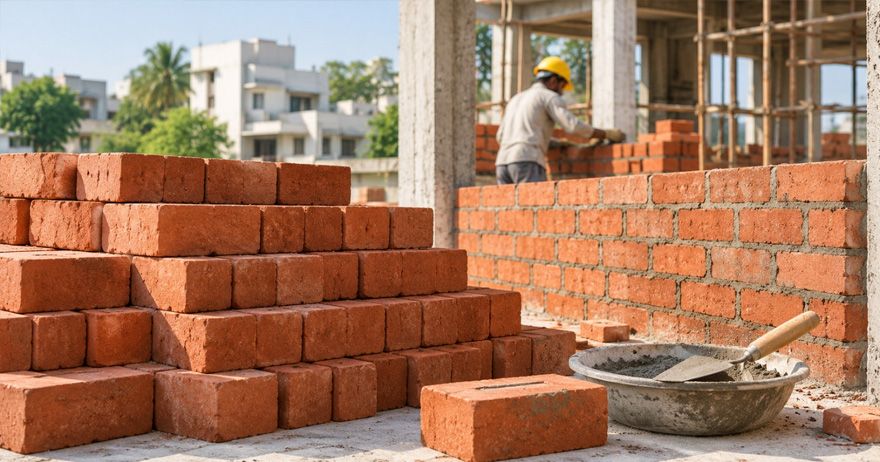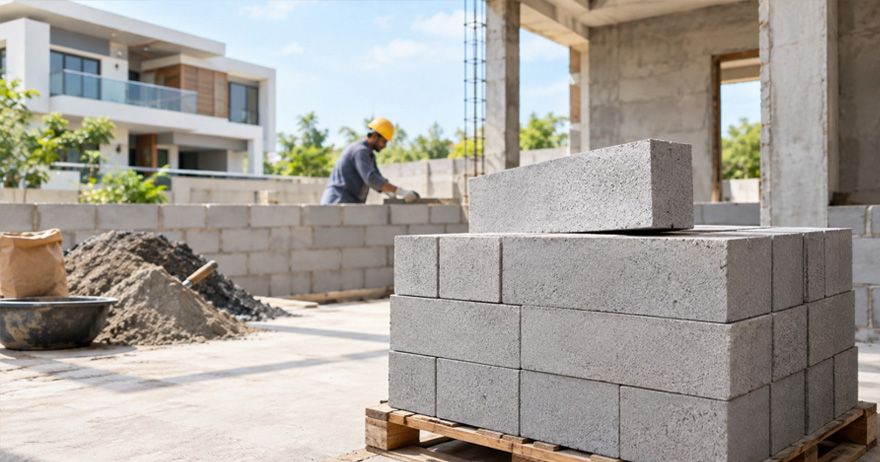
Choosing the right brick is an important decision during home construction because brick quality can affect wall strength, durability, finish, and overall construction cost. Fly ash bricks have become a popular alternative to traditional red clay bricks because they offer consistent dimensions, a smooth finish, and useful strength characteristics.
Made using fly ash along with materials such as cement or lime, sand, and other suitable ingredients, these bricks can also reduce the dependence on topsoil required for conventional clay-brick production. However, choosing fly ash bricks should not be based on price alone. Manufacturing quality, local availability, transportation, wall requirements, and workmanship all matter.
In this guide, we explore the properties, fly ash bricks advantages, fly ash bricks disadvantages, applications, cost factors, and important points to consider before buying them for your project.
What Are Fly Ash Bricks?
Fly ash bricks are masonry units manufactured using fly ash, sand or stone dust, cement or lime, and other suitable binding materials. Fly ash is a fine residue generated mainly from coal-based power generation.
Unlike traditional clay bricks, which are generally made from natural clay and fired in kilns, fly ash bricks are manufactured through a controlled mixing, moulding, and curing process.
One of their major benefits is dimensional consistency. Properly manufactured bricks can have relatively uniform shapes and sizes, which can make wall construction and finishing easier.
The quality of fly ash bricks depends heavily on the raw materials, mix proportions, manufacturing process, curing, and quality control followed by the manufacturer.
How Are Fly Ash Bricks Made?
The fly ash brick construction process generally involves several stages:
- Raw material selection: Fly ash is combined with suitable materials such as sand, stone dust, cement, or lime.
- Mixing: The ingredients are mixed in controlled proportions to achieve the required consistency.
- Moulding: The mixture is compressed in a brick-making machine to form uniform units.
- Compaction: Mechanical pressure helps improve the density and shape of the bricks.
- Curing: The moulded bricks are cured under controlled conditions to develop strength.
- Drying and storage: After adequate curing, the bricks are dried and stored before transportation and use.
Proper curing is particularly important because inadequate curing can affect the final performance of the bricks.
Advantages of Using Fly Ash Bricks
There are several fly ash bricks advantages that make them attractive for residential and commercial construction.
Consistent Size and Shape
Machine-made production can provide uniform dimensions. This can make bricklaying more systematic and may reduce variations in joints.
Smooth Finish
The relatively smooth surface can make plastering and finishing easier in suitable applications.
Good Strength
Quality products can provide adequate compressive strength for many building applications. However, the strength of a particular batch should be verified rather than assumed.
Reduced Mortar Consumption
Because the bricks can have consistent dimensions and smoother surfaces, masonry may require less mortar for joints compared with irregular brickwork.
Reduced Topsoil Dependence
Fly ash bricks can reduce the dependence on clay and topsoil used in conventional fired-brick production.
Lower Material Variation
Controlled manufacturing can result in more uniform products when the manufacturer follows appropriate quality-control practices.
Easier Handling
Their uniform dimensions can make planning, stacking, and masonry work more convenient.
Suitable for Different Construction Applications
Depending on their grade and specifications, fly ash bricks can be used in a range of masonry applications.
Disadvantages and Limitations of Fly Ash Bricks
While there are several benefits, understanding the fly ash bricks disadvantages is equally important.
Quality Can Vary Between Manufacturers
Not every fly ash brick available in the market has the same quality. Poor raw materials, incorrect proportions, inadequate compaction, or insufficient curing can affect performance.
Transportation Can Increase Cost
The fly ash brick cost at the manufacturing unit may not represent the final cost at your construction site. Transport distance, fuel costs, quantity, and delivery arrangements can significantly influence the final price.
Local Availability Matters
Fly ash bricks may not be equally available in every location. If they have to be transported from a distant manufacturing unit, the logistical cost can reduce their economic advantage.
Improper Curing Can Affect Strength
Manufacturing quality is critical. Bricks that have not been adequately cured may not perform as expected.
Not Every Brick Is Suitable for Every Application
Different walls and structures may have different masonry requirements. The brick should be selected according to the project specifications rather than simply choosing the most affordable option.
Storage Requires Care
Bricks should be stored properly at the construction site to reduce unnecessary damage, contamination, or handling problems.
Fly Ash Bricks vs Red Clay Bricks
The choice between fly ash bricks vs red bricks depends on the project rather than a single universal rule.
| Feature | Fly Ash Bricks | Red Clay Bricks |
|---|---|---|
| Main material | Fly ash with other suitable ingredients | Clay |
| Manufacturing | Generally machine moulded and cured | Generally moulded and fired |
| Shape consistency | Usually more uniform | Can vary depending on manufacturing |
| Surface | Generally smooth | Often more textured |
| Topsoil use | Lower dependence | Uses clay/topsoil |
| Strength | Depends on grade and manufacturing quality | Depends on type and manufacturing quality |
| Water absorption | Depends on product quality | Can vary considerably |
| Availability | Depends on local suppliers | Widely available in many areas |
| Cost | Depends on manufacturing and transport | Depends on local production and transport |
| Best choice | Depends on project requirements | Depends on project requirements |
It is therefore better to compare actual product quality, specifications, availability, and delivered cost instead of assuming that one brick type is always superior.
Where Can Fly Ash Bricks Be Used?
Fly ash bricks for house construction can be considered for several types of masonry work, provided the selected product meets the project's requirements.
Common applications include:
- Internal partition walls
- External masonry walls
- Residential buildings
- Commercial buildings
- Boundary walls
- Non-load-bearing masonry
- Suitable structural masonry applications where specified
- Other general building work according to design requirements
The appropriate brick grade should be selected based on the structural design, wall type, exposure conditions, and applicable construction standards.
For structural applications, homeowners should always follow the recommendations of the structural engineer or project professional.
Factors That Affect Fly Ash Brick Cost
There is no single fixed fly ash bricks price because the final amount depends on several factors.
Quality and Grade
Higher specified performance can affect the manufacturing cost. Always compare bricks based on their specifications rather than price alone.
Quantity Ordered
Large orders may have different rates from small purchases.
Transportation
This can have a significant effect on the delivered fly ash brick cost, particularly when the manufacturer is far from the construction site.
Manufacturing Quality
Reliable manufacturers that maintain proper mixing, moulding, compaction, and curing practices may charge differently from suppliers offering lower-quality products.
Location
Local market conditions, availability of raw materials, labour, and transportation can influence prices.
Delivery Charges
Ask whether the quoted price includes transportation, unloading, taxes, and other applicable charges.
For an accurate estimate, compare the fly ash brick price from multiple local suppliers based on the same specifications and delivered quantity.
Final Thoughts on Fly Ash Bricks
Fly ash bricks can be a useful alternative to conventional clay bricks when they are manufactured properly and selected according to the requirements of the project. Their consistent dimensions, smooth finish, strength characteristics, and reduced dependence on topsoil make them attractive for many construction applications.
However, the benefits depend heavily on product quality. Fly ash brick strength, water absorption, dimensions, curing, transportation, and local availability should all be considered before making a purchase.
Instead of choosing bricks solely based on fly ash bricks price, compare the overall value of the product. A reliable supplier, good-quality material, proper masonry work, and appropriate construction practices are essential for achieving durable results.