



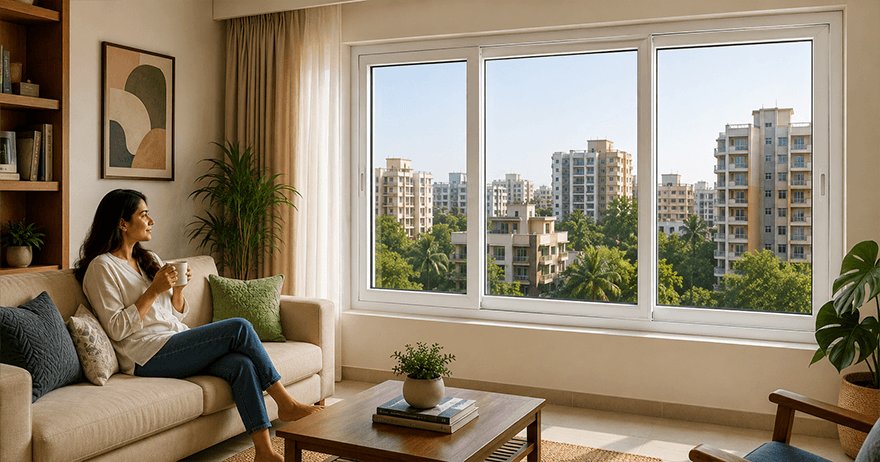
Your window choices play a major role in how comfortably your home feels every day. If your home feels too hot, noisy, or dusty even when everything seems shut, your windows could be the reason.
Many homeowners do not realise how much windows affect temperature control, outside noise, and indoor air quality. Choosing the best windows for home comfort is especially important in India, where heat, pollution, and noise levels are high.
Based on how different window types impact your living environment, here’s how to choose windows for home. This way, you can create a quieter, cleaner, and more energy-efficient home.
How Windows Affect Comfort In Your Home
Windows are not just mere openings in a wall; they are active barriers between your indoor environment and everything outside. Every window in your home is constantly managing three things-
- Heat transfer
- Sound transmission
- Air infiltration
When a window does these three jobs poorly, you can feel your room getting stuffy, can hear the outside noise clearly, and notice a thin layer of dust entering house through windows.
In India, we have 3 challenges. They are intense summer heat that can reach 45 °C in many cities, heavy traffic noise, and high outdoor pollution and dust levels. Poorly chosen or ageing windows can fail all these challenges, and worse, reduce your quality of life daily and push up your electricity bills.
So, understanding which windows are best for Indian climate will help you make a smarter choice for every room in your home.
How Windows Impact Heat, Noise & Dust Levels
Heat And Temperature Control
Have you ever wondered why is my home hot even with windows closed? The answer lies in the window frame material and glazing. Single-pane offers almost no resistance to heat. Solar radiation passes straight through, heating your rooms like a greenhouse.
Windows with low-emissivity (Low-E) glass coatings reflect infrared radiation, keeping heat outside in summer and inside during cooler months. Double-glazed windows add an air gap between two glass panes, which acts as an insulating layer that significantly slows heat transfer. These are considered the best windows to reduce heat in Indian for long-term comfort.
Noise Reduction
If you give up thinking you cannot do anything about noise coming through windows problem, wake up, as the right window can make a difference.
Standard aluminium windows with single glass allow most of the outdoor noise spectrum to pass through.
Windows For Soundproofing Homes
You need to opt for windows that come with laminated or thicker glass and are combined with multi-chamber frames that act as soundproof. Double-glazed windows with an asymmetrical gap (different widths between panes) are particularly effective as different frequencies of sound are absorbed at different glass thicknesses.
Dust Infiltration
Dust does not enter only when the windows are open. It also seeps through gaps in poorly fitted frames, corroded tracks, or worn-out seals. Aluminium windows with standard weather stripping are vulnerable to this over time, as the seals degrade.
The best windows for home comfort comes with precisely engineered frames and multi-point locking systems, providing tighter seal. Proper sealing not only prevents dust, but also allergens, pollen, and pollution particles from coming inside.
Common Window Mistakes That Reduce Home Comfort
Most homeowners make window decisions based on budget and appearance. Here are some common mistakes to avoid.
- Choosing single-pane glass: Refrain from choosing single-pane glass, as they easily give in to heat, dust, and noise.
- Ignoring frame material: Do not ignore the frame material, as it is one of the major reasons for discomfort.
- Skipping proper installation: Prioritise proper installation, as even the best windows perform poorly if it is not installed with tight seals and proper flashing. Gaps around the frame bring in more heat, noise and dust.
- Not considering room orientation: Windows must be chosen based on the room orientation. For instance, west-facing rooms receive the most afternoon heat. Windows on these walls need better solar control than those on north-facing walls.
- Treating all rooms the same: It is a myth that one window type suits every space. It does not, because the purpose is different. While a kitchen needs ventilation and heat-resistance, a bedroom needs soundproofing as a priority.
Best Window Types For Better Comfort In Indian Homes
Here are some of the best windows for home comfort.
uPVC Windows
uPVC (unplasticised polyvinyl chloride) windows have become the preferred choice these days. uPVC windows benefits India include excellent thermal insulation, near-zero infiltration, strong noise reduction, and a multi-chamber profile that prevents heat transfer through the frame itself.
Unlike aluminium, uPVC does not conduct heat, warp in humidity, or corrode in coastal environments. These windows maintain their seal integrity for decades, which is critical for dust and noise control.
Double-Glazed Windows
If you live in a city with extreme heat or high noise levels, double-glazed windows are the best. The insulating air gap between the two glass panes reduces solar heat gain by up to 30 to 40 percent compared to single-pane glass. When combined with a uPVC frame, Low-E coating, and double-glazed windows are among the most energy efficient windows for homes India.
So, if you are wondering, are double-glazed windows worth it in India? The answer is YES.
Casement Windows
Casement windows open on hinges and, when closed, press tightly against the frame on all four sides. This creates a better seal than sliding windows, which always have some gap in the track. For rooms where dust infiltration is a priority concern, casement-style windows are the best option.
Sliding Windows With Brush Seals
Sliding windows fitted with high-quality brush seals and weather-stripping significantly reduce dust and noise infiltration compared to basic sliding designs. They are a cost-effective upgrade.
How To Choose The Right Windows For Your Home
If you are thinking about how to choose windows for home, here’re some tips.
- Know your problem first: Identify whether the primary issue is heat, noise, dust, or a combination. As rooms vary, your window specifications should vary too.
- Prioritise frame material: If your goal is comfort and longevity, uPVC is better than aluminium. It is the most energy-efficient window frame type.
- Choosing double glazing for high-impact rooms: Make sure to choose double-glazing windows combined with Low-E coating for living rooms, master bedroom, and west-facing rooms.
- Check the hardware: Multi-point locking handles create a tighter seal across the full frame. Single-point locks leave the corners of the frame slightly loose, which allows both noise and dust infiltration.
This is how you choose the best windows for home comfort.