


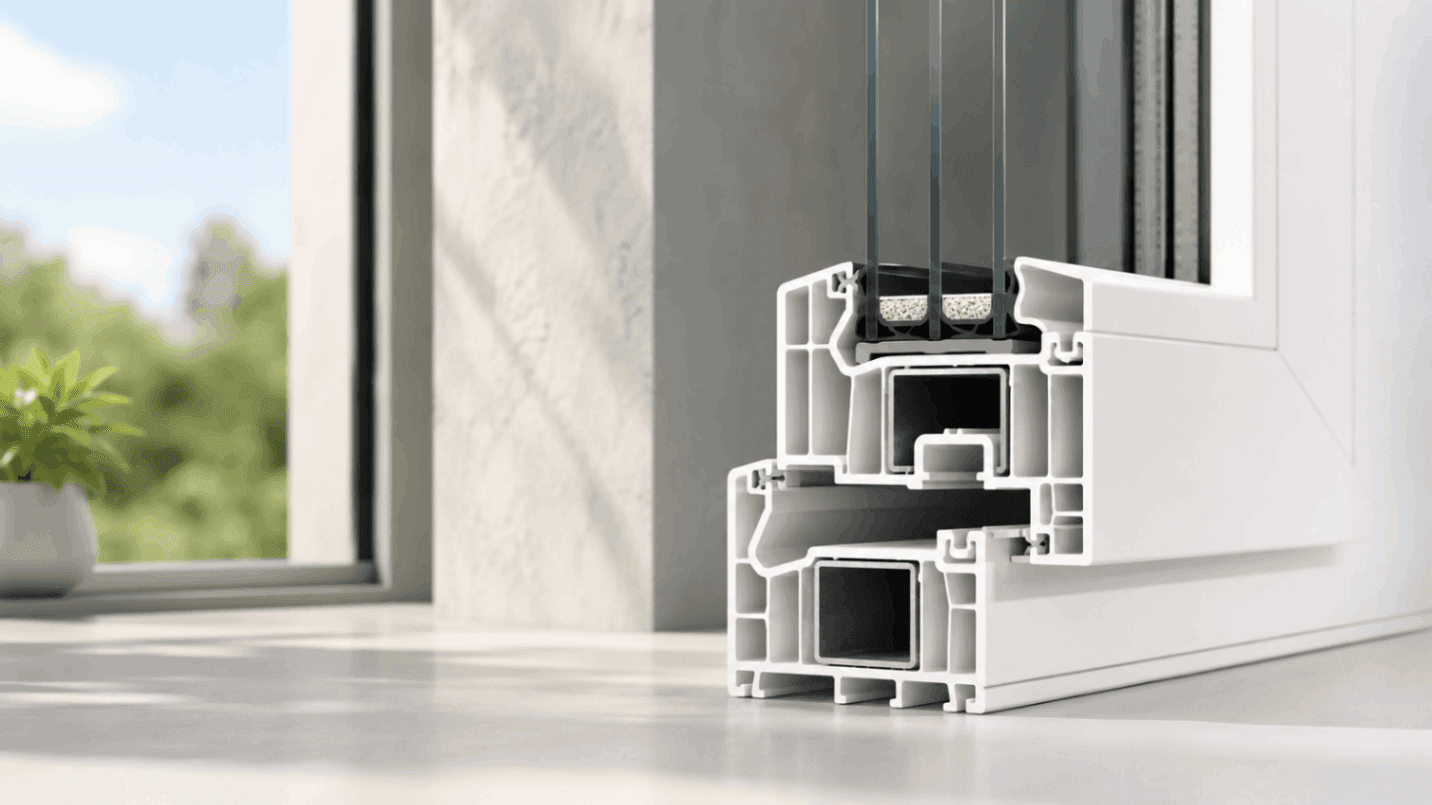
In this article, we will explain how multi-chamber uPVC profiles function, their main advantages, and why they are vital when selecting windows.
How Multi-Chamber uPVC Profiles Work
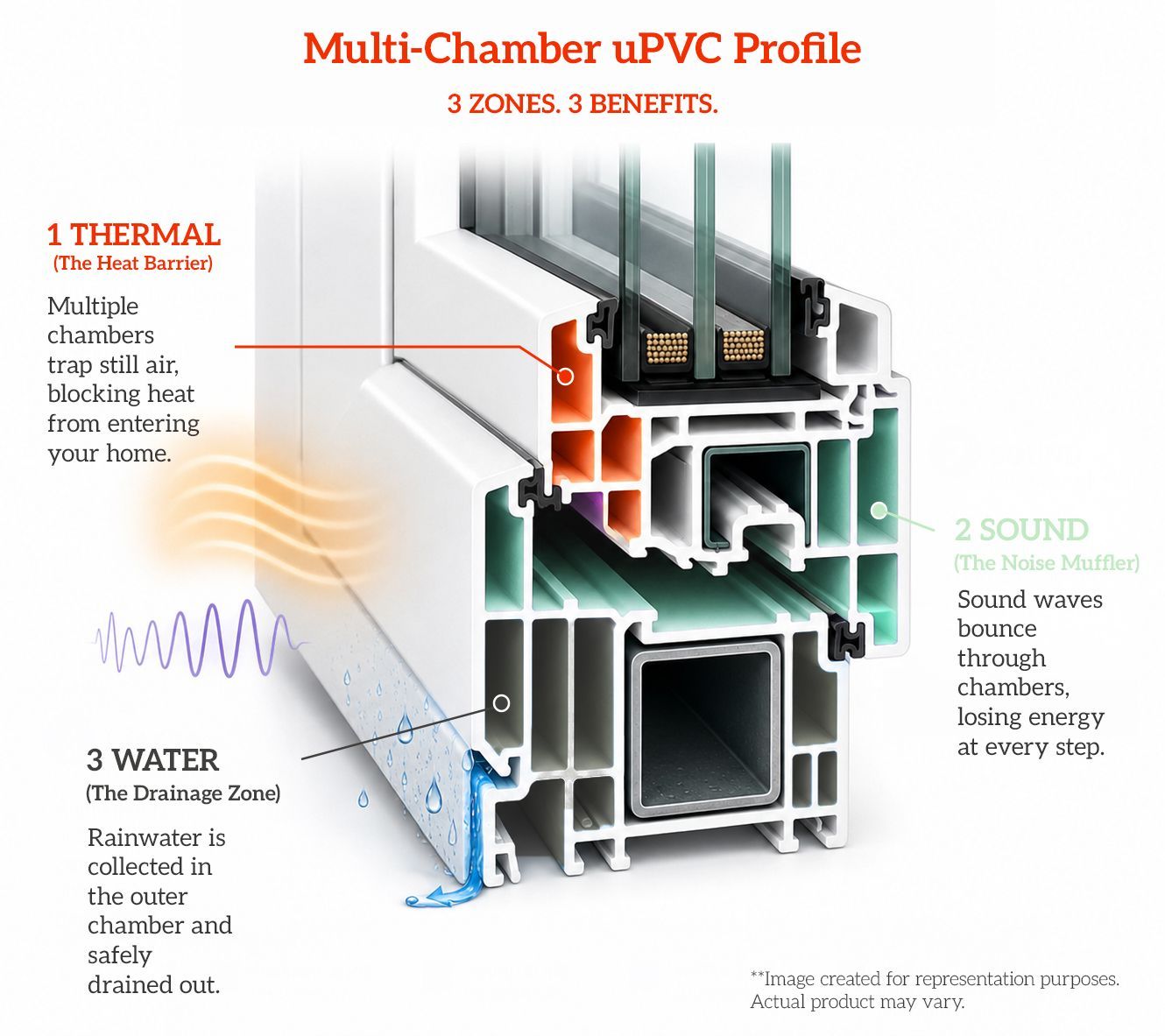
Benefits of Multi-Chamber uPVC Windows
Multi-Chamber Design:
Three internal chambers create separate air pockets within the profile, enhancing insulation, strength, and overall window performance.
Sound Insulation:
Helps reduce external noise by up to 30–35 dB when combined with the right glazing and sealing systems.
Thermal Insulation:
Air trapped within the chambers can reduce heat transfer through the frame by up to 20–30% compared to non-insulated profiles.
Water Tightness:
Multi-chamber construction supports drainage pathways and sealing systems designed to withstand heavy rainfall and wind-driven water.
Energy Efficiency:
Better insulation can reduce cooling loads by 10–20%, depending on the building design and glazing specification.
Structural Stability:
Chambered profiles improve rigidity and support reinforcement systems, helping windows maintain performance over years of operation.
Long-Term Performance:
Designed for a service life of 20–30+ years with minimal maintenance under normal operating conditions.
How It Improves Insulation & Energy Efficiency
One of the biggest advantages of a multi-chamber uPVC profile is its ability to improve thermal insulation and reduce energy loss.
1. The Power of "Stagnant Air"
Sealed chambers filled with stagnant air create insulation barriers that improve uPVC window insulation by slowing down heat transfer.
2. Breaking the "Thermal Bridge"
Multi-chamber profiles break the heat path with multiple walls and air pockets, reducing heat transfer indoors.
3. Shielding the Steel Core
By surrounding the steel chamber with insulated air pockets, multi-chamber profiles reduce heat reaching indoors.
4. Reducing the "AC Load"
Multi-chamber profiles create insulation barriers that keep heat outside and cool air inside, reducing AC usage and electricity costs. This is one reason they are preferred for energy efficient windows India homeowners increasingly choose for better indoor comfort.
5. Reduced condensation and drafts
Multi-chamber profiles keep the inner frame closer to room temperature and use layered air pockets to reduce condensation and weaken wind pressure before it reaches the seals.
Strength & Durability of Multi-Chamber Frames
Multi-chamber uPVC profiles are built for long-term strength, stability, and durability. Their internal uPVC frame structure improves rigidity, helping windows and doors handle heavy glass, strong winds, daily use, and changing weather without bending or losing alignment.
The multiple chambers distribute stress evenly, improving overall uPVC window strength and making the profile more resistant to warping, cracking, and structural fatigue. A separate chamber also houses galvanized steel reinforcement, adding stiffness while protecting it from moisture and corrosion.
During manufacturing, the profile corners are heat-fusion-welded across multiple internal walls, creating stronger joints and improved structural stability for long-term performance.
Does More Chambers Mean Better Quality?
Not necessarily. While additional chambers can improve thermal insulation, sound reduction, and structural performance, the overall quality of a uPVC window depends on much more than the chamber count alone. Factors such as profile wall thickness, uPVC formulation, steel reinforcement, sealing systems, hardware quality, glazing, and manufacturing precision all play a critical role. A well-engineered 3-chamber profile can often outperform a poorly designed profile with more chambers. Chambers should be viewed as one part of a complete window system, not the sole indicator of quality.
Factors to Consider When Choosing uPVC Profiles
Choosing the right uPVC profile goes beyond appearance. The profile system determines the strength, durability, insulation, and long-term performance of windows and doors. Standards like IS 17953:2023 help define quality benchmarks.
1. Compliance with Standards: IS 17953:2023 or EN 12608 and ISO 9001:2015 Certification
2. Structural Strength & Reinforcement
3. UV & Weather Resistance
4. Impact & Heat Resistance
5. Surface Finish & Appearance
6. Dimensional Accuracy & Tolerances
7. Weldability & Fabrication Quality
8. Material Quality & Sustainability
Why It Matters for Your Home
Windows and doors are long-term investments that impact comfort, efficiency, and durability. The right multi-chamber uPVC profile improves insulation, reduces noise, enhances stability, and delivers better long-term performance. Beyond appearance, profile quality affects weather resistance, functionality, and overall indoor comfort, making it a valuable long-term investment.