




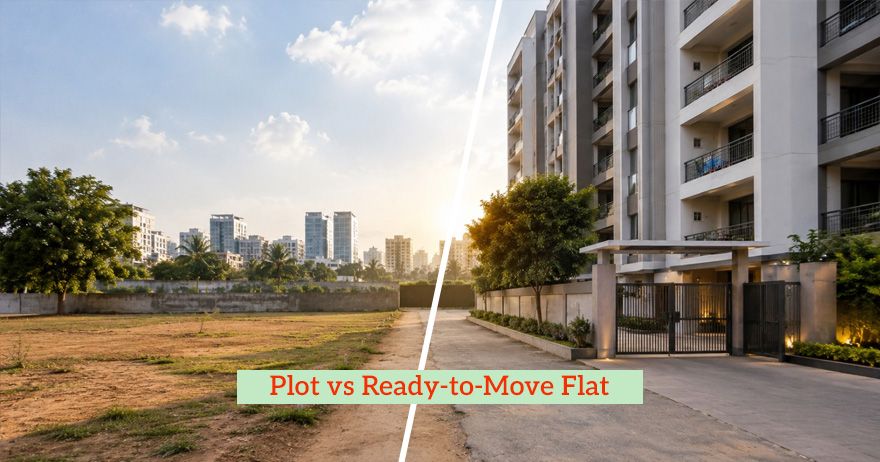
Choosing between a plot and a ready-to-move flat is one of the biggest decisions for homebuyers and real estate investors. While a plot offers greater flexibility, long-term appreciation, and the freedom to build your dream home, a ready-to-move flat provides immediate possession, modern amenities, and lower construction hassles.
The right investment depends on your budget, lifestyle, financial goals, and future plans. In this guide, we'll compare plots and ready-to-move flats based on cost, returns, maintenance, risks, and convenience to help you make a smart property investment decision.
What Is a Residential Plot?
A residential plot is a piece of land approved for housing construction. It doesn't come with a built structure. Instead, it gives you the flexibility to build your home whenever you are ready. You will gain the freedom to decide the layout, number of floors, architectural style, materials, and timeline for construction. If your family grows in the future, you may even be able to expand the building depending on local regulations.
Another reason many buyers consider Plot investment in India is the potential for long-term appreciation. As surrounding infrastructure improves with new roads, schools, hospitals, metro connectivity, and commercial developments, land values increase.
What Is a Ready-to-Move Flat?
A ready-to-move flat is a completed apartment that is available for immediate possession. You do not have concerns about construction delays, changing specifications, or waiting several years before moving in. One of the biggest Ready-to-move apartment benefits is convenience. Essential services such as electricity, water supply, lifts, parking, security, and landscaped common areas are usually already operational.
For working professionals, families with school-going children, and people relocating to a new city, they eliminate the stress associated with construction management. You can generate rental income almost immediately if purchased as an investment property.
Plot vs Ready-to-Move Flat: Key Differences
When comparing Plot vs ready-to-move flat, there is not a universal winner. The table below will help you understand buying a plot vs apartment, which is better for you.
| Factor | Residential Plot | Ready-to-Move Flat |
|---|---|---|
| Immediate use | No and construction is required before occupancy | Yes and you can move in on possession day |
| Land ownership | Full exclusive ownership | Undivided share of land only |
| Customisation | Complete and build as per your design and needs | Limited to interior fit-out only |
| GST applicability | Nil on plot purchase and applies on construction costs | Nil with occupancy certificate and 5% without occupancy certificate |
| Construction risk | High as the homeowner manages construction | None because the building is complete |
| Rental income | Only after construction is complete | Immediate and can be rented out from day one |
| Maintenance | Owner-managed with no mandatory levy | Society maintenance levy is mandatory |
| Home loan availability | Plot loans are available at slightly higher rates and a separate construction loan is needed | Standard home loan available with a straightforward process |
| Long-term appreciation | Higher potential driven by full land value growth | Good but building depreciation partially offsets the land component |
| Liquidity | Lower with a smaller buyer pool for plots | Higher with a larger buyer and tenant pool |
| Security | Owner-arranged after construction | 24-hour gated security is typical in residential projects |
Investment Potential and Long-Term Appreciation
When comparing Plot vs flat investment, it is important to think beyond short-term price movements. When considering Real estate investment India, buyers should evaluate infrastructure plans, employment hubs, transportation projects, and future urban development.
As cities expand and develop, well-located residential plots often appreciate steadily because the supply of land remains fixed while demand continues to grow. Plots are considered a long-term asset, particularly in developing suburbs.
Apartments also appreciate, but their value depends on several additional factors. The building ages over time, maintenance quality affects resale value, and newer residential projects entering the market create more competition. Apartments in prime city locations with excellent connectivity often perform very well.
Cost Comparison and Financing Options
Cost Factor
The purchase price is the first factor buyers look for. In many locations, plots may have a lower initial purchase price than completed apartments of similar size. However, construction costs need to be added later, including approvals, labour, materials, architects, and finishing work. So the total investment may eventually exceed the cost of purchasing a ready-to-move apartment.
Finance
Home loans are also slightly different. Banks generally finance ready-to-move apartments more easily because the completed building serves as immediate collateral. Loans for residential plots are available too, although repayment conditions and loan amounts may vary between lenders.
Lifestyle, Amenities, and Maintenance
Lifestyle expectations vary from one buyer to another.
Apartments offer several conveniences such as security staff, landscaped gardens, children's play areas, fitness centres, clubhouses, backup power, visitor parking, and maintenance services that individual homes usually do not have. However, these conveniences also come with recurring maintenance charges.
Independent homeowners do not need to spend on maintenance charges, but they are individually responsible for repairs, painting, plumbing, security, gardening, and exterior maintenance.
Risks and Challenges of Both Investment Options
Plot Investment Risks
- Legal verification: Buyers should carefully check ownership records, land titles, approvals, zoning regulations, and access roads before completing the purchase.
- Construction execution risk: The homeowner is responsible for managing the construction process, engaging contractors, monitoring quality, managing schedule, and controlling costs.
- Idle period cost: A plot that is not immediately developed generates no income and incurs property tax while appreciating
- Encroachment risk: Vacant plots without boundary walls and without regular inspection are vulnerable to encroachment
- Financing complexity: Construction costs may also increase over time due to rising material prices and labour charges.
Ready-to-Move Flat Risks
- Building age depreciation: Ready-to-move resale flats in older buildings carry the depreciation of the structure.
- Housing society governance risk: Poorly governed housing societies with dysfunctional management committees can create problems for individuals.
- Maintenance charges: Society maintenance charges are mandatory and increase over time as the building ages.
- Limited customisation: A ready-to-move flat's layout, window placements, structural elements, and many finishes are fixed at purchase.
Which Option Is Best for Different Types of Buyers?
There is no single answer to Plot or flat which is better. If you are deciding between Buying a flat or building a house, start by asking yourself whether your priority is convenience today or flexibility for the future.
If you're planning to build a customised home that suits your family's long-term needs, a residential plot offers greater flexibility. You can choose the architectural style, number of floors, room sizes, and construction timeline according to your budget and preferences.
A ready-to-move flat is often a better choice for buyers who need immediate accommodation. It is for those who usually appreciate the convenience of moving into a completed home without worrying about construction.
Key Factors to Consider Before Making Your Decision
You have to compare a residential plot vs flat based on your future lifestyle. Property investment guide is given below to help you make an informed decision.
| Decision Factor | Favours Plot | Favours Ready-to-Move Flat |
|---|---|---|
| Occupancy need | Can wait 12 to 18 months while construction is completed | Need immediate possession |
| Management capacity | Can manage the construction project personally or through professionals | Prefer fully managed low-involvement ownership |
| Family structure | Multi-generational family needing layout flexibility and private outdoor space | Nuclear family with an urban lifestyle that values community and amenities |
| Budget and financing | Can manage two-stage financing with a plot loan and construction loan | Single home loan with simpler financing and an immediate asset as collateral |
| Location | Tier-2 or Tier-3 cities and city peripheries where plots are accessible | Metro city cores and well-connected urban areas where plots are scarce |
| Rental strategy | Multi-income configuration with a commercial ground floor | Immediate single-unit rental |
Final Thoughts
If you are still deciding between a plot vs ready-to-move flat, avoid making the decision based only on today's property prices. Think about your financial goals, family needs, preferred lifestyle, and investment horizon. A single wise decision today can become one of the most rewarding investments. Do your own research, verify legal documents, compare locations carefully, and follow practical home buying tips India before making your final decision.