Choosing between pre-hung vs slab doors is an important decision when planning interior doors for a new home or renovation. Although both options provide the actual door leaf, they differ considerably in how the door is supplied, installed and finished.
A pre-hung door arrives with the door already attached to its frame, while a slab door is supplied as the door leaf without the complete frame assembly. This difference affects the installation process, labour requirements, hardware selection, flexibility and overall project cost.
For Indian homes, factors such as wall thickness, existing frame condition, opening dimensions, material, finish and site conditions should also be considered.
So, which option is better? There is no universal answer. The right choice depends on whether you are constructing a new home, replacing an existing door, reusing a frame or looking for greater customisation.
What Is a Pre-Hung Door?
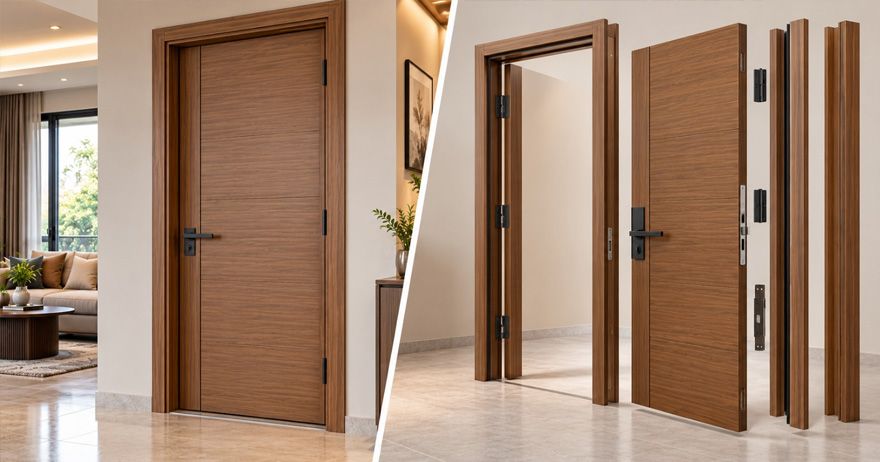
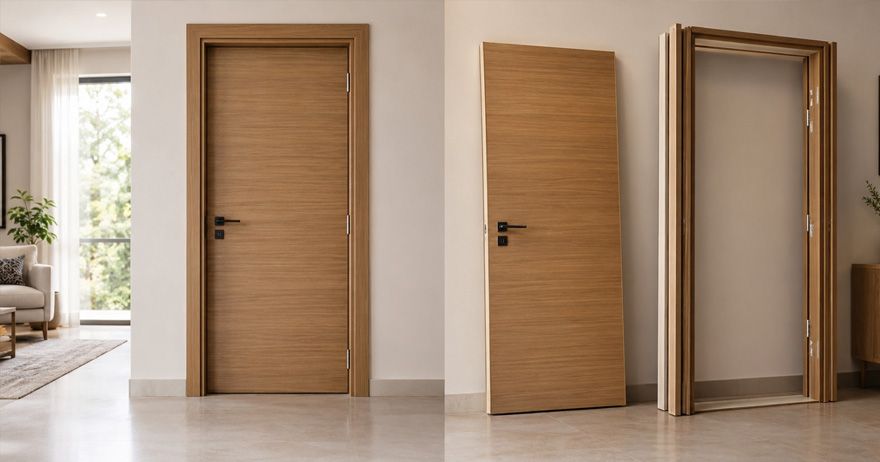
A pre-hung door is supplied as a complete door-and-frame assembly. The door is already mounted on its hinges within the frame, which is prepared for installation at the site.
A typical pre-hung unit may include:
- Door slab
- Door frame
- Hinges
- Strike plate
- Basic hardware
- Other components depending on the supplier
The main advantage is convenience. The door and frame are manufactured to work together, reducing some of the fitting work required at the site.
Pre-hung door installation can therefore be particularly convenient in new construction where door openings and frame requirements can be planned from the beginning.
However, the price depends on what is included. Some suppliers provide only the door and frame, while handles, locks, transportation and installation may cost extra.
What Is a Slab Door?
A slab door is essentially the door leaf without a complete pre-assembled frame.
It may be purchased for:
- A new frame
- An existing frame
- Replacement of an old door leaf
- A customised interior door project
Because the door is supplied separately, additional work may be required to install hinges, handles, locks and other hardware.
A slab door can be useful when the existing frame is in good condition and matches the new door dimensions. It can also provide greater flexibility for homeowners who want to select their own frame and hardware.
However, successful installation depends heavily on accurate measurements and proper fitting.
Cost Differences Between Pre-Hung and Slab Doors
The slab door cost can initially appear lower because you are purchasing only the door leaf. However, the final project cost needs to include all additional components and labour.
A slab door may require separate costs for:
- Door frame
- Hinges
- Lock
- Handle
- Installation
- Hardware fitting
- Finishing
- Site adjustments
A pre-hung door may have a higher initial price because the frame and door are supplied together.
Cost comparison at a glance
| Factor | Pre-Hung Door | Slab Door |
|---|---|---|
| Door leaf | Included | Included |
| Frame | Usually included | Usually separate |
| Hinges | Often included | Usually separate |
| Hardware | Depends on supplier | Usually separate |
| Installation | May be separate | Usually requires more fitting |
| Initial price | Often higher | Often lower |
| Customisation | Moderate | Generally greater |
| Existing frame reuse | Less relevant | Strong advantage |
| New construction | Convenient | Requires more fitting |
The important point is to compare the complete installed cost, rather than assuming the lower door price automatically means lower project cost.
A slab door may be economical when a suitable frame already exists. A pre-hung unit can offer better value when a new frame is required and you want a coordinated door assembly.
Installation Time and Labour
One of the biggest differences in pre-hung vs slab doors is the amount of fitting required.
A pre-hung unit is already assembled, so the installer mainly needs to position and secure the frame, check alignment, and complete the required hardware and finishing work.
The opening still needs to be correctly prepared. If it is uneven, incorrectly sized or out of square, additional work may be necessary.
A slab door requires more on-site fitting. The installer may need to:
- Measure and mark hinge positions.
- Prepare the door for hinges.
- Align the door with the frame.
- Install hinges.
- Mark and install the lock.
- Fit the handle.
- Check the door swing.
- Adjust clearances.
- Complete finishing or trimming.
Therefore, a pre-hung door is generally faster to install when the opening and frame conditions are suitable.
A slab door can still be installed efficiently by an experienced carpenter, particularly when replacing a door with one of the same dimensions.
Finish and Hardware Considerations
The door finish comparison between the two options depends more on the door material and finishing process than on whether the door is pre-hung or a slab.
Both types can be available with finishes such as:
- Paint
- Laminate
- Veneer
- Natural wood finishes
- Decorative coatings
- Factory-applied finishes
A factory-finished pre-hung door can provide a consistent appearance across the door and frame when both are designed as one system.
With a slab door, you have greater freedom to select the frame finish separately. This can be useful when matching an existing frame or creating a specific interior design.
Flexibility and Customisation
Slab doors generally offer greater flexibility.
You can select:
- Door material
- Frame material
- Hinges
- Handles
- Locks
- Door finish
- Frame finish
- Hardware style
- Door thickness
This can be particularly useful for renovation projects where the existing frame needs to be retained.
Pre-hung doors offer less flexibility because the door and frame are supplied as a coordinated unit. However, this coordination is also one of their biggest advantages.
For homeowners who want convenience and predictable installation, the pre-hung system can be attractive.
For homeowners who want maximum control over individual components, a slab door may be preferable.
Which Option Suits Different Projects?
New Construction
A pre-hung door can be an excellent choice for new construction because the door opening can be planned around the required frame dimensions.
It can simplify installation and help maintain consistency across multiple rooms.
Renovation
A slab door can be useful when the existing frame is structurally sound and suitable for reuse.
Instead of replacing the complete assembly, you may only need to replace the door leaf.
Replacing a Damaged Door
If the existing frame is in good condition, a slab replacement can reduce unnecessary work.
However, measurements must be accurate, including door height, width, thickness, hinge positions and hardware locations.
Multiple Interior Doors
For a new home with several similar doors, pre-hung units can make installation more systematic. Matching units can also provide a consistent appearance.
Highly Customised Interiors
If you want unusual hardware, a specific frame material or a particular combination of door and frame finishes, slab doors may offer more freedom.
Common Selection Mistakes
Comparing Only the Door Price
Do not compare a slab door price directly with a complete pre-hung unit without considering frames, hardware and labour.
Assuming a Slab Door Fits Any Frame
Even small differences in dimensions, thickness or hinge position can create fitting problems.
Ignoring the Existing Frame
Before choosing a slab replacement, check whether the existing frame is level, square, structurally sound and suitable for the new door.
Forgetting Hardware
Handles, locks and hinges can significantly affect the final cost.
Choosing a Door Before Checking the Opening
Measure the actual opening and confirm the required door dimensions before ordering.
Assuming Pre-Hung Means No Installation Work
A pre-hung unit still needs proper installation and alignment. Poor site conditions can increase labour requirements.
Ignoring Wall Thickness
Frame dimensions should be compatible with the wall construction. This is particularly important in Indian homes where wall thickness and finishing layers can vary.
Choosing Only on Initial Cost
The cheapest door may not be the most economical after hardware, labour, finishing and future maintenance are considered.
Final Comparison Checklist
Before choosing between a pre-hung and slab door, ask:
- Is this a new construction or renovation project?
- Is there already a suitable door frame?
- What is the exact opening size?
- What is the wall thickness?
- What door material do I need?
- Which finish do I want?
- Are hinges included?
- Are handles and locks included?
- Is installation included?
- Will the existing frame need modification?
- How much customisation do I need?
- What is the complete installed cost?
- What warranty is provided?
Ultimately, pre-hung vs slab doors is not simply a question of which is cheaper. It is about matching the door system to your project.
A pre-hung door can save fitting time and simplify new construction, while a slab door can provide flexibility and work particularly well when an existing frame can be reused. Compare the complete material, hardware, installation and finishing requirements before making the final decision.