




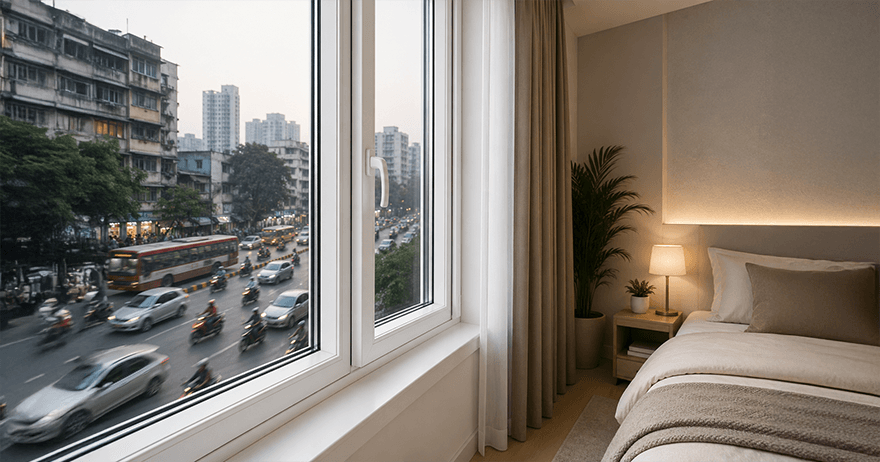
Street noise is one of the common problems in India, especially in busy urban cities. So, if you're struggling with traffic noise, honking, or constant outside disturbances, you might be wondering how to reduce street noise in your apartment effectively.
Most of the noise that gets into your home comes in through weak points: windows, gaps in the sealant, and poorly sealed doors. Poor quality window systems allow outside noise coming through windows to easily penetrate even though your windows are closed, and you are inside a room.
To start addressing noise that enters your home, you'll want to understand how sound travels into your house, particularly when you are considering soundproof or noise-reducing windows in India.
Why Street Noise Enters Apartments So Easily?
Most apartment buildings in India are built without soundproofing in mind. Unlike Western countries with stricter building codes around sound insulation. In India, construction largely prioritises structural integrity, ventilation, and cost efficiency, leaving sound transmission as an afterthought.
Everyone knows that sounds travel as pressure waves, and they will take the path of least resistance within a building. For example, just a 1mm gap around a window frame can allow enough sound into the room to create a similar effect as if you were standing at your partially opened window.
The construction materials that are used in most Indian residential buildings are single-pane glass, hollow-core doors, and thin walls of fly-ash bricks. And they have minimal sound transmission loss ratings.
What Causes Noise Problems in Indian Homes?
There are multiple causes of noise problems in Indian homes. And understanding which applies to your home helps you target the right intervention.
- Traffic and honking.
- Construction and ongoing urban development.
- Loudspeakers and public events, such as religious functions, political rallies, and weddings.
- Street and neighbour noise, including vendors, stray dogs, and general pedestrian activity.
Beyond sources, the structural weaknesses of your apartment determine how much noise actually gets in. Poorly fitted aluminium window frames, standard across most affordable housing, have notoriously poor acoustic seals. Sliding windows with gaps, thin 4mm single-pane glass, and open ventilation grilles are the main culprits in most apartments.
How to Reduce Traffic Noise in Apartment India?
Reducing noise effectively requires a layered approach, addressing the building envelope at multiple points rather than relying on a single solution. Here are the most impactful interventions available in India, roughly in order of effectiveness.
- Upgrade to double or triple-glazed windows.
- Seal all gaps around frames and walls. Use acoustic sealant around the perimeter of all window and door frames.
- Install heavy drapes or acoustic curtains. Thick, floor-to-ceiling curtains made from mass-loaded or multi-layered fabric can reduce transmitted noise.
- Add secondary glazing or window inserts. If replacing windows is not possible due to rental restrictions or cost, secondary glazing, a separate pane installed inside the existing frame.
- Use solid-core doors and door seals.
- Add rugs, bookshelves, and soft furnishings.
Best Window Solutions for Noise Reduction in India
Windows are the primary battleground for noise reduction in Indian apartments. The market has developed considerably in the last decade, offering options across a range of budgets. The best windows for noise reduction India are:
- uPVC double-glazed casement windows
- Acoustic laminated glass
- uPVC single-glazed casement windows
- Secondary glazing inserts are the best budget option, sitting inside your existing frame and adding a second acoustic barrier for ₹250–500 per sq ft, with 15–25 dB reduction.
- Standard aluminium sliding windows, the most common type found in Indian apartments, offer only 8–15 dB of noise reduction and are generally inadequate for urban noise environments.
Signs Your Windows Are Not Soundproof
Many residents discover their windows are acoustically inadequate only after years of disrupted sleep or distracted work. These are the clearest indicators that your current windows are failing on noise control.
You can clearly hear individual conversations from the street below, even with all windows closed. Traffic noise is audible as a constant presence rather than a distant hum. You can feel vibration in the glass or window frame when heavy vehicles pass.
There are visible hairline gaps between the frame and the wall, or the sealant around the frame has cracked and shrunk. Your windows are of the aluminium sliding type with no rubber or brush seal visible on the tracks. You notice a draft near the window even when it is fully closed, if air gets through, sound gets through too. The noise level inside your apartment when windows are closed feels only marginally better than when they are open.
If three or more of these signs apply to your home, window upgrades combined with gap sealing should be your priority. Addressing the windows alone, particularly with double-glazed uPVC casements and proper sealant, can transform a loud, stressful apartment into a noticeably quieter living space, even in the heart of a busy Indian city.