



Indoor air quality in homes is becoming a growing concern in India, especially with rising pollution levels and tightly sealed spaces. People struggle with stale air, poor ventilation, and indoor pollutants without realising that windows play a key role in airflow and fresh air circulation.
Choosing the right windows for ventilation can significantly improve indoor air quality and create a healthier living environment. Understanding how window design impacts airflow is essential if you want to reduce indoor pollution and maintain better air quality at home.
Why Indoor Air Quality Matters In Indian Homes
If you are wondering why indoor air quality is poor in homes, here is the answer.
According to Dyson’s Global Connected Air Quality Study, India has the highest average indoor PM2.5 levels in the world- 55.18 micrograms per cubic metre. The WHO-recommended safe limit is 5 micrograms per cubic meter. That means indoor pollution levels in many homes are far above what is considered safe.
Studies show that people in urban areas spend roughly 70 to 90% of their time inside homes, offices or other enclosed spaces. So, whatever is trapped in your indoor air, for instance, stale air in closed rooms, dust, cooking smoke, moisture or vehicle pollution from outside, you are breathing it all for most of the day.
Poor indoor air quality can lead to headaches, fatigue, breathing discomfort, and long-term respiratory problems. A study published in the Indian Journal of Community Medicine found that more than 75% of surveyed urban homes lacked proper cross ventilation, and over half the residents reported at least one health symptom linked to indoor air pollution.
The right windows for ventilation can improve this significantly by allowing fresh air to move through the house and push stale air out naturally.
How Windows Affect Ventilation And Air Quality
Air moves through homes because of pressure differences. Fresh air enters from the side facing the breeze and pushes warm, stale air out through another opening. This movement is called cross ventilation, and it is one of the most effective ways to improve indoor air quality naturally, if you are wondering how to increase airflow in home.
Cross ventilation windows design has openings on opposite or nearby walls. When all the windows are placed on only one side, airflow becomes weaker and slower.
The type and size of the window also affect ventilation. A window that opens fully allows much more airflow than one that opens only halfway. Window placement matters too. If windows are placed too high or too low, airflow may not reach the level where people sit, sleep, or spend most of their time.
Many people also prefer uPVC windows ventilation benefits because they offer better sealing when closed, while still allowing strong air flow when opened properly.
Best Window Types For Better Ventilation And Fresh Air
Here are the top 5 windows for ventilation and better airflow.
Casement Windows
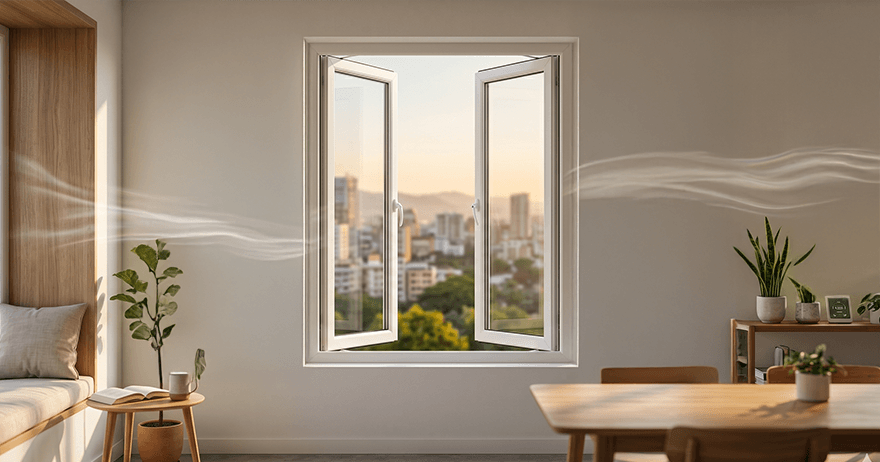
Casement windows are hinged on one side and open fully outward like a door. Because the window opens outward, it also catches the moving breeze and directs it inside more effectively. Since it seals tightly when closed, it reduces the entry of dust and outside pollution. It is one of the best windows for ventilation in India.
Casement windows are suitable for bedrooms, living rooms, and spaces where strong airflow is important.
Louvred Windows (Jalousie Windows)
Louvred windows use horizontal slats that tilt open and closed together. They allow steady airflow even during light rain because the slats help direct water away while still letting air pass through. They also offer some privacy because the slats block a direct view from outside.
However, louvred windows usually do not seal as tightly as casement systems. Dust, outside noise, and moisture can enter more easily. So, louvred windows are best suited for kitchens, bathrooms, utility rooms, and humid spaces.
Awning Windows
Awning windows are hinged at the top and open outward from the bottom. The open glass creates a cover-like effect that prevents rainwater from entering the room. This allows the window to stay open during light to moderate rain, which is especially useful in coastal cities and monsoon-heavy regions.
Though they do not provide as much airflow as casement windows, they work well in spaces where continuous ventilation during rainy weather is important.
Awning windows are best suited for bedrooms, living rooms, and homes in areas that are prone to heavy rainfall.
Tilt And Turn Windows
Tilt and turn windows can open in two ways. They can tilt slightly inward from the top for controlled airflow or open fully inward like a casement window. The tilt feature provides better ventilation without fully exposing the room to dust, strong wind, or rain. When opened fully, these windows also allow strong airflow.
Tilt and turn windows are suitable for high-rise homes and urban areas with dust or pollution concerns. It is one of the best window design for airflow India.
Sliding Windows
Sliding windows are mostly preferred because they are compact and easy to use and maintain. However, they are less effective for ventilation compared to most window types. Since one panel always stays fixed, only half the window area can open at a time. This limits the amount of fresh air entering the room.
They are used in apartments because they help save space. If your home already has sliding windows, keeping the movable panel fully open and cleaning the mesh regularly will help improve ventilation.
Sliding windows are best for utility rooms, compact spaces, balconies, and areas where space-saving is important.
Common Window Problems That Reduce Airflow
If you understand what blocks airflow, you can avoid these lack of ventilation in house problems while choosing or replacing windows.
- Security grills stacked with mesh: Airflow is reduced when grills, fly meshes, and extra mosquito nets are layered on the same window. Dirty mesh screens can further block air movement over time. Regular cleaning helps maintain proper airflow.
- Windows on only one wall: When all windows face only one direction, fresh air enters but does not move properly through the room. This often makes rooms feel hotter and stuffier.
- Enclosed balconies: Many homeowners convert balconies into enclosed spaces using glass or aluminium frames. While this creates extra usable space, it can also block the main airflow path for nearby rooms.
- Sliding windows that open only halfway: A standard sliding window can open only up to 50% of its total size because one panel always remains fixed. This naturally limits airflow.
- Wrong window height: Windows placed only near the ceiling help release hot air, but may not bring enough fresh air to the level where people sit or sleep. On the other hand, a window placed only at a lower level may not allow trapped hot air to escape.
How To Choose Windows That Improve Indoor Air Quality
If you are exploring windows for ventilation that help improve indoor air quality, here are some tips.
- Think about airflow paths, not just the individual windows. A room ventilates properly only when air has both an entry point and an exit path.
- Choose windows that open wider, as they provide better airflow than windows with fixed sections.
- Bedrooms and living rooms need stronger airflow, while the kitchens and bathrooms need continuous moisture removal. Make sure to choose the window accordingly.
- If your window has too many grills, mesh screens, and coverings, it can reduce natural ventilation to a greater extent. Avoid blocking airflow with multiple layers.
- Plan window heights carefully, as windows placed at different heights help both fresh air entry and hot air removal.
If you are exploring how to improve air quality at home naturally, follow these steps.
Conclusion
If you choose the most expensive or stylish window design and think you have opted for the right window for your home, you are wrong. Window selection is all about understanding how air moves through your home. So, make sure you choose the best.