


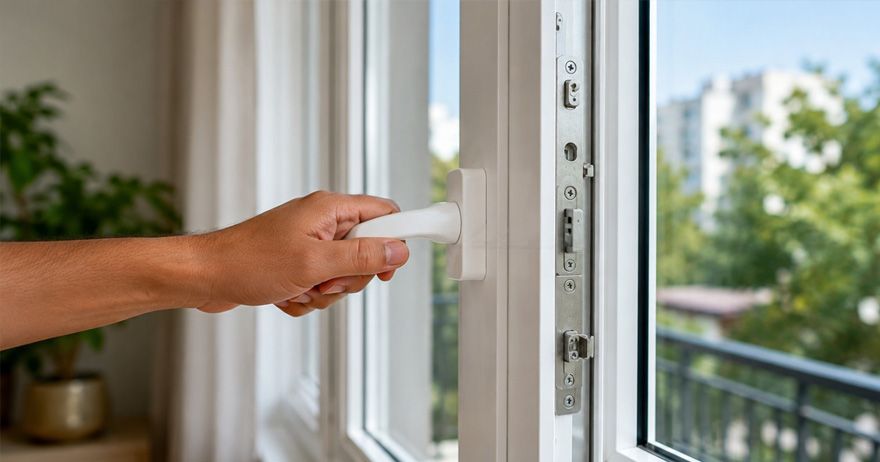
What Is Window Hardware?
Window hardware is the collective term for the mechanical operating system of a window. While the frame and glass define its structure and appearance, the hardware determines how the window operates, how securely it closes, and how consistently it performs over years of daily use. Well-designed hardware contributes to smoother operation, better weather sealing, enhanced security, and a longer service life.
Window Hinges Types Explained
3D Hinge
A 3D hinge is an adjustable hinge used on uPVC casement doors. It has a compact, robust body with a neat cover that conceals the fixing screws, giving the door a clean, finished appearance. It is designed to support the door's weight while allowing precise adjustments after installation. The term "3D" refers to its ability to be adjusted in three directions:
- Height (up and down)
- Lateral position (left and right)
- Compression (towards or away from the frame)
These adjustments help keep the door properly aligned, ensure smooth opening and closing, maintain an even seal against the frame for improved weatherproofing, and make it easier to correct minor alignment changes over time without removing the door.
Butt Hinges
Butt hinges are the most common type of hinge used in casement windows. They consist of two rectangular metal plates (called leaves) joined by a central pin. One leaf is fixed to the window frame and the other to the sash, allowing the window to swing open and closed like a door.
They are primarily used on casement windows because they provide a simple, strong, and reliable pivot for side-hung or top-hung sashes. When the handle is operated, the hinge supports the sash's weight while allowing it to open smoothly.
Butt hinges are preferred for smaller and medium-sized casement windows as they are durable, easy to install, cost-effective, and capable of supporting repeated opening and closing over many years. They also offer a clean, unobtrusive appearance while providing the strength needed for everyday residential use.
Concealed Hinges
A concealed hinge is a type of window or door hinge that remains hidden from view when the sash is closed. Unlike standard butt hinges that are visible on the frame, concealed hinges are integrated within the frame and sash, creating a clean, uninterrupted appearance from both the inside and outside.
They are commonly used in casement windows and casement doors, where the sash opens inwards or outwards on side-mounted hinges. Concealed hinges perform the same function as visible hinges—supporting the sash and allowing it to swing open and closed—but without being exposed.
The main reason for using concealed hinges is aesthetics. By hiding the hardware, they give windows and doors a more minimalist, contemporary look. They also make the frame easier to clean, reduce dust accumulation on exposed hardware, and provide an additional layer of security, as the hinges cannot be accessed from the outside when the window or door is closed. Many concealed hinge systems also allow fine adjustments during installation, helping ensure smooth operation and proper alignment over time.
Friction Stay
A friction stay is a type of window hinge used in casement windows. It consists of two slim stainless steel arms connected by a sliding mechanism and is usually concealed between the window sash and the frame when the window is closed.
As the window opens, the friction stay guides the sash outward in a smooth, controlled motion while supporting its weight. The built-in friction keeps the window in the desired open position, preventing it from swinging freely in the wind or closing unexpectedly.
Friction stays are used in side-hung and top-hung casement windows because they provide stable operation, distribute the sash's weight evenly, and allow the window to open to the required angle.
Window Handles Types and Their Uses
Touch Lock
A touch lock is a compact, surface-mounted locking mechanism commonly used on sliding windows. It features a spring-loaded push lever that locks or releases the sliding sash with a simple press. When engaged, the lock secures the sash to the frame at a single point, preventing the window from opening unintentionally.
Touch locks are widely used on residential sliding windows because they are easy to operate, durable, and unobtrusive. Their slim profile complements the window's design without affecting the smooth movement of the sash. While they provide reliable day-to-day security, they are best suited for standard applications where a single-point latch is sufficient, rather than installations requiring enhanced security or compression sealing offered by multi-point locking systems.
Casement Handle
A casement handle is the operating handle fitted to the sash of a casement window or door. It typically has a slim lever that is turned to open or close the sash and engage the locking mechanism. Depending on the hardware system, the handle may have different internal operating designs, but its purpose remains the same.
It is used to operate side-hung and top-hung casement windows, allowing the sash to swing open or close securely. When the handle is turned, it activates the locking points inside the frame, making the window easy to operate while ensuring it locks firmly when shut.
Casement handles are designed to provide a comfortable grip, smooth operation, and secure locking. They make everyday use effortless while contributing to the window's security, weather sealing, and overall functionality.
L-Handle
An L-handle is a simple, right-angled handle designed specifically for sliding doors. It projects outward in an "L" shape, providing a comfortable grip while maintaining a slim profile so the door panels can slide past each other without obstruction. Depending on the door's size and weight, it is available in small and large variants, both typically offered with a short-neck design.
It is primarily used on uPVC sliding doors, in which the door moves horizontally along a track rather than swinging open. The handle allows users to pull or slide the door smoothly with minimal effort while occupying very little space.
The short-neck L-handle is preferred because it offers a secure grip without protruding excessively, reducing the risk of interference with adjacent sliding panels, curtains, or blinds. The availability of small and big sizes also allows the handle to be matched to the door's dimensions and weight, ensuring comfortable operation and a balanced appearance.
Types Of Strikers And Their Uses
Sliding Striker
A sliding striker is a metal plate fixed to the frame of a sliding door. It is typically rectangular with precisely shaped cut-outs or slots designed to align with the door's locking mechanism.
It is used on sliding doors as the point where the lock engages when the door is closed. When the handle is operated, the locking hooks or latch on the sliding sash lock securely into the striker.
The striker provides a strong, accurately positioned locking point, ensuring the door closes securely, resists forced entry, and maintains proper alignment over repeated use. It also helps the lock operate smoothly by guiding the locking mechanism into the correct position.
Casement Striker
A casement striker (also known as a strike plate or keeper) is a small metal component fixed to the frame of a uPVC casement window or door. It is typically made from stainless steel or zinc-coated steel and features shaped recesses that receive the locking cams or mushroom rollers when the handle is operated.
As the lock engages, the striker pulls the sash tightly against the frame, creating a secure multi-point lock. This improves security, compresses the weather seals for better air and water tightness, keeps the sash properly aligned, and helps ensure smooth operation while reducing wear on the locking hardware over time.
Window Locks Types and Security Systems
Mortise Lock
A mortise lock is a heavy-duty locking mechanism that is installed inside a rectangular pocket (called a mortise) cut into the edge of a door. Unlike cylindrical locks, where the mechanism is fitted through circular holes drilled into the door, a mortise lock sits completely within the door, making it stronger, more durable, and capable of accommodating more advanced locking functions. It is commonly used on main entrance doors, commercial buildings, and premium residential doors where security and long-term performance are priorities.
A mortise lock door set refers to the complete hardware package built around this lock. Instead of supplying just the lock body, the set includes all the components required for the door to function as intended, ensuring they are fully compatible with one another. A typical mortise lock door set includes:
- Mortise Lock Body – The main locking mechanism installed inside the door.
- Pair of Lever Handles – Operate the latch to open and close the door.
- Euro Profile Cylinder – Accepts the key and operates the locking mechanism.
- Latch – Holds the door shut until the handle is operated.
- 90 mm Double Cylinder with Keys – Allows the door to be locked and unlocked from both sides with a key.
Bathroom Door Lock
A bathroom door lock is a privacy lock designed specifically for internal bathroom and washroom doors. Unlike entrance door locks, it is not intended to provide high security against forced entry. Instead, its primary purpose is to allow occupants to lock the door from the inside for privacy while still permitting emergency access from the outside if required.
A bathroom door lock set refers to the complete hardware package required to operate the lock. Rather than supplying only the lock body, the set includes all the essential components needed for smooth and reliable operation.
A typical bathroom door lock set includes:
- Bathroom Door Lock Centre Body – The main locking mechanism installed inside the door. It contains the latch and privacy locking mechanism.
- Pair of Handles – Lever handles fitted on both sides of the door to operate the latch and open or close the door.
- Latch – A spring-loaded bolt that keeps the door closed and retracts when the handle is pressed.
Window Hardware Functions: Safety, Security & Performance
Every time you open a window, lock it, tilt it, or slide it shut, you're relying on its hardware. Hinges carry the weight of the sash; handles and locking mechanisms keep it secure; rollers allow smooth movement; while stays and restrictors control how far the window opens. If any of these components fail, the window may become difficult to operate, fail to lock properly, or no longer seal against wind and rain.
Similarly, a window that locks securely is more resistant to forced entry. Properly engineered friction stays prevent top-hung windows from falling open unexpectedly, while opening restrictors help reduce the risk of accidental falls where required. The right materials matter too; stainless steel or corrosion-resistant hardware continues to perform even after years of exposure to moisture and changing weather.
Common Problems with Window Hardware
Window hardware experiences thousands of operating cycles over its lifetime. As these components wear or become damaged, they can affect the window's security, ease of operation, and weather performance. Some common hardware-related problems include:
- Loose or damaged handles: Can make the window difficult to open, close, or lock securely, and may eventually fail altogether.
- Worn or damaged hinges: Can cause the window sash to sag or become misaligned, resulting in difficulty closing the window, poor sealing, and increased wear on other hardware.
- Faulty locks: May prevent the window from locking properly, compromising security and reducing the effectiveness of the window's weather seal.
- Misaligned or damaged strikers: Can prevent the lock from engaging correctly, causing the window to rattle, remain partially unlatched, or require excessive force to close.
Left unaddressed, these issues can make the window harder to operate, reduce security, allow air and water leakage, and accelerate wear on the entire window system.
How to Choose Window Hardware for Your Home
When deciding how to choose window hardware, the most important factors are the window type, sash size, weight, frequency of use, security requirements, and environmental conditions. The best window hardware for home use is compatible with the window system, supports smooth daily operation, provides reliable locking, resists corrosion, and maintains performance over many years.
In most projects, the choice of window hardware is made by the window manufacturer rather than the homeowner. The manufacturer's role is to select hardware compatible with the window system and capable of supporting the window's size, weight, and operating style.
For architects and specifiers, the focus should be on specifying window systems that use durable, tested hardware suited to the project's requirements. Choosing a reputable manufacturer that integrates high-quality hardware into its windows is often more important than selecting individual hardware components.
Maintenance Tips for Window Hardware
With respect to IndiFrame, we use high-quality window hardware engineered for reliable, long-term performance. Like any mechanical component, however, it performs best when maintained periodically.
To keep your window hardware in good condition, we recommend that you:
- Clean handles, hinges, locks, and strikers regularly using a soft cloth to remove dust and dirt.
- Lubricate moving parts periodically with a suitable lubricant to ensure smooth operation.
- Check that hardware remains securely fastened and operates without resistance.
- Avoid applying excessive force while opening, closing, or locking your windows.
- Contact our service team if you notice stiff operation, loose hardware, or difficulty locking the window.
Every IndiFrame window is backed by a warranty, with coverage varying depending on the hardware and other components. We recommend referring to your IndiFrame Warranty Policy for the applicable terms and coverage.
To help your windows continue performing at their best, IndiFrame also offers an Annual Maintenance Contract (AMC). Under this service, our trained technicians carry out periodic inspections, lubrication, adjustments, and servicing of your windows and hardware, helping maintain smooth operation, identify potential issues early, and extend the service life of your windows.
Choosing Durable Window Hardware
Window hardware may seem like a small component of a window system, but it plays a critical role in its everyday performance. The right combination of hinges, handles, locks, and other hardware components ensures smooth operation, secure locking, proper alignment, and long-term durability.
This guide covers some of the types of window hardware and their applications. IndiFrame offers a wide range of hardware options depending on the window and door typologies. However, selecting the right hardware depends on several factors, including the window or door configuration, size, weight, usage frequency, security requirements, and installation conditions.
For a more detailed understanding of window hardware options and expert assistance in choosing the right solutions for your project, contact IndiFrame.