



What Are 3 Track Sliding Windows?
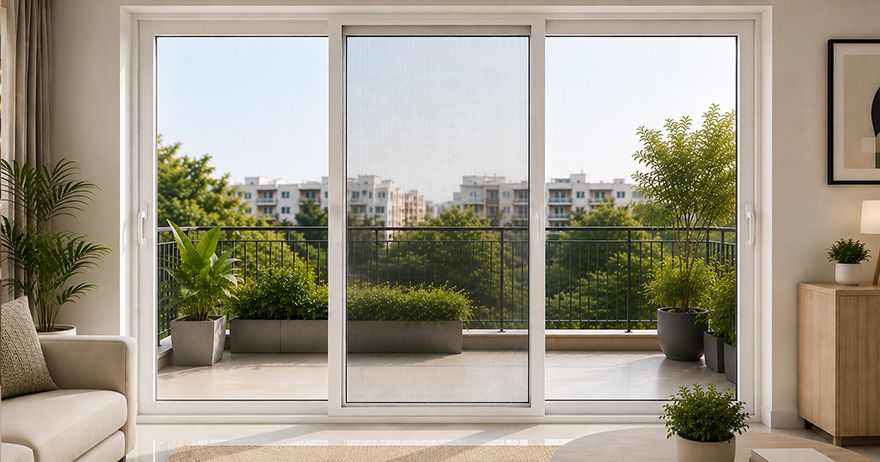
3 Track Sliding Windows are a part of the Horizontal Sliding Window Series that has the provision of 3 tracks to glide through. This type of sliding window works well when you have a wider window provision and need more flexibility in controlling ventilation.
How a 3 Track Sliding Window with Mosquito Mesh Works
A typical, base-standard 3-track sliding window can have 3 glass panes or 2 glass panes with 1 mosquito mesh pane. When you glide one glass pane toward the dormant glass pane, you glide the mosquito mesh pane toward the open section to let air in while insects and bugs are blocked from entering.
Today, IndiFrame offers sliding windows with panes that can glide independently to either side or both sides at once, depending on how many panes are involved in a 3-track sliding system.
Some examples below:
| Configuration | How it opens | Type of opening | Approx. opening |
|---|---|---|---|
| 2 Glass Panes + 1 Mosquito Mesh | The two glass panes slide horizontally with one moving behind the other | Side opening — the opening is created on one side of the window | ~50% |
| 3 Glass Panes + Pleated Mesh | The three glass panes slide horizontally and overlap. The pleated mesh folds sideways when opened | Side opening — glass panels stack towards one side. Mesh covers the window horizontally | ~66% |
| 3 Glass Panes + Pulldown Mesh | The three glass panes slide horizontally while the mesh moves vertically | Side opening for the glass; the mesh covers the entire window vertically | ~66% |
| 4 Glass Panes + 2 Mosquito Meshes | Four glass panes run across two tracks and overlap. Two mesh panes share the third track and slide sideways | Central and Side opening — panels create side or central openings with mesh positioned over them | ~50% |
Benefits of 3 Track Sliding Windows for Balconies
Greater Ventilation
With three tracks, you can configure the window to achieve 50% to 66% opening, depending on the number and arrangement of panes. This gives you a larger opening for ventilation compared to a standard 2-track system.
Allocation for Another Glass Pane or Mosquito Mesh Pane
The additional track gives you room for one more glass or mosquito mesh pane within the same overall window width. This lets you combine ventilation with insect protection without compromising the window configuration.
Wider View
With more panes sliding along the tracks, you can move the panes away from your preferred viewing area, creating a wider, less interrupted view of the outdoors.
Flexibility in Pane Positioning
You can slide and position the panes based on where you want the opening. You can open one section for everyday ventilation or move multiple panes aside when you need a larger opening.
Ideal for Window Sizes Starting at 3 ft × 3 ft
A 3-track system works well for moderate to larger window openings starting from 3 ft × 3 ft, where the additional track allows better use of the available width and provides more flexibility in pane and mesh configurations.
3 Track vs 2 Track Sliding Windows
| Feature | 2-Track Sliding Window | 3-Track Sliding Window |
|---|---|---|
| Number of tracks | 2 | 3 |
| Panels | Usually 2 or 4 panels | Usually 3 or more panels |
| Mesh Provision | No unless opted for pleated or pull-down mesh | Yes the third track can be used for a mesh pane unless occupied for another glass |
| Opening and ventilation | 50% when 2 panels are used and each is half the total window size | 50% with 3 panels (2 glass and 1 mesh) or 66% with 3 glass panels |
| Use Case | Suitable for standard openings | Suited for standard as well as wider balcony openings |
| Flexibility | 2 panels slide within 2 tracks giving limited flexibility. 4 panels slide within 2 tracks | Panels slide across 3 tracks giving more flexibility in how much you open |
| Cost | INR 600 to INR 800 per sq ft | INR 900 to INR 1200 per sq ft |
Also Read: 2 Track vs 2.5 Track vs 3 Track Sliding Windows: Which Is Best for Your Home?
Why Built-In Mosquito Mesh Is a Game Changer
Built-in mosquito mesh is fantastic when you can independently glide it on its track on either side of the sliding window. Plus, it’s no longer ‘either left or right’; you can place a mosquito mesh in the centre, provided your 3-track sliding window has 4 glass panes that can open from the centre. It isn’t that mosquito meshes never existed before; they did in the form of Velcro nets, but unlatching the Velcro tapes made it lose its grip over time. Therefore, a built-in mesh gliding on a track becomes more sturdy and durable to use
Things to Consider Before Choosing a 3 Track Sliding Window
Check the Window Cavity Provision
A 3-track window needs sufficient wall depth and cavity space to accommodate the additional track. Plan for it before the opening is finalised.
Make Sure It Has Wool Pile
Check that the sliding panels have wool-pile weatherstripping to reduce gaps around the panels and limit dust and air entry.
Consider Ease of Cleaning
Choose a system that lets you clean the tracks and frames easily. uPVC frames are low-maintenance and easily cleaned with a simple wipe.
Choose a Sturdy Material
For a large balcony opening, choose a material that can handle regular use and larger glass panels. uPVC offers a sturdy, low-maintenance frame for sliding windows.
Common Mistakes to Avoid When Buying Sliding Windows
Deciding on a 3-Track Window After the Cavity Is Done
A 3-track system requires additional track space and adequate wall depth. Finalising the window cavity first can limit your options or require changes later.
Forgetting Ventilation Requirements
A sliding window doesn't provide a full-width opening. Depending on the configuration, you may get around 50–66% opening. Choose the number of tracks and panes based on how much ventilation the room actually needs.
Neglecting Glass Choice
Don't choose glass based on appearance alone. Choose between clear, toughened or laminated glass based on the opening, safety requirements, noise levels, privacy needs and the level of impact protection required.
Are 3 Track Sliding Windows Worth the Investment?
A 3 Track uPVC Sliding Window costs more than a 2-track and 2.5-track - INR 900 to INR 1200 per sq ft for a 3 Track uPVC Sliding Window with Integrated Mesh Pane vs INR 600 to INR 800 per sq ft for a 2 Track uPVC Sliding Window with External Mesh (Pull-down or Pleated). However, your decision should not depend solely on cost; balance your ventilation needs with protection from mosquitoes, bugs, and other outside insects (and elements such as leaves, too). Plus, how flexibly you can glide through the windows and how you want them to work matters equally. So, it is worth the investment when you ponder all the factors and make an informed decision to enhance your daily comfort.
Also Read: What Are Sliding Windows? Benefits, Types & When to Choose Them
Final Thoughts
A simple piece of thought: be thorough about the mechanism, benefits, mistakes to avoid, and considerations to keep in mind before choosing and installing a 3-track uPVC sliding window. We recommend checking our Resources tab to learn more about sliding windows and contacting our experts at IndiFrame for thorough guidance.