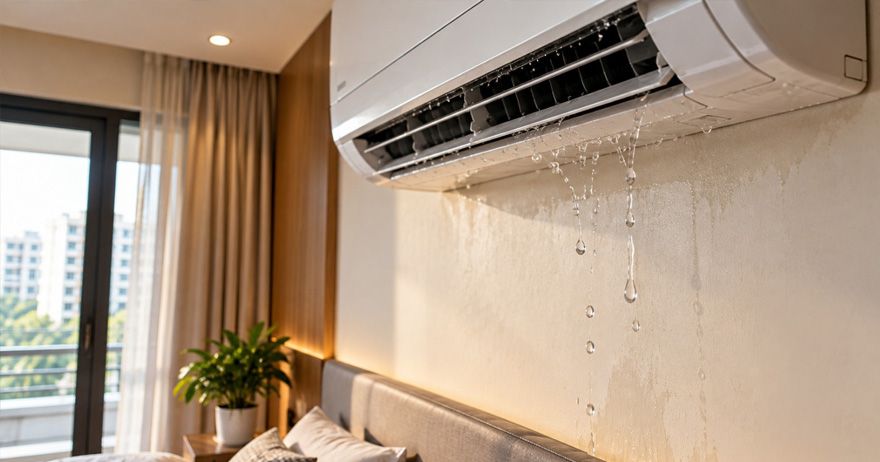
An air conditioner is supposed to produce water. Cooling pulls moisture from the air, and that condensate collects in a tray and leaves through a drain pipe. When water appears inside the room the cooling is usually fine — the drainage has failed. Most often it is a blocked drain pipe or a dirty filter, and you can check both yourself.
Before touching anything, switch the unit off at the MCB, not just the remote. You are dealing with water around a live electrical appliance.
Why Is My AC Leaking Water Inside the Room?
Warm room air passes over a cold evaporator coil, moisture condenses on it, drips into the drain pan below and flows out through a pipe to the outside.
Water enters the room when that path fails — either it cannot leave (blocked pipe, wrong slope, cracked pan), or far more is produced than usual by a coil that froze and is now melting. Act quickly: a slow drip damages plaster, paint and furniture, and in a flat it reaches the ceiling below.
Common Causes of Water Leakage From an Indoor AC Unit
| Cause | How it shows |
|---|---|
| Blocked drain pipe | Steady drip; no water coming out of the pipe outside |
| Dirty air filter | Weak airflow and poor cooling; then dripping |
| Frozen evaporator coil | Ice on the coil; heavy dripping after switching off |
| Wrong installation slope | Leaking from day one; or since a refit |
| Cracked drain pan | Older unit; leak worsening gradually |
| Loose drain hose | Water appearing suddenly after servicing |
| Low refrigerant | Poor cooling with ice on the pipe |
Blocked or Clogged AC Drain Pipe
This is the most common cause by a wide margin. The drain pipe collects dust, algae and slime over time, with insects nesting in the open end. Once blocked, water backs up in the pan and spills into the room. The signs are steady dripping, no water coming out of the pipe outside, and cooling that is otherwise normal.
You can often clear it yourself — find the outdoor end and flush it with water from a bottle, or blow through it. If that fails, a technician will use a pump from the indoor end. Check the pipe too: a kink, a sag holding water, or an end sitting in a puddle stops flow even when it is clean.
Dirty Air Filters and Reduced Airflow
A dirty filter starves the coil of airflow. The coil gets colder than designed, frost forms, and when you switch off that frost melts at once — far more water than the pan can hold.
Filters need cleaning every two to four weeks in most Indian homes, more often near a main road or construction. Switch off at the MCB, slide the filters out, wash under running water, dry fully in shade, refit. Never put a damp filter back — it grows mould and pushes the smell into the room.
Frozen Evaporator Coil and Refrigerant Issues
A frozen coil has two usual causes: restricted airflow from dirty filters, a blocked coil or a failing blower, or low refrigerant, which means a leak in a sealed system.
If you see ice, switch the AC off and leave the fan running if your unit allows it. Let it thaw fully — two to four hours — and put towels down. Never chip or scrape the ice, since coil fins damage easily. Clean the filter before restarting, and if it freezes again, call a technician.
Refrigerant is not a DIY job. It is a sealed system needing licensed handling, and a top-up without finding the leak is money wasted — it will be low again within months. Anyone offering a refill without a leak test is selling a temporary fix.
Incorrect AC Installation or Drainage Slope
Drainage works on gravity alone, so the angles decide everything. The indoor unit should tilt very slightly towards the drain side — not level, and never away. The drain pipe needs a continuous downward slope, with no rise, loop or sag.
If your AC has leaked since installation or a refit, this is almost certainly why. It is a fitting correction, not a repair.
Check the wall sleeve slopes outward too. One sloping inward carries rainwater into the room, which looks exactly like an AC leak but is not.
Damaged Drain Pan and Other Component Problems
On older units the drain pan rusts or cracks, so water escapes underneath instead of reaching the pipe. The leak starts small and worsens over months, and a cracked pan needs replacing since sealants rarely last. Other causes include a dirty coil, a loose drain hose or a blower at the wrong speed.
What Can You Check Before Calling a Technician?
With the power off at the MCB, check five things: whether the filter is dirty, whether water comes out of the drain pipe outside, whether that pipe end is kinked or sitting in water, whether there is ice on the coil, and whether the unit is tilted the wrong way.
Two clues narrow it further. A leak starting right after a service visit usually means a loose drain hose. Poor cooling alongside the leak points to airflow or refrigerant, not drainage alone.
How to Fix AC Water Leakage Safely
- Switch off at the MCB and unplug if there is a socket.
- Place a bucket and towels under the unit.
- Clean the filters and dry them fully.
- Flush the drain pipe from the outdoor end and straighten any kink.
- Let any ice thaw completely before restarting.
- Restart and watch for an hour. If it leaks again, call a technician.
- Never open the electrical section, run the AC with the panel off, or pour water near the wiring.
How to Prevent Your AC From Leaking Water
- Clean filters every two to four weeks through the cooling season.
- Service the unit twice a year, before summer and after the monsoon.
- Flush the drain pipe at the start of every season.
- Fit a mesh on the outdoor pipe end and keep that end out of puddles.
- Avoid setting the thermostat below 24°C for long periods, which encourages frosting.
- Insist on correct slope at installation and check drainage before the fitter leaves.
- Keep windows and doors sealed while the AC runs. Humid air leaking in means more condensate for the unit to handle, which worsens every drainage problem. Old aluminium and wooden frames warp and stop sealing — IndiFrame's uPVC windows seal on a gasket, keeping humid air out and cooled air in.
When Does AC Water Leakage Require Professional Repair?
Call a technician if the leak continues after cleaning the filter and flushing the drain, if the coil freezes again, if cooling is poor as well as leaking, if the drain pan is cracked, if water reaches the electrical section or the MCB trips, or if the unit has leaked since installation. Call them too if the AC is under warranty, since opening it yourself may void it.
Do not run the unit while it leaks onto a wall or socket. The water damage costs more than the service call.
Final Thoughts
Water inside the room almost always means blocked drainage, not a broken air conditioner. Check the filter and drain pipe first and most leaks resolve there.
The rest is maintenance: filters every few weeks, drain flushed each season, service twice a year. That prevents nearly every leak, and costs far less than repairing a damp wall.