


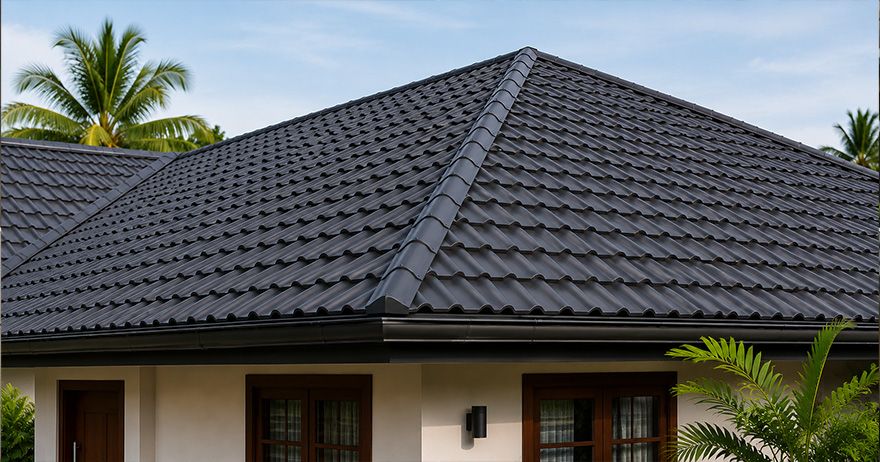
Some roofing sheets provide better heat insulation, while others are preferred for strength, affordability, and low maintenance. The ideal choice depends on your climate, budget, and roof design. In this blog, let’s look into the 5 best roofing sheets for homes.
Here are the top 5 roofing sheet types India.
Metal Roofing Sheets
Metal roofing sheets for homes are durable, weather-resistant, and available in different material options depending on your climate and budget. They are most commonly used roofing for houses, factories, warehouses, and commercial buildings.
Iron Roofing Sheets (GI Sheets)
Galvanised Iron (GI) sheets are steel sheets coated with a protective zinc layer. The zinc prevents rust from forming on the steel underneath. Iron roofing sheets are affordable and easily available, but the zinc layer wears down in 15 to 20 years, and even sooner in coastal or humid areas where salt accelerates corrosion.
Galvalume Roofing Sheets
Galvalume roofing sheets are steel coated with 55% aluminium, 43.5% zinc, and 1.5% silicon. The aluminium forms a protective oxide layer that holds even after minor scratches, which a zinc-only coating cannot do. Galvalume lasts easily for 40 to 60 years under normal conditions, and is one of the best weather resistant roofing sheets.
The only drawback is that it cannot be used near livestock areas, because ammonia from animal waste reacts with the aluminium and speeds up corrosion.
Aluminium Roofing Sheets
Aluminium roofing sheets are rust-resistant and lightweight, and are most suitable for coastal areas. They may cost more upfront than GI or Galvalume, but they need very little maintenance over their lifetime. They are one of the best roofing sheets for homes.
Color-Coated Roofing Sheets
Color-coated roofing sheets use galvanised or galvalume steel base with an additional paint or polymer coating on top. These sheets are popular in residential construction because they provide a cleaner and more finished appearance. PVDF (polyvinylidene fluoride) coatings last much longer and resist better than cheaper polyester finishes. They are one of the best heat proof roofing sheets.
Plastic & Polycarbonate Roofing Sheets
Plastic roofing sheets are lightweight, affordable, and easy to install. They also allow natural light to pass through. They work well for covered outdoor areas but are usually not ideal as the primary roof over living spaces in hot climates.
Polycarbonate Roofing Sheets
Polycarbonate roofing sheets are translucent and highly impact-resistant. They are around 250 times stronger than glass of the same thickness. They are a popular choice for skylights, carports, balcony roofing and covered walkways. They last from 10 to 25 years, depending on quality.
The most important thing to check when buying polycarbonate sheets is UV protection. Without proper UV protection, the sheets can turn yellow, brittle, and weak after continuous exposure to the sun. Always confirm that the UV layer is co-extruded into the sheet, not just sprayed or coated on the surface.
PVC & uPVC Roofing Sheets
PVC and uPVC roofing sheets are lightweight, affordable, and easy to install. uPVC is more rigid than standard PVC and holds up slightly better over time. These sheets are best suited for garden sheds, temporary structures, utility areas and small outdoor roofs. Keep in mind that these sheets are not ideal for extreme summer temperatures, as they can warp under high heat.
Fibre-Reinforced Fabric Roofing Sheets
Fibre-reinforced fabric roofing sheets are made by embedding glass fibres into a plastic resin, which gives them more rigidity and scratch resistance than plain polycarbonate sheets. They are translucent and are commonly used in factories, greenhouses, industrial roofing inserts, and in areas that require natural light.
Know that low-quality FRP sheets can become brittle with age.
Fibre Cement Roofing Sheets
Fibre cement roofing sheets are made from cement, sand, and cellulose fibres that are compressed into corrugated profiles. These sheets are fire-resistant, rust-free, and can withstand heavy monsoon rain. They are one of the best roofing sheets for homes.
They are one of the durable roofing sheets for houses and have a lifespan of 30 to 50 years. The only drawback is that the roof structure needs to be strong enough to carry fibre cement sheets, and installation takes more time and labour. They also need periodic resealing every few years to prevent water from being absorbed into the surface.
Bitumen Roofing Sheets
Bitumen roofing sheets are made from modified bitumen reinforced with fibreglass or polyester. They are waterproof, flexible, easy to cut, and suitable for low-slope roofing. A properly installed bitumen roof can last around 20 years. They are commonly used in garages, sheds, and outbuildings.
Insulated Sandwich Panels
Insulated sandwich panels consist of two outer metal sheets and a rigid foam insulation core in between. The insulation core is usually made from PU (polyurethane), PIR (polyisocyanurate), and EPS (expanded polystyrene).
These are one of the best roof sheets for heat reduction. Panel thickness runs from 40mm to 150 mm, and thicker panels insulate better. Insulated sandwich panels can be very expensive upfront.
Factors To Consider Before Buying Roofing Sheets
Here are some factors to consider before choosing the best roofing sheets for homes.
Climate and location
Homes near the coast need materials that resist salt and humidity, like aluminium or high-quality Galvalume. In areas with intense heat, light colored color-coated sheets or sandwich panels help keep indoor temperatures down.
Roof slope
Metal and fibre cement sheets need a minimum pitch so rainwater runs off properly. For very low-slope or flat roofs, bitumen sheets or waterproof membrane systems work the best.
Load capacity
Fibre cement and sandwich panels are heavier than metal or plastic sheets. So, before choosing them, make sure your existing roof structure can carry the weight.
Lifespan vs budget
Plastic and polycarbonate sheets cost less upfront but may require replacement far sooner. Metal and fibre cement sheets cost more initially but can last longer with minimal maintenance expenses over time.
Requirements
For the main living areas of a home, metal sheets, fibre cement, or sandwich panels make the best choice. For garages, sheds, and carports, polycarbonate or bitumen sheets are practical and cost-effective.
Roofing Sheet Cost & Maintenance Tips
Before choosing the best roofing sheets for homes, look into the cost and maintenance angle.
Roofing Sheet Price India
Prices vary depending on brand, thickness, and region.
| Sheet Type | Approximate Price |
|---|---|
| GI sheets | INR 35 to INR 60 per sq ft |
| Galvalume/Color-coated | INR 50 to INR 90 per sq ft |
| Aluminium | INR 100 to INR 180 per sq ft |
| Polycarbonate/uPVC | INR 30 to INR 60 per sq ft |
| Fibre cement | INR 35 to INR 80 per sq ft |
| Bitumen | INR 20 to INR 65 per sq ft |
| Sandwich panels (PUF) | INR 95 to INR 250 per sq ft |
Roofing Sheet Maintenance Tips
Metal sheets: Inspect annually for coating scratches. Touch up exposed steel with zinc-rich primer and clear moss or debris that holds moisture on the surface.
Polycarbonate and PVC sheets: Clean with a mild, pH-neutral cleaner only. Check every season for yellowing or surface cracks.
Fibre cement sheets: Reseal every three to five years to prevent water absorption. Tighten the fasteners after heavy winds.
Bitumen sheets: Inspect edges and overlaps regularly. Even a small tear lets water through.
Sandwich panels: Keep all joint seals intact. If moisture enters the foam core, the panel needs replacement.
Which Roofing Sheet Is Best For Your Home?
The best roofing sheets for homes depends on your budget, climate, and the type of structure you are building.
- For long lifespan and low maintenance, choose Galvalume or aluminium sheets.
- For the best heat insulation, choose sandwich panels or color-coated profiles.
- For best performance in homes, choose color-coated Galvalume or fibre cement sheets.
- For garages and sheds, choose polycarbonate or bitumen roofing.