



Why Choosing the Right Window Design Matters
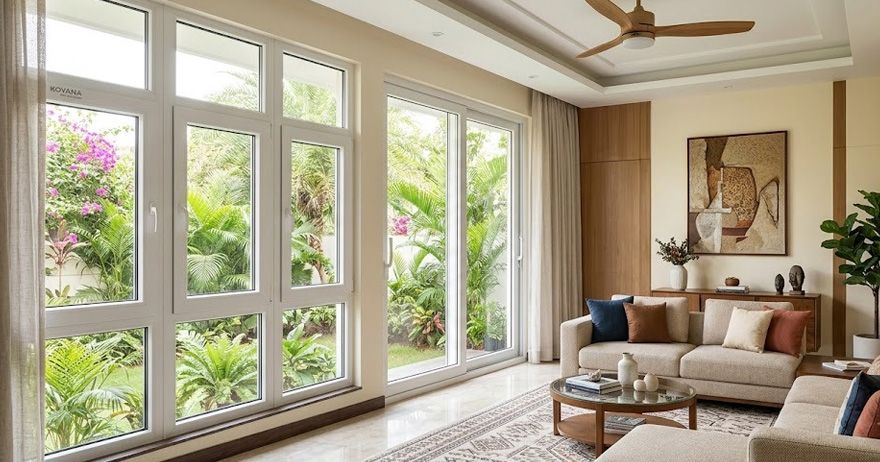
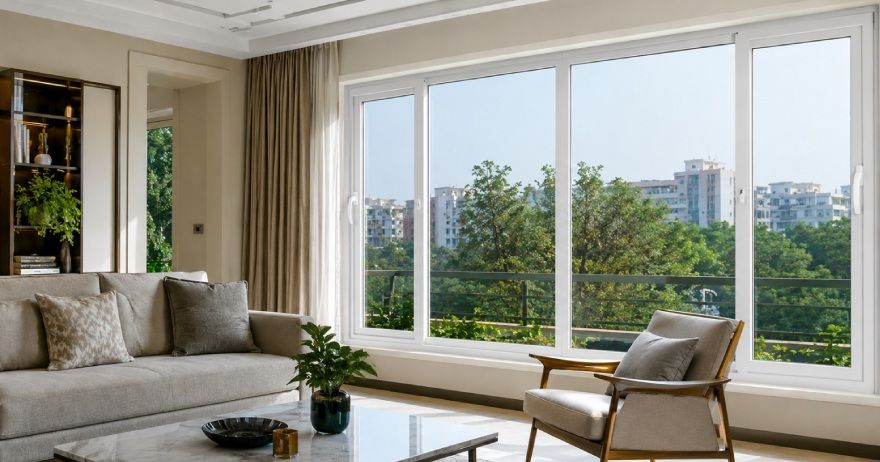
The perfect window design depends on the room’s purpose, ventilation needs, natural light requirements, and available space. Living rooms benefit from large windows that maximise daylight and outdoor views, while bedrooms require windows that balance ventilation, privacy, and noise control. Kitchens need easy-to-operate windows for airflow, and bathrooms require designs that provide ventilation while maintaining privacy. Choosing the right uPVC window style for each room can improve comfort, energy efficiency, and the overall appearance of your home.
Best Window Design for Living Rooms
Most Commonly Preferred
| Configuration | Why it is commonly preferred |
|---|---|
| Sliding | Large openings uninterrupted views and space-efficient operation |
| Fixed | Ideal for feature glazing where ventilation is not required |
| Combination | Balances expansive glass with operable sections |
| Casement | Suitable where homeowners want wider openings and superior sealing |
Alternative Window Configurations
| Configuration | Best suited for |
|---|---|
| Bay and Bow | Villas and premium homes looking to create a focal point or seating nook |
| Glass-to-Glass Corner | Contemporary homes with corner views |
| Arch | Homes with classical or Mediterranean-inspired architecture |
Best Window Design for Bedrooms
Most Commonly Preferred
| Configuration | Why it is commonly preferred |
|---|---|
| Casement | Excellent sealing secure locking and versatile sizing |
| Sliding | Ideal for compact bedrooms where furniture is placed close to windows |
| Tilt and Turn | Flexible operation and easy maintenance |
Alternative Window Configurations
| Configuration | Best suited for |
|---|---|
| Combination | Large master bedrooms with expansive glazing |
| Bay and Bow | Reading corners premium bedrooms and villas |
| Double Hung | Traditional and colonial-style homes |
Best Window Design for Kitchens
Most Commonly Preferred
| Configuration | Why it is commonly preferred |
|---|---|
| Sliding | Does not interfere with countertops |
| Casement | Easy operation where side clearance is available |
| Tilt and Turn | Controlled opening with convenient cleaning |
Alternative Window Configurations
| Configuration | Best suited for |
|---|---|
| Combination | Larger kitchens requiring both glazing and ventilation. |
Best Window Design for Bathrooms
Most Commonly Preferred
| Configuration | Why it is commonly preferred |
|---|---|
| Tilt and Turn | Provides privacy with controlled ventilation |
| Casement | Effective for larger bathrooms |
| Sliding | Practical for compact layouts |
Alternative Window Configurations
| Configuration | Best suited for |
|---|---|
| Vertical Slider | Narrow or tall bathroom openings |
| Glass to Glass | Villa or luxury residence with a landscaped view provided privacy is achieved |
Best Window Design for Dining Areas
Most Commonly Preferred
| Configuration | Why it is commonly preferred |
|---|---|
| Sliding | Creates a seamless connection with outdoor spaces |
| Fixed | Maximises views where ventilation is provided elsewhere |
| Combination | Offers design flexibility |
Alternative Window Configurations
| Configuration | Best suited for |
|---|---|
| Bay and Bow | Premium dining spaces overlooking gardens |
| Glass-to-Glass Corner | Modern homes with panoramic views |
Window Designs That Maximise Natural Light
| Rank | Window Configuration | Natural Light Potential | Why |
|---|---|---|---|
| 1 | Glass-to-Glass Corner | ⭐⭐⭐⭐⭐ | Eliminates the corner mullion allowing daylight from two directions and creating the largest uninterrupted glazed area |
| 2 | Fixed Window | ⭐⭐⭐⭐⭐ | No hardware or operable sash allows the maximum glass area within an opening |
| 3 | Lift and Slide | ⭐⭐⭐⭐⭐ | Supports very large glass panels with slim sightlines making it ideal for expansive openings |
| 4 | Bay and Bow Window | ⭐⭐⭐⭐⭐ | Projects outward and captures daylight from multiple angles increasing both light and the sense of space |
| 5 | Combination Window | ⭐⭐⭐⭐☆ | Combines fixed and operable sections allowing large glazed areas while retaining functionality |
| 6 | Slide and Fold | ⭐⭐⭐⭐☆ | Typically features multiple glazed panels across a wide opening bringing in substantial daylight |
| 7 | Sliding Window | ⭐⭐⭐⭐☆ | Offers large glazed panels with relatively slim profiles making it a popular choice for naturally bright interiors |
| 8 | Casement Window | ⭐⭐⭐⭐☆ | Provides generous glazing though frames and sash dimensions may slightly reduce the glass area compared to fixed systems |
| 9 | Tilt and Turn Window | ⭐⭐⭐⭐☆ | Similar to casement in glazing with additional hardware that can marginally increase the frame width |
| 10 | Arch Window | ⭐⭐⭐☆☆ | Can bring in ample daylight but the curved geometry generally results in a smaller effective glazed area than a full rectangular opening of the same width |
| 11 | Villa Window (integrated with security grills and bug meshes) | ⭐⭐⭐☆☆ | Light performance depends on the specific design and decorative elements often reduce the overall glass area |
| 12 | Double Hung Window | ⭐⭐⭐☆☆ | The meeting rail divides the opening into two sashes reducing the amount of uninterrupted glazing |
| 13 | Single Hung Window | ⭐⭐⭐☆☆ | Similar to double hung but with one fixed sash and still limited by the central meeting rail |
| 14 | Vertical Slider | ⭐⭐⭐☆☆ | Like hung windows the meeting rail and stacked sashes reduce the effective glazed area |
Note: The amount of natural light a window brings into your home depends on more than just its configuration. Factors such as the window's size, orientation, glass specifications, frame design, and surrounding obstructions all play an equally important role. While the rankings below compare the daylight potential of different window configurations, the ideal solution for your home should be based on your room layout and design goals.
Choosing Windows for Better Ventilation
| Rank | Window Configuration | Ventilation Potential | Why |
|---|---|---|---|
| 1 | Casement Window | ⭐⭐⭐⭐⭐ | Opens almost fully allowing maximum airflow and effectively capturing prevailing breezes |
| 2 | Tilt and Turn Window | ⭐⭐⭐⭐⭐ | Offers two ventilation modes with tilt for controlled everyday airflow and turn for maximum ventilation |
| 3 | Slide and Fold | ⭐⭐⭐⭐⭐ | When fully opened it creates a large unobstructed opening making it ideal for cross-ventilation |
| 4 | Lift and Slide | ⭐⭐⭐⭐☆ | Provides wide openings with large operable panels allowing substantial airflow in expansive spaces |
| 5 | Sliding Window | ⭐⭐⭐⭐☆ | A practical choice for most homes though only one side can typically be open at a time around 50% of the opening |
| 6 | Combination Window | ⭐⭐⭐⭐☆ | Ventilation depends on the operable sections offering flexibility in design and airflow |
| 7 | Double Hung Window | ⭐⭐⭐⭐☆ | Allows ventilation through both the top and bottom sashes encouraging natural air circulation |
| 8 | Single Hung Window | ⭐⭐⭐☆☆ | Offers ventilation only through the lower sash providing moderate airflow |
| 9 | Vertical Slider | ⭐⭐⭐☆☆ | Similar to hung windows with ventilation limited by the operable sash |
| 10 | Bay and Bow Window | ⭐⭐⭐☆☆ | Ventilation depends on whether the side panels are operable and many designs incorporate casement windows for airflow |
| 11 | Arch Window | ⭐⭐☆☆☆ | Typically fixed and used as a design feature though custom operable versions are available |
| 12 | Villa Window | ⭐⭐☆☆☆ | Ventilation varies depending on the specific configuration and design |
| 13 | Glass-to-Glass Corner | ⭐⭐☆☆☆ | Usually designed as fixed glazing to maximise views although operable corner systems are available in select applications |
| 14 | Fixed Window | ⭐☆☆☆☆ | Does not open and therefore provides no direct ventilation |
Note: This ranking compares the ventilation potential of different window configurations, assuming similar opening sizes. In reality, airflow is also influenced by factors such as window placement, room layout, prevailing wind direction, ceiling height, and the availability of openings on opposite sides of a room for cross-ventilation.
Modern uPVC Window Designs for Indian Homes
No two Indian homes are exactly alike. A high-rise apartment in Mumbai, a villa in Bengaluru, and an independent house in Delhi each have different requirements for windows. The amount of available space, the local climate, and even the way you use each room can influence which window design is the right fit.
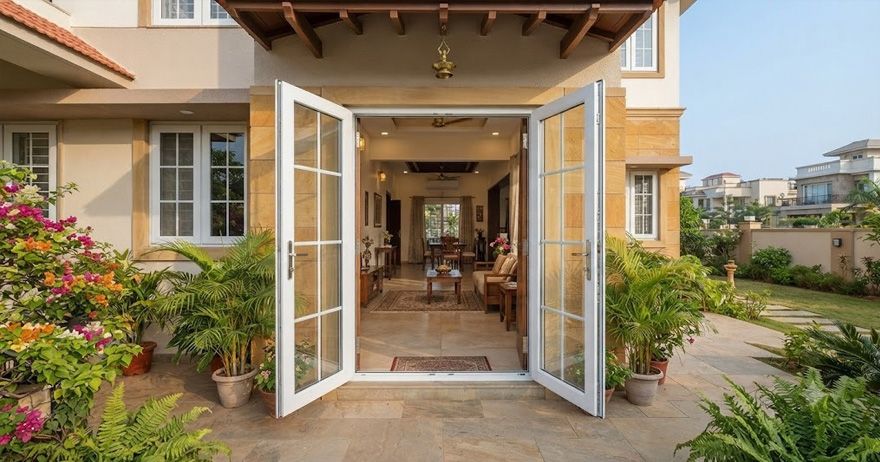
That's why choosing between a casement, French, or sliding design isn't just a matter of appearance. Each serves a different purpose and offers its own advantages.
Common Mistakes to Avoid When Selecting Windows
We get it. A sleek frame, expansive glass, and a modern façade can make any window look like the perfect choice. But if looks are all that matter, you're already asking the wrong question.
Windows are those design elements that influence how your home feels, functions, and performs every single day. That's why choosing the same window configuration for every room rarely works. Your living room doesn't have the same needs as your kitchen, and your bathroom certainly doesn't function like your bedroom.
Then comes the common assumption that bigger windows automatically mean better homes. In reality, without the right orientation, glazing, and shading, they can invite more heat and glare than comfort. And while many homeowners spend hours comparing uPVC profiles, they often overlook the role of glass, which has an equal impact on safety, energy efficiency, acoustics, and comfort.
The same goes for ventilation: how effectively your windows open and allow air to circulate. Yet another detail that slips under the radar is hardware. Good locks, hinges, rollers, and handles aren't upgrades; they're what determine how your windows perform year after year. Security, too, is often treated as an afterthought until it becomes a necessity. At the same time, maintenance only enters the conversation once cleaning those hard-to-reach windows starts feeling like a chore.
Add to that the temptation to follow trends or choose the lowest quote, and it's easy to end up with windows that look right but don't live right. The right solution depends on your home's layout, your family's needs, and the way you use each room. And remember, even the best window can fail to perform if it's not measured, manufactured, and installed correctly.
How to Choose the Right Window Style for Your Home
By now, you've probably realised that when it comes to choosing the right window style, there's no one-size-fits-all answer. What works beautifully in one home may not be the best choice for another. The key is finding the right balance between design, functionality, and long-term performance. And if you're still weighing your options, you don't have to do it alone. Reach out to the team at IndiFrame, and we'll help you choose window solutions tailored to your home, lifestyle, and vision—so you can invest with confidence.