



| Cost Category | POP | Gypsum |
|---|---|---|
| Rate per sq ft (with material + labour) | ₹60 – ₹120 | ₹75 – ₹180 |
| Labour only (per sq ft) | ₹20 – ₹45 | ₹25 – ₹50 |
| 10x10 room (100 sq ft) | ₹6000 – ₹12000 (cove: up to ₹14000) | ₹7500 – ₹18000 |
| Full 2BHK (~600 sq ft ceiling) | ₹36000 – ₹72000 | ₹45000 – ₹108000 |
False Ceiling Cost for a 10x10 Room in India
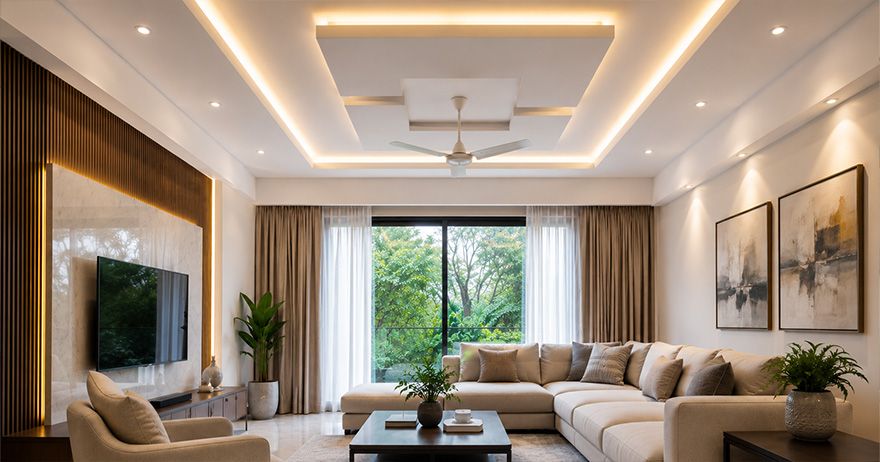
For a standard 10x10 ft room (100 sq ft), a basic flat POP ceiling costs ₹6,000–₹12,000. Adding a cove or border takes it to ₹9,000–₹14,000. A basic gypsum ceiling costs ₹7,500–₹13,000, and premium Saint-Gobain Gyproc or USG Boral boards take it to ₹12,000–₹18,000.
| Ceiling type | Material cost | Labour cost | Total (10x10 room) |
|---|---|---|---|
| Basic flat POP | ₹3500 – ₹6000 | ₹2000 – ₹3000 | ₹6000 – ₹12000 |
| Decorative POP (cove + border) | ₹5000 – ₹8000 | ₹3000 – ₹4500 | ₹9000 – ₹14000 |
| Basic gypsum board | ₹4500 – ₹7000 | ₹2500 – ₹4000 | ₹7500 – ₹13000 |
| Premium gypsum (Saint-Gobain or USG) | ₹7000 – ₹10000 | ₹4000 – ₹5000 | ₹12000 – ₹18000 |
Prices cover material and labour only. Add 18% GST, ₹1,500–₹4,000 for 2–4 recessed light points, and paint. A 10x10 room with a cove POP ceiling and four lights typically lands at ₹12,000–₹20,000 all-in.
Worked Example: 10x10 Bedroom, POP with Cove and 4 Lights
| Item | Calculation | Cost |
|---|---|---|
| POP ceiling with cove | 100 sq ft × ₹90 | ₹9000 |
| Light points | 4 × ₹800 | ₹3200 |
| Emulsion paint | 100 sq ft × ₹12 | ₹1200 |
| Subtotal | ₹13400 | |
| GST at 18% | ₹2412 | |
| Total | ≈ ₹15800 |
False Ceiling Cost by Room Size (1 Room, 2BHK, 3BHK)
| Room Size | POP False Ceiling Cost | Gypsum False Ceiling Cost |
|---|---|---|
| 10x10 ft (100 sq ft) | ₹6000 - ₹12000 | ₹7500 - ₹18000 |
| 10x12 ft (120 sq ft) | ₹7200 - ₹14400 | ₹9000 - ₹21600 |
| 12x12 ft (144 sq ft) | ₹8640 - ₹17280 | ₹10800 - ₹25920 |
| 12x15 ft (180 sq ft) bedroom | ₹10800 - ₹21600 | ₹13500 - ₹32400 |
| 15x20 ft (300 sq ft) living room | ₹18000 - ₹36000 | ₹22500 - ₹54000 |
| Full 2BHK (approx. 600 sq ft ceiling) | ₹36000 - ₹72000 | ₹45000 - ₹108000 |
| Full 3BHK (approx. 900 sq ft ceiling) | ₹54000 - ₹108000 | ₹67500 - ₹162000 |
These are indicative estimates for standard designs in Tier-2 cities in 2026. Metro rates run 15–20% higher. POP figures use ₹60–₹120 per sq ft; cove or curved POP designs can add ₹10–₹20 per sq ft on top. Premium-board gypsum designs fall at the top of the gypsum range.
POP Rate Per Sq Ft in India (With Material vs Labour Only)
POP false ceiling rate is ₹60–₹120 per sq ft with material and ₹20–₹45 per sq ft for labour only. The "with material" rate includes POP powder, GI framework, labour and a basic finishing coat. If you buy the POP, channels and mesh yourself, you pay only the labour rate.
| POP rate type | ₹ per sq ft |
|---|---|
| With material; flat design | ₹60 – ₹90 |
| With material; cove or border design | ₹90 – ₹120 |
| Labour only; flat | ₹20 – ₹30 |
| Labour only; design work | ₹30 – ₹45 |
| Material only | ₹35 – ₹60 |
POP Ceiling Design Rate Per Sq Ft
The more layers, curves and coves a design has, the higher the rate per sq ft.
| Design type | Rate per sq ft (with material) | Best for |
|---|---|---|
| Plain flat ceiling | ₹60 – ₹80 | Bedrooms; kitchens |
| Peripheral or border design | ₹75 – ₹95 | Small bedrooms |
| Single-layer cove with LED strip | ₹85 – ₹105 | Bedrooms; halls |
| Double-layer or multi-level | ₹100 – ₹120 | Living rooms |
| Curved or custom designer POP | ₹120+ (quoted per design) | Living room; pooja room |
Gypsum False Ceiling Rate Per Sq Ft
Gypsum false ceiling costs ₹75–₹180 per sq ft in India, excluding 18% GST. A basic ceiling with local A-grade channels and standard Gyproc board costs ₹75–₹110 per sq ft. Premium boards and channels take it to ₹120–₹180 per sq ft.
Gypsum boards come pre-made in standard 6x4 ft sheets, so installation is faster than POP.
Gypsum False Ceiling Labour Rate
| Work type | Gypsum labour rate (₹/sq ft) |
|---|---|
| Basic flat gypsum board | ₹25 – 35 |
| Gypsum with cove or multi-level | ₹35 – ₹50 |
| Grid ceiling (offices; bathrooms) | ₹15 – ₹25 |
POP vs Gypsum: Which Is Cheaper?
POP is cheaper upfront by about ₹15–₹60 per sq ft, roughly ₹1,500–₹4,000 less for a 10x10 room. Gypsum installs in 1–2 days instead of 4–6, cracks less, and handles humidity better, so it often costs less over 10 years.
| Factor | POP | Gypsum |
|---|---|---|
| Rate per sq ft (with material + labour) | ₹60 – ₹120 | ₹75 – ₹180 |
| Installation time (10x10 room) | 4–6 days (wet work) | 1–2 days (dry work) |
| Design flexibility | High (custom shapes) | Moderate (panel-based) |
| Moisture resistance | Low | Better (moisture-resistant boards available) |
| Finish | Can show hairline cracks | Smooth; uniform |
| Durability | Prone to cracking over time | Less likely to crack |
| Lifespan | 10–15 years | 20–25 years |
Factors That Affect False Ceiling Cost
- Design: Flat single-level ceilings cost least. Coves, recessed sections, levels and curves need more material, time and skilled labour.
- Room size and ceiling height: Bigger rooms need more material and labour. Below 9 ft ceiling height, a false ceiling makes the room feel cramped. Taller ceilings need more support framework.
- City: Labour in Mumbai, Chennai, Bengaluru and Delhi runs 10–20% above Tier-2 cities.
- Material quality: Branded boards (Saint-Gobain Gyproc, USG Boral) with high-grade channels cost more but finish and last better.
- Framing: A GI (galvanised iron) grid instead of a wooden frame adds ₹15–₹25 per sq ft and improves durability.
POP Labour Rate Per Sq Ft by Work Type and City (2026)
POP labour costs ₹20–₹45 per sq ft. POP is applied wet on site, so complex designs take more hours and more skill than gypsum panels.
| Work type | POP labour rate (₹/sq ft) |
|---|---|
| Basic flat POP ceiling | ₹20 – ₹30 |
| POP with cove or border design | ₹30 – ₹40 |
| Decorative or curved POP design | ₹35 – ₹45 |
| POP repair or patching | ₹15 – ₹25 |
| POP false ceiling removal | ₹8 – ₹20 |
| City tier | POP labour rate (₹/sq ft) |
|---|---|
| Tier-1 (Mumbai; Delhi; Bengaluru) | ₹28 – ₹45 |
| Tier-2 (Hyderabad; Pune; Nagpur) | ₹20 – ₹35 |
| Tier-3 and smaller cities | ₹15 – ₹28 |
Hidden Costs Most Homeowners Ignore
- GST: False ceiling work attracts 18% GST, which most quoted per-sq-ft rates exclude.
- Electrical points: Each recessed light or LED strip needs wiring through the framework, at ₹500–₹1,500 per point.
- Paint or texture: Quotes usually cover only putty. Emulsion paint adds ₹8–₹15 per sq ft; texture or banding adds ₹20–₹40.
- Trims and cove moulding: Edge trims and cornice profiles add ₹50–₹200 per running foot.
- Removal of an old ceiling: Charged separately, as below.
| Ceiling type | Removal cost (₹/sq ft) | 10x10 room (approx.) |
|---|---|---|
| Gypsum board | ₹5 – ₹12 | ₹500 – ₹1200 |
| POP false ceiling | ₹8 – ₹20 | ₹800 – ₹2000 |
| Old wooden false ceiling | ₹10 – ₹25 | ₹1000 – ₹2500 |
| Debris disposal (flat) | ₹1000 – ₹3000 | — |
If wiring runs through the old ceiling, an electrician must disconnect and reroute light points during removal, adding ₹500–₹1,500.
Tips to Reduce False Ceiling Cost
- Finalise the design before work starts: Mid-job changes can add 10–15% to the bill.
- Design around 6x4 ft board sizes: Less cutting means less wasted gypsum.
- Get at least three quotes: Prices for the same work vary 20–30%, and comparing shows what each quote includes.
- Club ceiling work with painting or other interiors: Contractors often give a lower combined rate.
- Keep small rooms simple: A flat ceiling with good lighting often looks better in a bedroom and costs far less.
- Buy materials directly: Sourcing boards or POP yourself can cut material markup by 10–15%.
Which False Ceiling Should You Choose?
Choose POP if your budget is tight and you want custom decorative shapes. It costs less per sq ft and can be moulded on site.
Choose gypsum if you want faster installation, fewer cracks and better performance in humid rooms. It costs more upfront but needs little or no repair and keeps a smooth finish for years.