



What Are Fixed Windows?
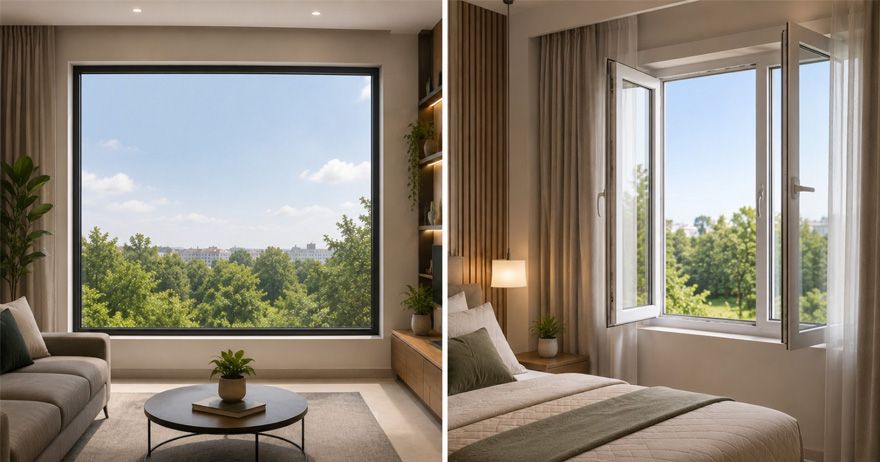
Fixed windows or picture windows are non-operable framed windows. Their purpose is limited to providing light and views, so they do not slide or swing. They are called picture windows because they involve the least hardware beyond the frame and glass; it's like a framed live picture, as opposed to a framed painted still picture.
Also Read: Fixed Windows Explained: Design, Natural Light & When to Choose Them
What Are Operable Windows?
Operable windows are an umbrella category for windows whose pane(s) operate or function like swing, fold, slide, tilt or awn. As a result, windows fall into various subcategories depending on their function.
- Sliding Windows: Open by moving one or more sashes horizontally along a track.
- Slide & Fold: Sashes slide along a track and fold together to create a wider opening.
- Vertical Slider: Sashes slide vertically, allowing the window to open from the top, bottom, or both.
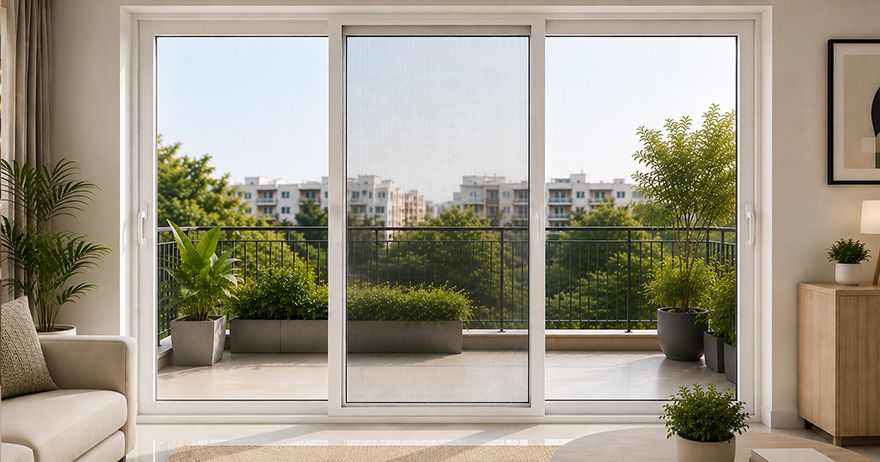
- Horizontal Sliding: Sashes slide sideways over one another to open the window.
- Top Hung Window: Hinged at the top, the sash opens outward from the bottom to allow ventilation while offering some protection from rain.
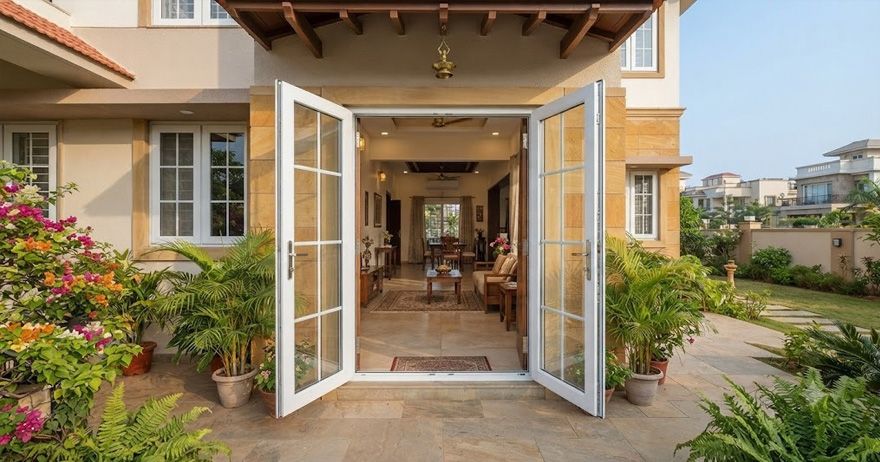
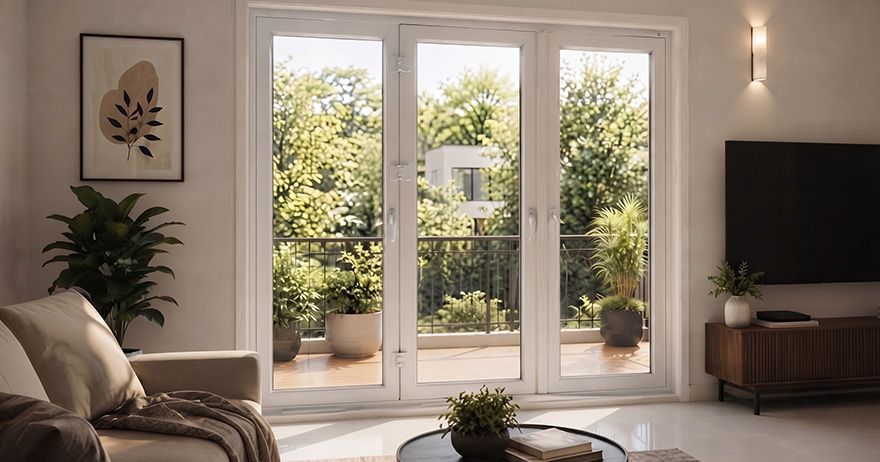
- Casement Window: Hinged at the side, the sash swings outward to open the window fully for ventilation and access.
- Tilt & Turn Window: Tilts inward from the top for controlled ventilation or swings inward from the side for a wider opening.
Fixed vs Operable Windows: Key Differences
| Feature | Fixed Windows | Operable Windows |
|---|---|---|
| No. of types | Fewer types mainly based on shape and design | Multiple types based on opening mechanism |
| No. of hardware involved | Minimal hardware as there is no opening mechanism | More hardware required for opening closing and locking |
| Panes usually involved | Usually 1 fixed pane | Usually 1–2 operable panes depending on the window type |
| Ventilation | No ventilation | Provides ventilation when opened |
| Thermal Comfort | Excellent as the sealed unit minimises air leakage | Varies by type hardware seals and how well the window is closed |
| Noise Insulation | Generally better due to the fixed sealed construction | Can offer good noise insulation depending on the system and seals |
| Light Pass-through | Excellent; large uninterrupted glazed areas are possible | Good but frames sashes and hardware can reduce the glazed area |
| Cost (as of 2026) | Generally lower. Starts from INR 350 to INR 650 | Generally higher due to additional components and operating mechanisms. Starts from INR 400 to INR 2800 |
Best Window Choice for Living Rooms and Dining Areas
There is no fixed best window choice between fixed vs operable windows for living rooms and Dining Areas. The choice depends entirely on the home layout and size, the intended architectural style, and the location and direction of sunlight and wind. That said, while you can opt solely for an operable window, the case isn't the same for opting solely for a fixed window, as living and dining areas are habitable rooms that require constant ventilation. However, IndiFrame also offers the flexibility of combination windows as well as custom windows. So, if needed, you can combine Fixed Windows with Casement Windows for balanced ventilation without compromising thermal comfort or noise control.
Fixed vs Operable Windows: Choosing Windows for Bedrooms
The same goes for bedrooms; never opt for a fixed window. This is because bedrooms fall under the habitable category. You can choose either an operable window (such as sliding or slide-and-fold) or a combination of fixed and operable windows.
Fixed vs Operable Windows: Best Window Types for Kitchens and Bathrooms
Now here’s the catch we would like you to pay attention to. Fixed, operable, or a combination of both can work well. But under certain conditions.
Fixed Windows work well in Kitchens when you place them at the higher elevation of a wall, or above cabinets like the sink, where you need maximum daylight, provided you have a strong HVAC (Heat, Ventilation and Air Conditioning) system in your kitchen. This includes an exhaust chimney to ensure humidity, odour, smoke and steam are vented outside.
Similarly, in bathrooms, mould build-up can be a huge issue, so ventilation is non-negotiable.
Also, during winters and monsoons, cold air leakage is absolutely zero; therefore, they retain the warmth from your hot showers. At the same time, fixed windows in both kitchens and bathrooms eliminate privacy and security risks from improper operable panel closure, since they have no operable panels.
Operable Windows work well in Kitchens when placed appropriately to help humidity, odour, smoke, and steam escape faster if no HVAC system is installed; therefore, they help to keep the room fresh with less mechanical work. Sliding windows or vertical sliders are preferable because they save space, work well where swing space is limited, and have integrated wool pile sealing to bridge the gap and help the windows glide smoothly. Top-hung, or casement windows (single/double) are preferable since they swing outwards and have a better sealing system through gaskets. Casement windows have multi-point locking that secures the panes tightly. Top-hung windows have friction stays that prevent uncontrolled swings.
Similarly, operable windows work well in bathrooms to prevent mould and mildew from retained humidity, mirror fogging from accumulated steam, and chemical venting when cleaning with bleach or heavy-smelling bathroom cleaners, when the exhaust fan stops working, or when there is no HVAC system provision. Single Casement Windows and top-hung windows are preferred for the same reason; however, note that, particularly with these, your swing space is usually less, which makes them ideal for smaller bathrooms. Vertical sliders also work well for small bathrooms for the same reasons as for a kitchen. If and only if your bathroom is huge and has a provision for a balcony or bigger windows, opt for regular sliding windows or double casement windows. Keep in mind: try to avoid casement windows with larger swing space that may be uncomfortable to operate, unless you have a larger balcony to access through the bathroom.
Combining Fixed and Operable Windows for Better Performance
Combination Windows serve as the best idea to maintain flexibility, balance and creativity in your facades. You don’t have to rely solely on a fixed window or solely on an operable window when you can combine both.
Also Read: uPVC Combination Window Types & Designs: Complete Guide for Modern Homes.
Common Mistakes to Avoid When Choosing Window Types
- Not Understanding the Purpose of Each Window Type — Choosing a window based only on its appearance without considering how it is designed to function.
- Choosing the Wrong Window for the Room — Using a fixed window where ventilation is needed for a habitable room like a living room or bedroom and vice versa for a non-habitable room like storage or a basement, or choosing an unsuitable operable style for the room, such as a casement where a sliding window would work better (say if you have a window opening over a kitchen counter that makes it sort of difficult for the user to access it).
- Overlooking Performance Needs — Failing to consider how much thermal comfort, noise insulation, ventilation or natural light each room actually needs.
- Getting the Fixed–Operable Combination Wrong — Using too many fixed or operable windows instead of balancing both to suit the room, opening size and ventilation requirements.
Tips for Selecting the Right uPVC Window Types for Every Room
- Check for Swing Space — Make sure the window has enough surrounding space to open fully without obstructing furniture, walkways or other fixtures.
- Check for Accessibility — Choose a window that can be easily reached and operated from where it is installed. IndiFrame offers uPVC windows that can be controlled using a rotating handle, button or remote too.
- Check the Wall Size — Match the window type and configuration to the available wall width and height for a practical, well-proportioned opening.
- Check the Direction of Light and Wind — Consider sunlight direction and prevailing winds to optimise natural light, ventilation and comfort.
- Choose Rain-Proof Operable Windows — For openings exposed to rain, select an operable window designed to allow ventilation while limiting water ingress.
Final Thoughts
To conclude, choosing between fixed and operable windows is straightforward at a basic level. However, the complexity increases when you compare a fixed window with an operable one, or one operable window against another, because of factors such as thermal performance, noise, ventilation, light, and accessibility. While combinations of fixed and operable windows can be a solution, it makes sense only if you need a wider opening height- or width-wise. To better understand which window will fulfil your needs, contact our IndiFrame experts for guidance.