What Is a Flush Door?
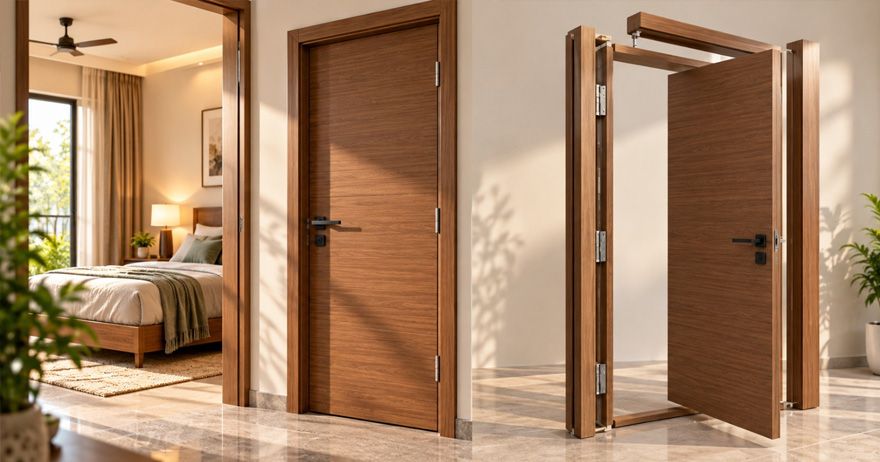
A flush door is a simple, modern door with a smooth, flat surface on both sides, with no panels, mouldings, or carvings. Flush doors are constructed like a sandwich, with a wooden frame made of rails and stiles that provides the outer edge and structural shape. The core (the interior) varies by type: hollow core, which uses a lightweight cellular or honeycomb structure (often cardboard, plastic, or aluminium), or solid core, which uses dense particle board, MDF (medium-density fiberboard), wood blocks, or solid timber.
How Flush Door Pricing Is Calculated
With Flush Doors starting at ₹500–₹1,000 per sq. ft. and going higher, you need to understand these core components that influence the price calculation of flush doors in India:
1. Door Shutter: depending on grade and finish
2. Door Frame (Chowkat): Sal wood, hardwood, or teak wood frames
3. Hardware & Accessories: Hinges, tower bolts, mortise locks, and handles.
4. Carpentry, Fixing & Architrave
5. Taxes: Applicable GST (usually 18%) is added to materials/services depending on the vendor bill.
Core Types and Their Cost Impact
A solid core flush door is an interior or light-commercial door built with a dense interior material, such as compressed particleboard or pine batten, wrapped in an outer wood veneer. This heavy-duty design provides excellent sound insulation, structural durability, and the substantial feel of a 100% solid wood door at a lower price point.
A hollow core flush door is a lightweight interior door with two outer face sheets (hardboard, plywood, or wood veneer) separated by a cellular or honeycomb internal framework, typically made of cardboard, plastic, wood, or aluminium, or tubular board surrounded by an empty air space. They are affordable, easy to install because they're lightweight, and commonly used for budget-conscious interior closets and bedrooms.
How Finish and Thickness Affect Price
Let’s look at the three typical types of flush doors: standard, medium-heavy duty, and heavy-duty/commercial.
Standard Interior Flush Doors are typically 30-32 mm thick and are best for light-to-medium-duty usage for internal living spaces like bedrooms. Standard Interior Flush Doors are among the most affordable because they have a hollow core, featuring a cardboard honeycomb or grid core surrounded by a minimal wood frame, which makes them lightweight and inexpensive to manufacture. With a flat surface, they lack complex panels, mouldings, or architectural details, so they require less labour and materials. Plus, the face/finish is thin plywood or hardboard (like MDF) glued over the core.
Medium-to-heavy-duty flush doors are typically 35-40 mm thick and suit main entrances, office cabins, and doors that hold heavier locks, door closers, or panic bars. Medium-to-heavy-duty doors use denser or solid cores, such as Solid Timber Blockboard Core, Tubular Particle Board/Extruded Core, or High-Density Fiberboard (HDF) Core, With Finishes Like Marine-Grade or High-Pressure Laminates (HPL), Premium Natural Wood Veneer, or Industrial PU Paint over HDF overlay, which can raise base prices by 20% to 100%.
Heavy-duty/Commercial flush doors are typically 40-45 mm and more and are commonly used for High-traffic commercial zones and heavy exterior or main entry doors. Heavy-duty/Commercial flush doors are in the highest price bracket (about 50% to 200% more than the base range) due to increased structural stability, sound insulation, and a thicker internal wood/block core, such as a Solid Hardwood Blockboard Core, Mineral Core / Fire-Rated Core, Acoustic / Multi-Layered Particle Core or Rigid Polyurethane Foam (PUF) Core, with finishes like High-Pressure Laminate (HPL) with Concealed Edge Banding, Thick Gurjan or Commercial Face Veneer or Pre-Painted Galvanised Iron (PPGI) / Stainless Steel Wrap.
Common Flush Door Sizes
The following table shows indicative flush door sizes, assuming your room/house height reaches 10 to 12 ft.
| Room / Location | Width | Height | Recommended Thickness |
|---|---|---|---|
| Bathroom / Utility | 2.3 ft to 2.5 ft (28" – 30" / 700 – 750 mm) | 7 ft (84" / 2100 mm) | 30 mm – 35 mm |
| Bedroom / Kitchen / Study | 2.5 ft to 3 ft (30" – 36" / 800 – 900 mm) | 7 ft (84" / 2100 mm) or 8 ft (2400 mm) for 11–12 ft ceilings | 30 mm – 38 mm |
| Main Entrance (Single Leaf) | 3 ft to 3.5 ft (36" – 42" / 900 – 1067 mm) | 7 ft or 8 ft (2134 – 2400 mm) | 40 mm – 45 mm |
| Main Entrance (Double Leaf / Villa) | 5 ft to 6 ft total (1500 – 1800 mm) | 7 ft or 8 ft (2134 – 2400 mm) | 40 mm – 45 mm |
Does the Price Include Frame and Hardware?
Yes, for branded flush doors of any size and thickness, you typically receive the frame and hardware. Some vendors provide only the leaf without hardware or frame, or the leaf with hardware but without the frame. So, ask what is included in the price.
How to Compare Supplier Quotes
Technical Specifications
Check the core type, face finish, and frame material.
Scope of Work
Does it include only the frame, or also installation with suitable hardware and any site labour?
Check for taxes
Usually, it is 18% GST. But depending on the yearly policies, this may differ.
Warranty and Credibility
Check for ISI certifications and after-sales service terms and conditions.
Common Budgeting Mistakes
Failing to Spec the Core Material by Room Traffic
Choosing cheap hollow-core doors for high-use entryways to save upfront cash.
Omitting Waterproofing Gaskets and Core Upgrades
Buying standard Commercial or Moisture Resistant (MR) grade doors for high-humidity areas.
Mismatching Finishing Styles to Veneer Grades
Buying paint-grade flush doors intending to apply a stain finish, or buying expensive wood-grain veneers only to paint over them.
Underbudgeting Hardware and Frame Alignment
Reusing lightweight old hinges or using cheap, thin metal hardware on heavy solid-core doors.
Final Buying Tips
Check the purpose of a flush door: is it light-duty or heavy-duty, and is it for the main entrance or a bedroom?
Check what you receive - whether it's only the leaf, the leaf with hardware, or the leaf with hardware and frame.
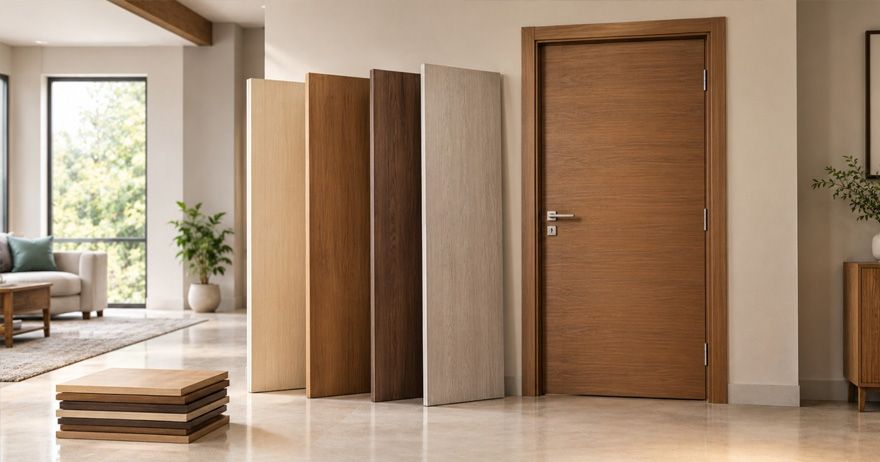
Check the quality and sturdiness of the door first-hand - visit the store and ask for samples!
Check the door components, from the core to the finish, and evaluate what you get.