
When choosing windows for a quieter home, it is easy to assume that thicker glass automatically provides better sound insulation. However, thicker glass is only one factor influencing how much outside noise enters a room. Glass type, pane configuration, air gaps, laminated interlayers, frame construction, sealing, and the frequency of the unwanted sound can all affect acoustic performance. A thicker pane may improve noise reduction in certain situations, but simply increasing glass thickness does not guarantee a significantly quieter room. For homes exposed to traffic, construction, or neighbourhood noise, looking at the complete window system rather than glass thickness alone can help achieve better and more consistent sound insulation.
How Glass Thickness Affects Sound Insulation
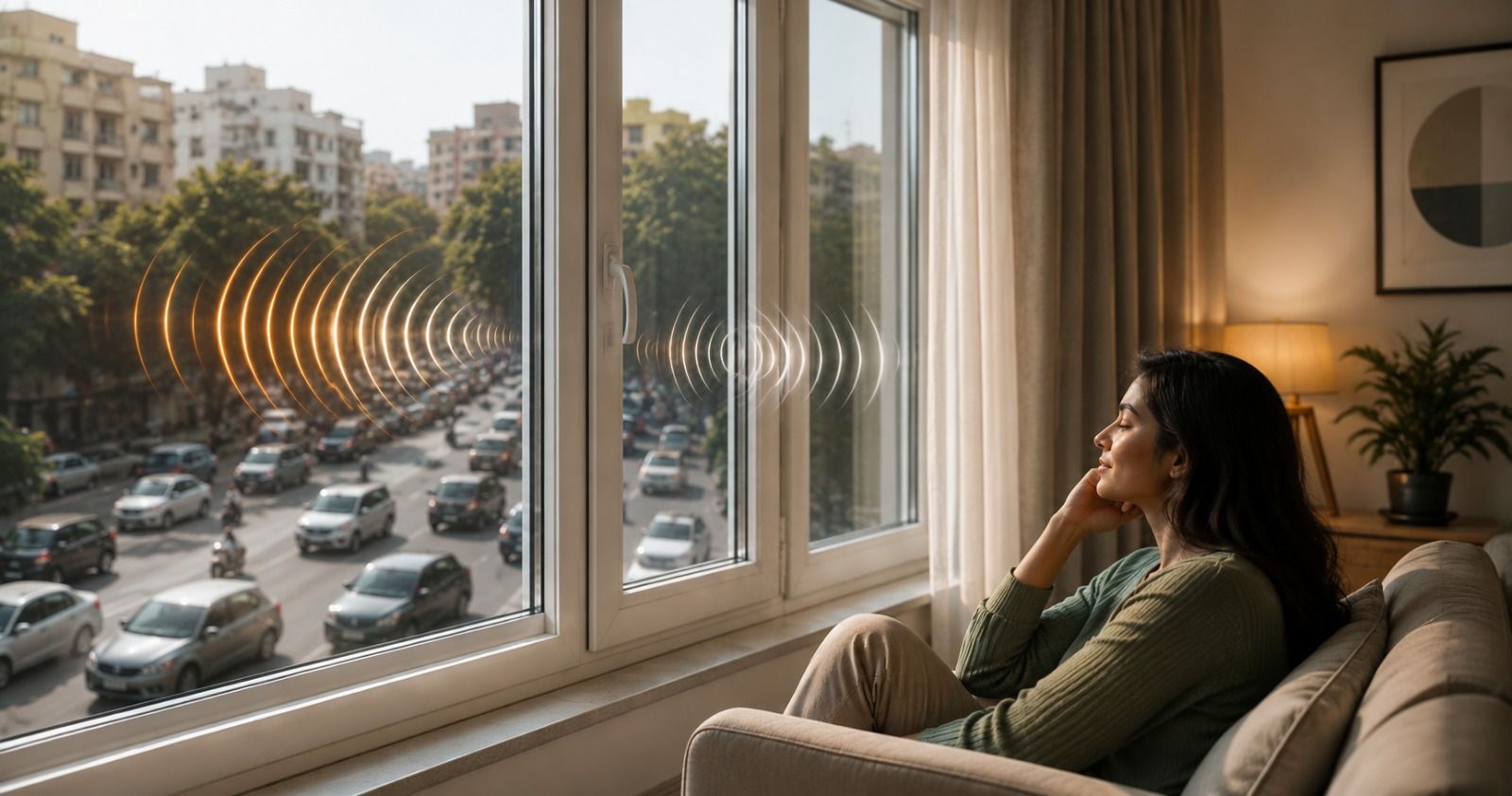
Sound travels through vibrations. When traffic, horns or construction noise hits a window, those sound waves make the glass vibrate. The harder those vibrations are to pass through the glass, the better the sound insulation.
This is where thickness helps. Thicker glass is generally heavier and more resistant to vibration, which means it can reduce sound transmission better than thinner glass.
But note this: increasing thickness doesn't make the noise disappear. It improves insulation, but the improvement is not necessarily proportional to the increase in thickness.
That's why simply specifying a very thick monolithic pane isn't always the smartest acoustic strategy.
Why Glass Thickness Alone Does Not Determine Acoustic Performance
Think of a window as a complete system, not just a sheet of glass.
Two windows can use the same glass thickness but perform differently acoustically because of their construction. The type of glass, the number of panes, the composition of laminated layers, the cavity between panes and the frame can all affect the final result.
Another consideration is that different sounds have different frequencies.
A window that performs well against higher-frequency sounds such as speech may not perform equally well against lower-frequency sounds such as traffic, trains or heavy vehicles. Acoustic ratings therefore use different measures and correction factors depending on the type of noise being considered.
So the question shouldn't simply be, “How thick is the glass?”
It should be, “How is this particular glazing system designed to deal with the noise I am experiencing?”
Laminated Glass vs Thicker Monolithic Glass for Noise Reduction
This is where laminated glass becomes particularly interesting.
Laminated glass is made by joining two glass panes with a polymer interlayer. When sound reaches the glass, this interlayer helps dampen vibrations rather than letting them pass through as easily.
That means a laminated configuration can provide better acoustic performance than a monolithic pane of comparable overall thickness.
Using an acoustic-grade interlayer can improve performance further. Guardian's laboratory data, for instance, shows a 6 mm + 6 mm laminated configuration with an acoustic PVB interlayer achieving an STC of around 40, compared with around 30 for a single 6 mm pane.
So instead of simply asking for “thicker glass,” it can make more sense to consider the right combination of thickness, lamination and acoustic interlayer.
How Double-Glazed Windows Help Reduce Noise
Double glazing introduces another layer to the equation.
Instead of having one pane separating your room from the outside, you have two panes separated by an air-filled cavity. This gap helps interrupt the path sound vibrations take.
The result can be better sound insulation than a single pane, particularly when the glazing is properly designed for acoustics. But double glazing isn't automatically acoustic glazing.
A basic double-glazed unit with two identical panes may not perform as well as a carefully designed unit using different glass thicknesses or acoustic laminated glass.
The Role of Air Gaps and Different Glass Thicknesses
The cavity between two panes isn't just for thermal insulation. It also plays an important acoustic role.
A larger gap can reduce sound transmission by creating more separation between the two panes. Another useful design strategy is to use different glass thicknesses for the two panes.
Why?
Because two identical panes can respond to certain sound frequencies in similar ways, different thicknesses change their resonance behaviour and can help reduce transmission across a wider range of frequencies.
For example, rather than simply using two identical panes, a system might combine a thicker outer pane with a thinner inner pane, depending on the required performance.
This is why acoustic glazing is ultimately about designing the combination, not simply increasing one number.
Why Window Frames and Seals Matter for Soundproofing
There is little point in investing in high-performance acoustic glass if sound can travel around it.
The window frame, seals, joints and installation all form part of the acoustic barrier. Even a small gap around a poorly sealed window can provide an easy path for sound to enter. This matters because windows are systems, not standalone glass panels.
So when specifying an acoustic window, look beyond the glass specification. The complete window assembly needs proper design and installation.
Choosing the Right Glass for Traffic and Urban Noise
Urban noise can be particularly challenging because it contains a mixture of frequencies: vehicle engines, horns, tyres, conversations, construction activity and occasional sirens.
For this reason, choosing glass based on thickness alone may not address the real problem.
If traffic noise is the main concern, look for glazing specifically tested for exterior noise, and consider acoustic ratings that account for lower-frequency sources. Laminated acoustic glass, asymmetric double glazing and appropriately sized air cavities can all form part of the solution.
The ideal specification depends on the location, noise source, window size, and building design.
Common Mistakes When Choosing Soundproof Windows
One of the biggest mistakes is assuming that thicker automatically means better.
Other common mistakes include choosing double glazing without checking its acoustic specification, using identical panes when an asymmetric configuration would be more suitable, overlooking acoustic interlayers and focusing on the glass while ignoring the frame and seals.
Another mistake is choosing a product based on a single acoustic number without considering what that number actually measures.
A window designed to reduce indoor speech transmission, for example, may not be equally effective against the low-frequency rumble of traffic.
How to Improve Overall Window Sound Insulation
If noise reduction is a priority, think about the window as a complete acoustic system.
Start by identifying the primary source of noise. Then consider the glass thickness, laminated versus monolithic construction, acoustic interlayers, the number of panes, the air gap and whether different glass thicknesses should be used.
Most importantly, pay attention to the frame, seals and installation quality.
In some cases, an acoustic laminated glass combined with an insulating glass unit can offer a significantly better solution than simply replacing an existing pane with a much thicker monolithic one.
Final Thoughts: Is Thicker Glass Always Better for Noise Reduction?
Not necessarily.
Thicker glass can improve sound insulation because greater mass makes it harder for sound vibrations to pass through. But it is only one piece of the puzzle.
For meaningful noise reduction, the better question is not “What is the thickest glass I can use?” but “What glazing combination is right for the noise I need to control?”
A well-designed acoustic window may combine the right glass thickness with laminated construction, an acoustic interlayer, an appropriate air gap, different pane thicknesses and well-sealed frames.
Because when it comes to soundproofing, quiet isn't created by thickness alone. It comes from how the entire window works together.