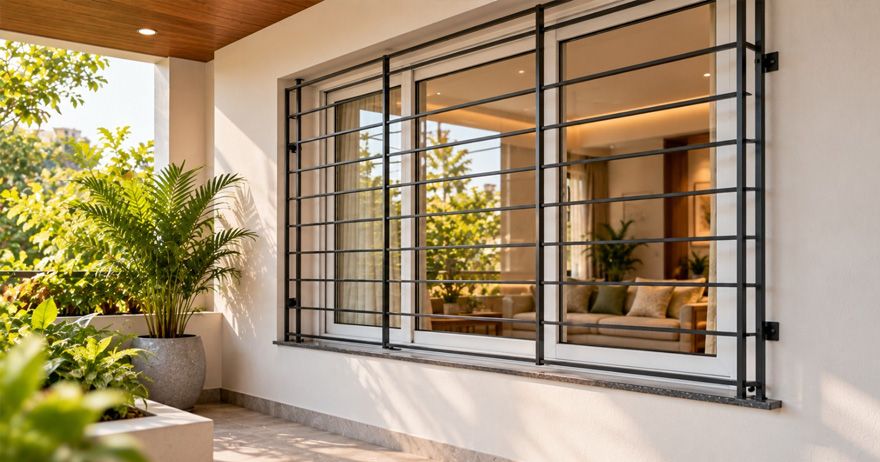
Can Grills Be Added to Existing uPVC Windows?
While it's generally possible to add security or decorative grills, IndiFrame does not offer security grills for existing uPVC windows. Security grills, or railings, are provided with the uPVC window itself for newer installations. This is because installing a grill separately requires drilling anchors into either the concrete wall or directly into the uPVC frame. If a third-party fabricator drills into the uPVC, it punctures internal chambers. This can cause problems such as rainwater leakage and void the manufacturer’s warranty (whether you bought it from IndiFrame or another brand).
Wall-Mounted vs Frame-Mounted Grills for uPVC Windows
IndiFrame offers both wall-mounted and frame-mounted grills (along with uPVC windows, and not separately) installed on the interior side of the opening (inside the house) to protect the metal from weather damage, simplify maintenance, and improve exterior aesthetics. In both cases, we show what it looks like to install a grill and why it's installed that way.
| Wall-Mounted Grill | Frame-Mounted Grill | |
|---|---|---|
| Where it fixes | Anchored to the wall/reveal around the window | Fixed directly to the uPVC window frame |
| Position | Sits separately from the window | Sits as part of the window assembly |
| Window operation | Window can operate independently of the grill | Grill and window configuration need to work together |
| Space required | Needs sufficient wall/reveal space for fixing | Takes up space within the window assembly |
| Visual appearance | More visually separate from the window | Looks more integrated with the window |
| Flexibility | Can be designed independently of the window | Design is tied to the frame size and configuration |
| Access & cleaning | Grill and window can be accessed separately | Access depends on the combined grill-window arrangement |
| Best suited for | When you want the grill to remain an independent element | When you want a compact integrated grill-and-window setup |
How Are Security Grills Installed Around uPVC Windows?
Wall-Mounted Grills
- The grill is positioned inside the window opening, against the surrounding wall/reveal.
- The grill frame is anchored into the masonry using suitable fasteners/anchors.
- The fixing points are distributed along the sides and, where required, the top/bottom.
- Install the uPVC window independently of the grill.
Frame-Mounted Grills
- The grill is positioned within the window assembly and aligned with the uPVC frame.
- It is mechanically fixed to the window frame using suitable fasteners and fixing points designed for the assembly.
- The grill and window are therefore treated as a combined installation, with the fixing method selected so it does not interfere with the window's operation or hardware.
Why Is the Installation Method Important? Can Grills Affect Window Operation, Ventilation, or Maintenance?
Keep in mind that the installation method matters; it can greatly affect how you operate the uPVC window, so the pane, handle, and any hardware should not be obstructed. The fixing should transfer the grill load proportionately to the wall or window. Frame-mounted grills especially need the right fixings to avoid damaging or overloading the uPVC window frame. Maintenance is another factor to consider; since grills are already obstructive, the design and space should allow for as little cleaning as possible. Lastly, the window's appearance and the grill's condition matter: if the grill isn't installed properly or is misaligned, it can be a disaster, both functionally and aesthetically.
How to Avoid Damage to uPVC Frames During Installation
If you are a homeowner or end user reading this, the best option is to choose a vendor or brand that can install windows and grills at the same time, like IndiFrame, since we have the technical expertise to add grills to uPVC windows during a new installation. If you'd like to learn more about them from a technical perspective, we suggest talking to us.
Choosing the Right Grill Design and Material
- Mild Steel (MS) (RECOMMENDED AND USED BY INDIFRAME): This is the most popular and budget-friendly material used for security grills. It is extremely strong and easy for local fabricators to weld into simple straight bars or custom grids, though it requires anti-rust primer and regular painting to prevent corrosion.
- Stainless Steel (SS): Known for its shiny, modern finish, stainless steel is completely rust-proof and very sturdy. It requires virtually no maintenance, making it a premium choice that resists weathering well.
- Wrought Iron: Highly malleable, wrought iron can be shaped into intricate, artistic, and ornate decorative patterns (such as leaves or curves). It offers high tensile strength and a classic aesthetic, but needs protective coatings to prevent rust.
- Cast Iron: Moulded into preset patterns through liquid casting rather than welding, cast iron produces heavy, durable, rigid grills that can hold intricate architectural details.
- Aluminium: Lightweight, naturally corrosion-resistant, and easy to maintain, aluminium is often used in modern apartments, offices, or damp areas like kitchens. However, it is softer and less secure than steel or iron.
- Concrete (RCC / Jali): Prefabricated concrete grills are affordable, highly weatherproof, and traditional, usually chosen for small utilitarian openings, garages, or boundary walls.
- Wood: Crafted into classic or decorative designs, wood provides a warm, natural look but is generally restricted to interior spaces or protected areas because it is vulnerable to moisture, weathering, and pests.
- Stone (Sandstone / Marble): Heavily carved stone jalis offer a unique, traditional, or heritage appearance, though they are expensive and rarely used for primary security.
Things to Check Before Installing Grills on uPVC Windows
- Choose the right mounting method — Decide between wall-mounted and frame-mounted grills based on the window type, surrounding wall space and available fixing points.
- Check clearances and window operation — Make sure the grill leaves enough space for the sash, handle, hinges, locks and sliding movement to work properly.
- Plan the grill size and design — Decide the height, width, bar spacing and pattern so the grill provides the required security without unnecessarily blocking the window.
- Plan for cleaning and maintenance — Ensure there is enough access to clean the glass and uPVC frame and to service the window or hardware later.
Common Mistakes to Avoid When Adding Window Grills
- Choosing a design that restricts the window — Avoid grill patterns, projections or spacing that interfere with opening the sash, operating the handle or accessing the window.
- Using the wrong fixing location — Avoid fixing wall-mounted grills into weak or unsuitable areas, or drilling into the uPVC frame without confirming that it can accommodate the fixing.
- Making the grill too bulky for the window — An oversized or overly dense design can reduce the usable opening, block light, and make the window look visually heavy.
- Installing without considering the finished look — Misaligned grills, uneven spacing, or a pattern that doesn't suit the window proportions can make the installation look untidy, even when the grill is securely fixed.
When Should You Consider Professional Grill Installation?
Consider professional installation whenever the grill needs to work around an existing uPVC window rather than being installed as part of a new window system. This is especially important when you are unsure where the grill can be safely anchored, when the window has limited space around it, or when the opening has sliding, casement, tilt-and-turn, or other moving configurations.
A professional can assess the wall/reveal, uPVC frame, fixing points, sash movement, hardware, and drainage paths before deciding how to install the grill. This helps avoid drilling into unsuitable parts of the frame or placing the grill where it restricts the window's operation, cleaning or maintenance.
For new windows, it is simpler to plan the grill and window together. You can decide the grill type, fixing method, clearances, and window configuration before installation, rather than modifying the window later. If you are adding a grill to an existing uPVC window, it is best to have the window and surrounding opening assessed before any drilling or fabrication work begins.
Final Thoughts
Adding a grill to an existing uPVC window is not simply a matter of fabricating a grill and fixing it around the opening. The fixing method and location can affect the window's operation, appearance, maintenance, and, in some cases, its performance and warranty.
If you add the grill separately, wall-mounted installation can keep the grill and window independent, provided there is enough masonry or reveal space for secure fixing. Frame-mounted grills require greater care because the fixing becomes part of the window assembly and must be compatible with the frame and its operation.
For homeowners planning new windows, designing and installing the window and grill together can avoid many of these complications. And if you already have uPVC windows and are considering adding grills, get the opening assessed before drilling into either the wall or the window frame.