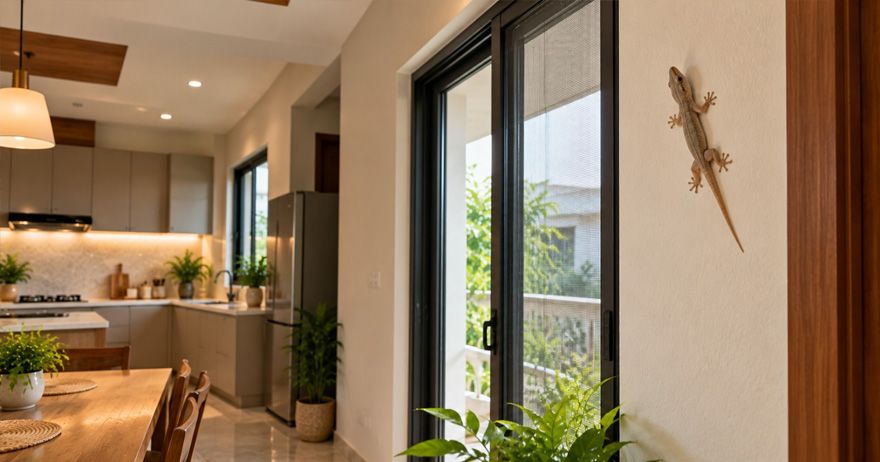
If you want to know how to get rid of lizards at home, start with one fact: lizards are in your house because insects are. House geckos eat mosquitoes, moths, cockroaches and flies. Remove the food supply and they leave on their own. That is why repellents rarely give lasting results — they treat the lizard, not the reason it came in.
Worth knowing first: house lizards are harmless, non-venomous and reduce the insects you would otherwise be dealing with. Some households leave them alone. If you would rather not, everything below makes the house unattractive rather than killing anything.
Why Do Lizards Enter Homes?
Four things draw them in. Insects are the main reason — where there are flying insects, there will be lizards. Light brings those insects, so outdoor and balcony lamps gather a food supply, and a tube light near a window is effectively a dinner bell.
Warmth matters because lizards cannot regulate their own body temperature, so they seek warm walls and the space behind appliances. Shelter comes from gaps behind cupboards, wall cracks and cluttered corners, where they rest during the day.
Where Are Lizards Commonly Found?
Near light sources and on the walls around them. Behind wall-mounted units, picture frames and switchboards. In the kitchen, behind the platform and near the bin. In bathrooms, which offer warmth and moisture. Behind the fridge, washing machine and TV unit. Around windows and ventilators, which are entry points and hunting grounds at once. If you keep seeing them in one spot, there is usually an insect supply nearby.
How to Remove a Lizard Safely
The simplest method works well and harms nothing.
- Open a window or door in the direction you want it to go.
- Close doors to other rooms so it does not run deeper into the house.
- Guide it gently with a broom, from behind rather than in front.
- Or cover and carry it out — a container over it, card slid underneath, released outside.
- A light spray of cold water slows one moving too fast to guide.
Never grab a lizard by the tail. The tail detaches as a defence, keeps moving for a while, and the lizard is left injured. Do not try to catch it by hand.
Seal Gaps Around Windows, Doors and Walls
Lizards squeeze through very small openings, so sealing is prevention that lasts. Check and close:
- Gaps around water and drain pipes entering the wall
- The AC pipe sleeve, often left open after installation
- Cracks in plaster and at wall joints
- Gaps under external doors, and open or broken ventilators
- Unsealed edges around window and door frames
- Gaps behind switchboards and at the meter box
Use sealant for small cracks, and steel wool packed in before sealing for larger gaps. Fit mesh over ventilators and duct openings.
Keep Insects and Other Food Sources Under Control
This is the step that actually works, because it removes the reason they visit.
- Switch outdoor and balcony lights to warm or yellow bulbs, which attract far fewer insects than white ones.
- Turn off outdoor lights when not needed, particularly near windows.
- Draw curtains at night so indoor light does not spill out and gather insects at the glass.
- Deal with standing water, which breeds the mosquitoes lizards feed on.
- Cover bins and empty them daily so flies do not gather.
- Clear cobwebs — where there are small insects, lizards follow.
Do this for two weeks and you will usually notice a difference without doing anything aimed at the lizards themselves.
Use Natural Methods to Keep Lizards Away
Some traditional remedies help a little, in a small area, for a short time. None clears a house.
May help slightly: garlic or chopped onion near entry points, a pepper and water spray on window ledges, eggshells in corners. The effect is modest and needs refreshing every few days.
Two warnings, since both are widely used in Indian homes. Naphthalene balls are toxic to inhale, particularly for young children, and should not be scattered where a child or pet might pick one up. And coffee and tobacco balls, often suggested online, are not a repellent — they poison the lizard, kill it slowly, leave dead lizards inside walls, and put nicotine within reach of children and pets.
Keep Kitchens and Food Areas Clean
Lizards do not eat your food, but the insects they hunt do.
Wipe the platform each night, sweep under appliances, and do not leave utensils soaking overnight. Store open food in closed containers. Clear crumbs from behind the toaster, mixer and microwave — that narrow warm gap is a common lizard spot because insects gather there. Keep the bin closed and the sink area dry at night.
Reduce Moisture and Hiding Places
Damp attracts insects, and insects attract lizards. Fix dripping taps and leaks under the sink, keep bathrooms and the utility area ventilated, and wipe condensation from sills.
Then remove the hiding places: clear stacked cartons, unused bags and newspaper piles, pull furniture away from walls to clean behind it, and keep storerooms tidy rather than packed.
How Window and Door Screens Can Help
Screens do two jobs here, which is why they are the most useful single investment. They stop lizards entering through an open window, and they keep out the insects that draw lizards in — cutting off the food supply at the same time.
For a screen to work, the mesh must be intact and the frame must seal. A torn corner or a warped frame with an edge gap lets both insects and lizards straight through. Wooden frames swell and shrink through the year and aluminium corrodes at the joints, which is how those gaps appear. IndiFrame's uPVC windows and doors close onto a gasket and can be supplied with mesh shutters in the same unit, so the screen and the seal work together.
Check mesh each season and repair tears rather than taping over them.
Common Mistakes to Avoid When Removing Lizards
- Chasing them deeper into the house instead of guiding them to an open door.
- Grabbing the tail, which detaches and leaves the animal injured.
- Relying only on remedies while the insects that feed them stay.
- Scattering naphthalene balls where children or pets can reach them.
- Using coffee and tobacco balls, which kill slowly and leave dead lizards in the house.
- Leaving outdoor lights on all night beside windows.
- Sealing gaps with a lizard inside. Remove it first.
- Expecting instant results. Insect numbers fall over weeks, and lizards follow.
How to Prevent Lizards From Returning
- Seal every gap around pipes, frames and ventilators.
- Keep window and door mesh intact.
- Switch to warm-toned outdoor lighting and turn it off when not needed.
- Keep bins covered and the kitchen wiped at night.
- Remove standing water so mosquito numbers stay low.
- Declutter storerooms and clean behind furniture.
- Fix leaks and keep damp areas ventilated.
- Check all of this again before the monsoon, when insect numbers rise.
Final Thoughts
The answer to how to get rid of lizards at home is indirect. Cut the insects, seal the gaps, screen the windows, and lizards stop finding your house worth visiting.
Remedies give short-term relief at a doorway or window ledge, but they are a supplement, not a solution. And there is no need to harm anything — the methods that work make the house uninteresting rather than dangerous.