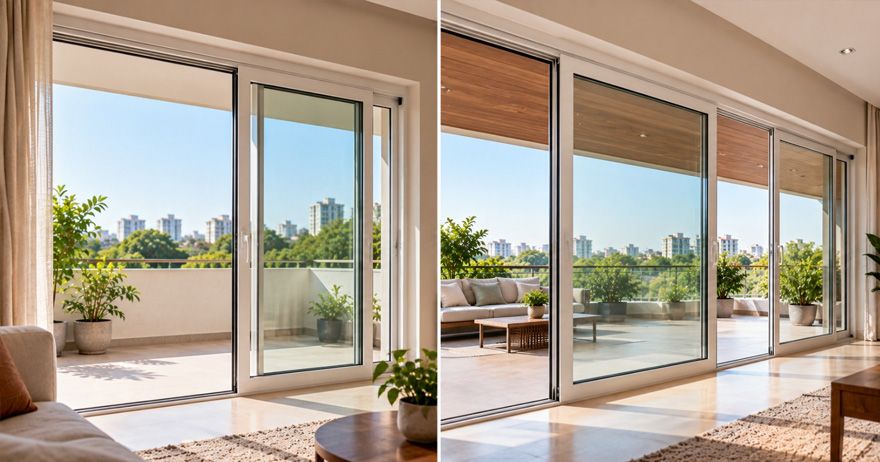
What Are Lift & Slide Doors?
Lift and slide doors are specialised sliding glass door systems featuring a mechanical handle that lifts the heavy door panel slightly off its weather seals and onto hidden rollers before it glides open.
How Do Regular Sliding Doors Work?
Regular sliding doors transfer the door's weight onto small wheels or rollers that glide horizontally along a metal track.
How Does a Lift & Slide Mechanism Work?
- Lifting phase: Turning the handle (typically 180 degrees) activates an internal gear mechanism that raises the door panel a few millimetres off the bottom tracks.
- Sliding phase: The weight of the glass shifts entirely onto precision rollers, allowing massive panels to move smoothly with minimal effort.
- Sealing and locking: Reversing the handle lowers the panel onto high-compression gaskets, creating a tight, airtight, watertight perimeter seal. You can also lock the door partially open for secure ventilation.
Yes — this can be structured as a practical homeowner-level comparison, without making it sound like lift & slide is automatically better.
Lift & Slide Doors vs Regular Sliders: Key Differences
1. Panel Size, Weight, and Ease of Operation
Regular sliding doors use rollers to move the panel along the track. They work well for everyday-sized panels, but as the panel becomes larger and heavier, moving it can require more effort.
Lift & Slide doors use a different hardware mechanism. Turning the handle lifts the door panel slightly off its seals, allowing the panel to move with much less resistance. This makes them suitable for larger, heavier panels while keeping operation smooth.
2. Sealing, Insulation, and Weather Performance
A regular slider relies on sliding seals, interlocking sections, and rollers to manage air, water, and dust.
In a Lift & Slide system, the panel is lifted while opening and drops back into position when closed. This allows the closed door to press firmly against its seals, improving airtightness, water resistance, dust control, and insulation.
Actual performance still depends on the complete door system, glass, seals and installation quality.
3. Design and Large Opening Possibilities
Regular sliders are a practical choice for balconies, rooms and other openings where you want a straightforward sliding door.
Lift & Slide systems are particularly useful when the design calls for wider openings, larger glass panels or fewer interruptions across the opening. Their ability to handle heavier panels gives designers more flexibility when creating large glazed openings.
4. Threshold and Floor-Level Installation Options
The bottom track becomes especially important when the door connects an indoor space to a balcony, terrace or outdoor area.
Depending on the system and installation design, Lift & Slide doors can be configured with low or floor-level thresholds, creating a cleaner transition between spaces.
Regular sliders can also have low-threshold options, so this is not exclusive to Lift & Slide. The important factors are the door system, drainage, waterproofing and how the threshold is detailed during installation.
5. Security and Hardware Considerations
Both systems can incorporate multi-point locking and other security hardware.
Lift & Slide doors typically use specialised hardware designed to lift, move and securely lock heavier panels. The quality of the locking system, frame, glass, and installation all contribute to the door's overall security.
With regular sliders, the locking and interlocking arrangement becomes particularly important because the panels meet and overlap at the centre.
6. Maintenance and Long-Term Performance
Both systems need basic maintenance: keep tracks clean, check moving hardware periodically, and inspect seals for wear.
Lift & Slide hardware has more specialised moving components, so proper installation and regular maintenance become especially important with large, heavy panels.
Which Door System Is Better for Different Home Requirements?
| Home requirement | Regular Sliding Door | Lift & Slide Door |
|---|---|---|
| Standard-sized balcony opening | ✓ Practical choice | Can be used; may be unnecessary |
| Large balcony or terrace opening | Suitable within system and panel-size limits | ✓ Better suited to large openings |
| Very large or heavy panels | Operation can become harder as weight increases | ✓ Designed to move larger; heavier panels more easily |
| Frequent everyday operation | ✓ Simple and practical | ✓ Smooth operation; especially with larger panels |
| Strong weather sealing | Good; depending on system and installation | ✓ Strong sealing when the panel is closed and engaged with the seals |
| Large glass areas with fewer panels | Limited by panel size and weight | ✓ Better suited to large glazed panels |
| Floor-level / low-threshold design | Possible with suitable systems | Possible with suitable systems |
| Budget-conscious project | ✓ Usually the more practical option | Usually a higher-cost system |
| Simple maintenance | ✓ Straightforward | Requires attention to specialised lift-and-slide hardware |
| Standard home renovation | ✓ Often sufficient | Consider when the opening or design calls for larger panels |
Common Mistakes to Avoid When Choosing Sliding Door Systems
When choosing between a regular sliding door and a Lift & Slide, the mistake is often choosing based on appearance alone. Look at how the door will actually be used.
Choosing the system before checking the opening size
A larger opening may require larger and heavier panels. Check the panel dimensions and weight before deciding which system is suitable.
Assuming bigger panels will always work
Large glass panels look great, but the frame, hardware, rollers and overall system must be designed to handle their weight.
Ignoring how often the door will be used
A door used several times a day needs smooth, reliable operation. Consider who will open it and how often, rather than judging the system only when it's new.
Looking only at the glass area
A large glass panel isn't useful if the door becomes difficult to operate or doesn't perform well when closed. Consider the complete door system — frame, hardware, seals and installation.
Treating weather performance as a product-name feature
Neither "sliding" nor "Lift & Slide" automatically guarantees better weather performance. Water drainage, seals, frame design and installation all matter.
Choosing a low threshold without considering drainage
A floor-level or low-threshold door needs proper drainage and waterproofing. Plan the threshold detail along with the floor and balcony/terrace design.
Overlooking hardware quality
Especially with large panels, the hardware must support the door and move it properly. The quality of rollers, locking components, and lift-and-slide hardware directly affects operation over time.
Choosing only on the initial price
Compare the complete system, including the panel size it can handle, hardware, glass options, performance and installation — not just the starting price.
Ignoring installation quality
Even a well-designed sliding or Lift & Slide system can perform poorly if the frame isn't aligned properly, the track isn't level or the sealing and drainage aren't done correctly.
Choosing a Lift & Slide when a regular slider would do — or vice versa
The decision should come back to the opening, panel size and weight, usage, performance requirements and budget. A more specialised system isn't automatically necessary for every opening.
Final Thoughts
To conclude, be thoroughly familiar with these types of sliding doors and their purposes. One may be more enticing than the other, but what can be even more enticing - how it serves aesthetically, functionally and purposefully, all at once.
For either system, smooth long-term operation depends heavily on correct track alignment, panel adjustment, drainage and installation quality.
The simplest way to understand the difference is that a regular slider is a practical sliding system for everyday openings. In contrast, Lift & Slide is a sliding system designed to make larger, heavier panels easier to operate while providing strong sealing when closed.