The dirty white deposits on taps and tiles are a common bathroom cleaning problem, particularly in homes that receive hard water. As water evaporates, the dissolved minerals remain behind on faucets, showerheads, tiles, glass and other bathroom surfaces. Over time, these minerals usually form a chalky, cloudy or crusty layer.
These hard water deposits usually involve minerals such as calcium and magnesium. Fresh deposits may be relatively easy to wipe away, but older buildup can become harder and more firmly attached to surfaces.
Regular cleaning can help to prevent mineral accumulation from becoming severe. However, the cleaning method matters because strong acidic products or abrasive tools can damage certain finishes.
This article explains what causes white deposits on taps and tiles, how to remove them safely, and what can be done to prevent them from coming back.
What Causes White Deposits on Taps and Tiles?
The most common cause of white deposits on bathroom taps and tiles is mineral residue from hard water.
When the hard water comes into contact with a surface, some of the water eventually evaporates. The dissolved minerals stay behind. Repeated exposure can cause these minerals to accumulate into visible deposits.
You may notice white or cloudy residue around taps, faucets, edges of sinks, shower panels, showerheads, etc.
Fresh mineral residues may also look like a thin white sheet. With repeated exposure, it can become thicker and more difficult to remove.
How does Hard Water Create Mineral Buildup?
Hard water consists of dissolved minerals, particularly calcium and magnesium. These minerals are not necessarily harmful to health at typical levels, but they can create cleaning and maintenance problems around the home.
The process is quite simple:
- Hard water comes into contact with a surface.
- Water remains on the surface after use.
- The water evaporates.
- Dissolved minerals remain behind.
- Repeated wetting creates additional deposits.
- The deposits gradually become thicker and more noticeable.
- This is why areas around faucets and showerheads often develop buildup faster than relatively dry areas of a bathroom.
Heat can also lead to faster evaporation, which is one reason mineral deposits can become noticeable around hot-water fixtures.
The longer the residue remains on a surface, the more difficult it may become to be removed. This is why regular bathroom tap and tile cleaning is generally easier than dealing with heavy, established buildup.
White Deposits on Bathroom Taps and Faucets
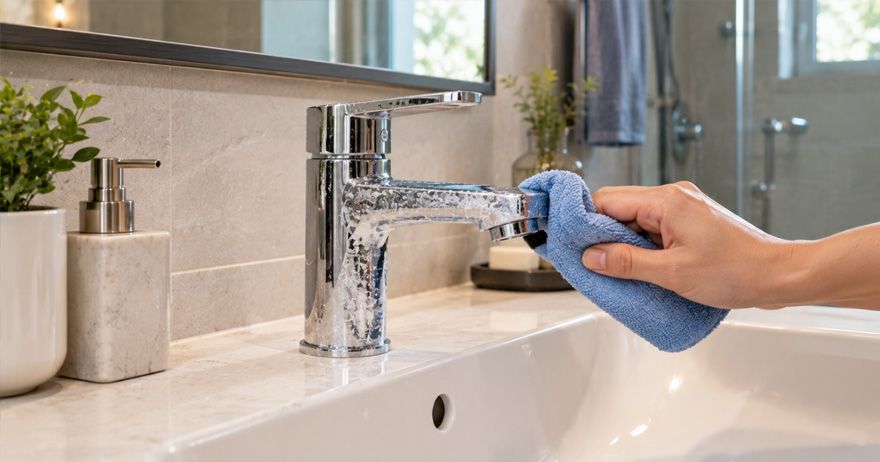
Faucets are particularly prone to mineral buildup because water frequently runs across their surfaces.
You may find deposits around faucet outlets, bases, edges, fixtures, handles, etc.
Small amounts of residue can often be removed through regular cleaning. More stubborn limescale on taps may require a suitable descaling method.
Before cleaning, identify the finish of the fixture. Chrome, stainless steel, brushed finishes, coated finishes, brass, natural stone and other materials may have different cleaning requirements.
After cleaning, rinse the fixture thoroughly if required by the product instructions and dry it with a soft cloth.
How to Remove Limescale From Taps Safely
If you want to know how to remove limescale from taps, start with the least aggressive method that is appropriate for the fixture.
For light deposits:
- Wipe the tap with a soft, damp cloth.
- Use a mild bathroom cleaner suitable for the tap finish.
- Gently loosen the residue without using abrasive tools.
- Rinse according to the product instructions.
- Dry the surface with a soft cloth.
For harder and more stubborn deposits, a suitable descaling product may be necessary. Follow the manufacturer's directions carefully, including the recommended contact time.
If the buildup is inside a removable aerator, the aerator may be cleaned separately according to the manufacturer's instructions.
How to Remove White Stains From Tiles
The right method on how to remove white stains from tiles depends on both the type of tile and the type of deposit.
For many glazed ceramic or porcelain tile surfaces, mineral deposits can be treated with an appropriate bathroom descaler or another cleaner recommended for that tile.
A basic cleaning process can include these steps
- Remove loose dust and dirt first.
- Apply a suitable cleaner according to its instructions.
- Allow the product to work only for the recommended time.
- Gently scrub with a non-abrasive sponge or suitable brush.
- Rinse the surface thoroughly where required.
- Dry the tiles to reduce water residue.
Do not automatically use vinegar or strong acidic cleaners on every tile.
Natural stone such as marble, limestone and some other stone surfaces can be too sensitive to acids. Acidic products can etch or dull these materials.
If you are not sure about the tile material, check for the manufacturer's cleaning recommendations before applying a descaler.
Cleaning Showerheads, Fixtures and Other Surfaces
Showerheads can develop significant mineral buildup because water continuously passes through their small openings.
If the showerhead is removable, follow the manufacturer's cleaning instructions. Some models can be soaked in an appropriate descaling solution, while others may require a different approach.
Glass shower panels can gather some cloudy mineral marks when water repeatedly dries on the surface. A suitable glass-safe cleaner or descaler can help, but avoid too abrasive tools that can scratch the glass.
Natural Cleaning Methods vs Commercial Descalers
Both household methods and commercial descaling products can be useful, but neither is suitable for every surface.
Vinegar
Diluted vinegar is commonly used for some hard water deposits because its acidity can help dissolve mineral residue.
However, vinegar should not be treated as a universal bathroom cleaner. It may damage or dull acid-sensitive surfaces such as certain natural stones and some finishes.
Always check surface compatibility first.
Commercial Descalers
Commercial descaling products are formulated specifically to break down mineral deposits. They can be useful for stubborn calcium deposits on bathroom fixtures.
However, they can also be stronger than ordinary cleaners. Follow the label instructions carefully and avoid mixing cleaning chemicals.
Soft Cloths and Non-Abrasive Sponges
These are useful for routine maintenance and light deposits. They are less likely to scratch delicate finishes than harsh scrubbers.
The safest method is usually to select the least aggressive cleaning product that can effectively remove the deposit from the particular surface.
Surfaces and Cleaning Products to Treat With Care
Not every bathroom surface should be cleaned with an acidic descaler.
Strong acids, abrasive powders and aggressive scrubbing can permanently alter a surface.
Do not mix vinegar, descaling products, bleach, ammonia-based cleaners or other chemicals unless the product manufacturer specifically states that they can be combined. Mixing cleaning products can produce dangerous reactions or fumes.
If a surface is valuable, delicate or unfamiliar, check the manufacturer's instructions before cleaning.
How to Prevent Hard Water Deposits From Returning
Completely preventing hard water deposits can be difficult if the water itself has a high mineral content. However, regular maintenance can significantly reduce visible buildup.
Wipe Wet Surfaces Regularly
After showering or using the sink, wipe water from taps, glass and other frequently wet surfaces where practical.
Dry Bathroom Fixtures
A dry fixture is less likely to develop repeated mineral residue than one that remains wet.
Clean Small Deposits Early
Do not wait until a thin white film becomes a thick crust. Regular cleaning usually requires less effort.
Improve Bathroom Ventilation
Good ventilation helps reduce persistent moisture and allows wet surfaces to dry more quickly.
Address Water Leaks
A continuously leaking tap or shower connection can keep a surface wet and encourage mineral buildup.
Consider Water Treatment
If hard water is a persistent household issue, a suitable water treatment system may help reduce mineral-related problems. The appropriate option depends on the water quality and household requirements.
Common Cleaning Mistakes to Avoid
Using a Strong Acid on Every Surface
A powerful descaler may damage natural stone, decorative finishes or other acid-sensitive materials.
Scrubbing Too Aggressively
Steel wool, rough scouring pads and abrasive tools can scratch taps, tiles and glass.
Leaving Descaler on Too Long
Follow the recommended contact time. Longer exposure can increase the risk of surface damage.
Mixing Cleaning Products
Never mix different cleaning chemicals unless the manufacturer specifically confirms that the combination is safe.
Ignoring the Fixture Finish
Two taps may look similar but have different finishes and cleaning requirements.
The most important principle is to match the cleaning method to the surface. Removing limescale on taps may require a different approach from cleaning natural stone tiles or glass.
With regular maintenance and careful product selection, you can reduce hard water stains in the bathroom and keep taps, tiles and other fixtures looking cleaner for longer.
Final Thoughts
White deposits on taps and tiles are usually a result of hard water mineral buildup, but regular cleaning and preventive maintenance can keep them under control. Wiping wet surfaces, using material-safe cleaning products, and considering water softening can help maintain clean and attractive bathroom fixtures.