


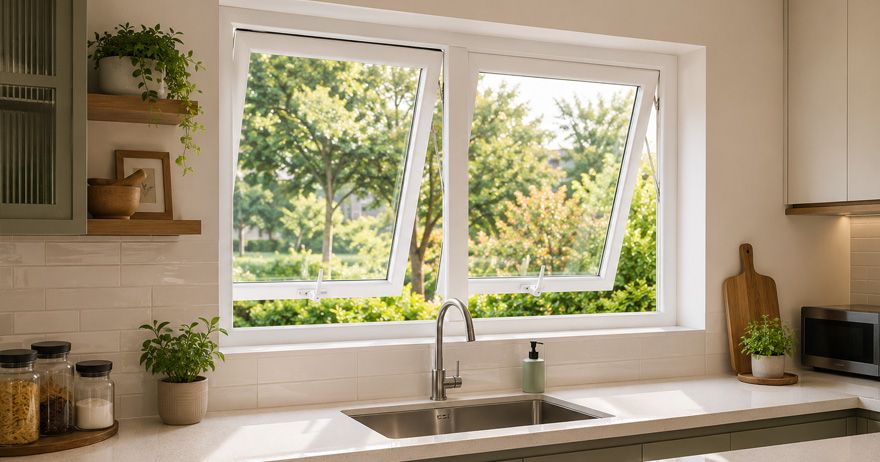
What Are Top Hung Windows?
Top-hung windows are hinged at the top of a complete window frame, or, for that matter, at the top of a wall.
How Top Hung Windows Work
The handle below has to be turned 90 degrees to the top or either side and pushed outward. Mechanical hinges or friction stays are secured exclusively along the top horizontal frame, which helps it move outwards.
Benefits of Top Hung Windows
Better ventilation and indoor comfort
A top-hung window helps bring in fresh air, release hot and stale air, and support natural circulation when paired with lower-level windows or doors. Its friction stays allow controlled opening at different positions, making it suitable for regular background ventilation. In bathrooms, kitchens, laundry rooms and utility areas, it also helps reduce humidity, odours, stuffiness and condensation. It can additionally be designed with a fixed section or panel for exhaust-fan integration.
Ventilation with improved rain protection
Because the sash opens outward from the bottom, it forms a small canopy over the opening. This helps deflect light rain while still allowing airflow and generally offers better weather protection than some other openable window styles. However, it should still be closed during heavy or wind-driven rain.
Privacy, safety and restricted access
When installed high on a wall, a top-hung window allows ventilation and daylight without creating a direct line of sight into the room. This makes it useful for bathrooms, toilets, staircases and other private spaces. Its high position and restricted opening can also make it harder for children to reach and more difficult for someone to enter through, although it should not automatically be considered child-safe or burglar-proof. Properly selected friction stays also help keep the sash stable and reduce the risk of it slamming shut.
Efficient use of space and flexible installation
Since the sash opens outward, it does not occupy space inside the room or interfere with curtains, furniture, countertops or movement. It can be installed above kitchen counters, bathroom fixtures, desks, storage units or machinery and is suitable for narrow or compact wall openings. It can be used as a standalone high-level window, above a fixed, sliding or casement window, or as part of a larger window configuration.
Effective opening, daylight and clean appearance
Unlike sliding windows, a top-hung window does not have overlapping sashes blocking part of the opening, allowing more effective air passage through the available openable area. It also brings natural light into spaces where a larger eye-level window may not be appropriate. Its compact horizontal form gives it a clean, modern appearance and makes it easy to integrate above doors, windows and other wall elements.
Best Rooms for Top Hung Windows
Ventilator windows operate on the principle of the stack effect, or chimney effect, in which the natural movement of air into and out of a building is driven by temperature and density differences. This type of ventilation mechanism works for compact rooms that experience significant heat and humidity buildup, require greater privacy than others, or have layouts where regular window placement is not possible; therefore, it performs best when installed at a higher level than regular windows. Bathrooms, toilets, kitchens, storerooms, basements, and staircases often need ventilator windows and higher placement, as discussed below.
Also Read: uPVC Ventilator Windows: Complete Guide for Bathroom & Kitchen Ventilation
Top Hung Windows vs Casement Windows
| Feature | Top-Hung Windows | Casement Windows |
|---|---|---|
| Opening mechanism | Hinged at the top and opens outward from the bottom | Hinged on one side and opens outward like a door |
| Ventilation | Provides controlled continuous ventilation | Provides wider and stronger ventilation |
| Airflow direction | Allows rising hot and stale air to escape when installed high on a wall | Can catch and direct passing breezes into the room |
| Rain protection | The outward-sloping sash helps protect the opening during light rain | More likely to allow rain inside when left open |
| Privacy | Offers ventilation and daylight while maintaining privacy especially when installed above eye level | Provides less privacy because it is generally installed at eye level |
| Daylight | Suitable for bringing light into bathrooms staircases and compact spaces | Larger glass area can provide more natural light and a clearer outside view |
| Space requirement | Does not occupy space inside and usually requires limited outdoor clearance | Requires more outdoor clearance for the sash to open fully |
| Opening size | Commonly used for smaller horizontal openings | Better suited to larger and taller openings |
| Accessibility | High-level installations may require a long handle pole or automation | Generally easier to reach and operate |
| Safety | A restricted high-level opening can reduce access for children and intruders | A large open sash may require restrictors or additional safety hardware |
| Typical applications | Bathrooms toilets kitchens staircases utility rooms and high-level ventilation | Bedrooms living rooms offices and spaces requiring maximum ventilation and views |
| Best suited for | Privacy background ventilation compact spaces and light-rain protection | Maximum airflow wider views and easy access |
Things to Consider Before Installing Top Hung Windows
1. Installation Location and Purpose
Top-hung windows perform best when installed high on a wall, where they can effectively release rising hot and stale air. Before installation, determine whether the window is primarily intended for ventilation, daylighting, privacy, exhaust fan integration or a combination of these, as this influences its ideal size, placement and glazing.
2. Window Size, Operation and Accessibility
Top-hung windows are generally better suited for small to medium-sized openings. Larger sashes require appropriately rated friction stays and hardware to support their weight. Since these windows are often installed at high levels, consider extended handles, pole-operated systems or motorised openers to ensure convenient operation.
3. Hardware Quality and Professional Installation
The performance of a top-hung window depends heavily on its friction stays and hardware. Choose hardware that is suitable for the sash size and weight, and use corrosion-resistant materials such as stainless steel in coastal environments. Equally important is professional installation, including proper alignment, anchoring and sealing, to ensure smooth operation, weather resistance and long-term durability.
4. Climate and Weather Conditions
Consider the local climate, building orientation, prevailing winds and rainfall before installation. While top-hung windows provide ventilation during light rain, they should not be left open during heavy or wind-driven rain. In exposed locations, stronger friction stays, restricted opening angles or additional weather protection may also be required.
5. Glass and Security Requirements
Select the glazing based on the room's needs, such as toughened glass for impact resistance, laminated glass for safety and sound reduction, double-glazed units for thermal and acoustic insulation, or frosted glass for privacy. If the window is accessible from outside, consider multi-point locks, lockable handles or opening restrictors for enhanced security.
6. Ventilation Accessories and Integration
If the window will be used frequently for ventilation, adding a mosquito mesh can improve comfort without restricting airflow. Top-hung windows also work well alongside fixed, sliding or casement windows and can be integrated with exhaust fans to create a more effective overall ventilation system.
7. Cleaning and Maintenance
Because top-hung windows open outward, cleaning the exterior can be more challenging, particularly on upper floors. Consider future maintenance access during the design stage to ensure the window can be cleaned and serviced safely throughout its lifespan.
Common Mistakes to Avoid When Choosing Top Hung Windows
1. Choosing the Wrong Size
Selecting a sash that is too large without considering hardware limitations can lead to operational issues and reduced durability. Conversely, choosing a window that is too small may not provide sufficient ventilation or daylight.
2. Overlooking Hardware Quality
Many homeowners focus on the frame and glass while overlooking the importance of friction stays and locking hardware. Using low-quality or undersized hardware can result in poor operation, premature wear and corrosion, particularly in coastal areas.
3. Ignoring the Room's Requirements
Using the same glass specification and window configuration throughout the home is a common mistake. Bathrooms may require frosted glass, bedrooms may benefit from better acoustic insulation, while kitchens and utility rooms often prioritise ventilation.
4. Not Considering Accessibility and Maintenance
Since top-hung windows are frequently installed at high levels, they may be difficult to operate or clean without extended handles, pole operators or motorised systems. Planning for future maintenance is equally important.
5. Assuming They Can Stay Open in All Weather
While top-hung windows perform well during light rain, they are not designed to remain open during heavy or wind-driven rainfall. Local climate, wind direction and building orientation should always be considered during selection.
6. Choosing the Wrong Supplier or Installer
Even a high-quality top-hung window can underperform if it is poorly manufactured or installed. Choosing an experienced supplier such as IndiFrame that uses quality uPVC materials, appropriate hardware and proper installation practices is essential for long-term performance, weather resistance and durability.
Why Top Hung Windows Are Ideal for Indian Homes
1. Suited to India's Hot and Humid Climate
Much of India experiences high temperatures for several months each year. When installed at the highest point of a wall, top-hung windows allow hot air, humidity and stale indoor air to escape naturally, improving indoor comfort and reducing dependence on mechanical ventilation.
2. Ventilation Even During the Monsoon
The outward-opening sash acts as a small canopy, allowing fresh air to enter while helping keep out light rain. This makes top-hung windows particularly useful during India's long monsoon season, although they should be closed during heavy or wind-driven rain.
3. Ideal for Compact Urban Homes
With shrinking apartment sizes, every square foot matters. Since top-hung windows open outward, they do not occupy any indoor space, making them suitable for kitchens, bathrooms, utility rooms, staircases and other compact areas.
4. Better Privacy Without Compromising Ventilation
Many Indian homes are built close to neighbouring buildings. Installed high on a wall, top-hung windows provide natural light and fresh air, at the same time maintaining privacy, making them an excellent choice for bathrooms, toilets and service areas.
5. Easy to Combine with Other Window Systems
Top-hung windows can be used as standalone ventilators or paired with sliding, fixed or casement windows to improve airflow and daylight. This flexibility allows homeowners and architects to create efficient ventilation strategies without compromising aesthetics.
Final Thoughts
Top-hung windows are a practical choice for spaces where ventilation, privacy and efficient use of space are priorities. Their ability to release hot, stale air, provide natural light, remain functional during light rain and fit comfortably into compact spaces makes them well suited to modern homes.
However, like any window style, their performance depends on choosing the right size, glazing, hardware and installation location. When specified correctly and installed by experienced professionals, top-hung windows can deliver years of reliable performance with minimal maintenance.
Whether used as a standalone high-level ventilator or combined with other window systems, top-hung windows offer to improve indoor comfort with a simple yet effective solution, especially in India's diverse climatic conditions.