



What Does the Building Code Say About Bedroom Windows?
According to the National Building Code (NBC) 2016, laid by the Bureau of Indian Standards (BIS), the minimum aggregate area of openings (windows + ventilators, excluding doors) for habitable rooms, which in this case is the bedroom, should be at least 10% of the floor area. So, for instance, if your bedroom is 12 ft x 15 ft (180 sq ft), then the total window area should be at least 18 sq ft. Now, whether you need a single 6 ft x 3 ft window or two 3 ft x 3 ft windows depends on your layout.
There is no credible account so far of how it concluded that it should be at least 10%. However, the Daylight Factor Theory, whose earliest versions date back to 1895, has been shown to have had a universal influence on the Ratio of Window Size to Room Floor Area and has hence been adopted in our National Building Code.
But considering the complex needs of each house, it is reassuring to say that NBC’s guidelines are the bare minimum. Think about it: would it be okay if the bedroom (of the same dimensions as mentioned earlier) in your house, situated on the top floor of a high-rise, would aesthetically and functionally suffice with a 6 ft x 3 ft window?
Is One Window Enough for a Bedroom? Situations Where One Window Is Sufficient
We believe that even your bedroom’s layout cannot fully answer it. It all depends on where you are located, the floor or level of your home, the surrounding infrastructure, the size and type of the window installed, its hardware and glazing, and of course the bedroom’s window placement. These play a huge role in carving out the path for sunlight and air to enter your home.
However, to give you a concrete reality, most urban homes are designed to accommodate one window per bedroom, unless the architect and developer need the feel of cross-ventilation (with two or more windows) for bedrooms or any habitable room.
Besides, a good thing about having one window open is that it limits heat gain and loss, keeping your bedroom's thermal comfort in check. And if your bedroom is compact (Indian homeowners have nicknamed it as ‘matchbox’), one window is enough to let light and air into your room.
Benefits of Two Windows in a Bedroom
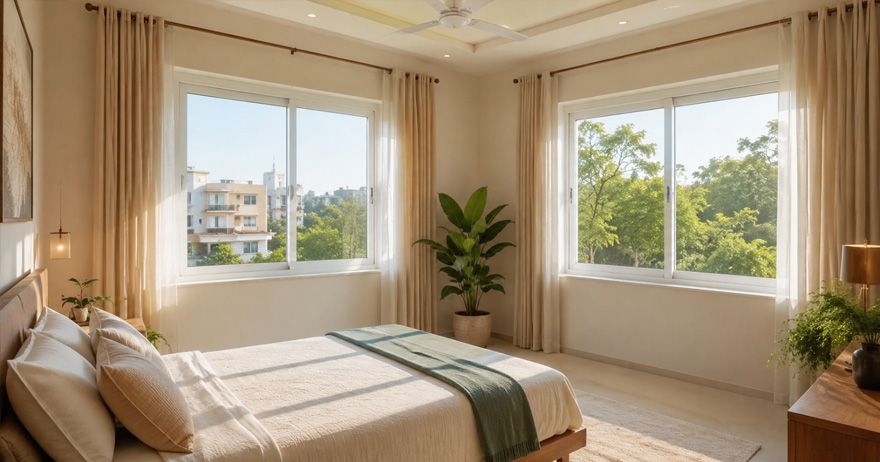
The concept of cross-ventilation (having two or more windows in a single habitable room) is at the foothills of peak luxury when it comes to accessing light, air, and expansive outside views (provided it’s worth capturing for your social media).
Typically, when two windows are installed on different corners of the walls correctly, keeping in mind the vastu, wind and sunlight direction, and assuming there are least to no obstructions around your home, you enjoy benefits like lower energy bills, since you dont have to rely much on air conditioner and fan, controlled humidity by removing moisture from your bedroom’s atmosphere, which also means you may not need to rely on an additional humidifier, and fresh, cool atmosphere since continuous air movement prevents heat build up.
But if your home is in an area or city with poor air quality and is surrounded by infrastructure at the same or higher elevation, it becomes the opposite of what we spoke about above, and that can be a sad state of affairs. Somehow, in this situation, someone with a cross-ventilated bedroom would be in better living conditions than someone with a single-ventilated bedroom, at least in terms of breathing space.
Factors to Consider Before Adding a Second Window
While cross-ventilation can bring stars to your eyes and everyday living, you need to consider factors behind a bedroom window design’s success that go beyond simply increasing daylight or airflow. The room's orientation and vastu shastra play a significant role, as a west-facing window may introduce excessive afternoon heat. In contrast, north- or east-facing windows generally provide softer, more comfortable daylight.
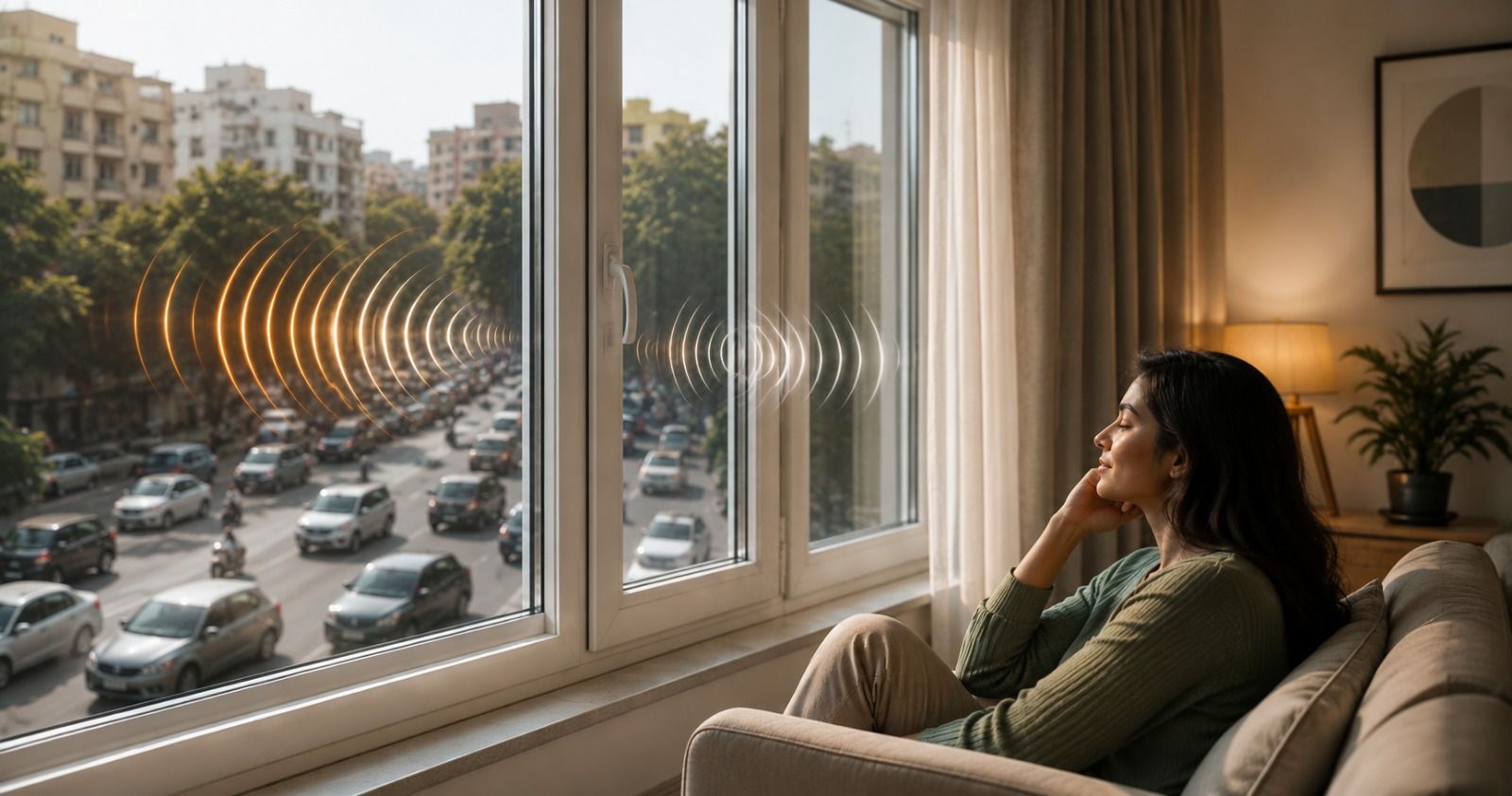
Cross-ventilation is only effective when the second window is positioned according to the prevailing wind direction and placed on an adjacent or opposite wall rather than the same wall. Oh, and how do we forget the core need for a bedroom - privacy! Especially if the new window overlooks neighbouring properties. And outdoor noise levels if it faces a busy street.
But if you are going for a cross-ventilated room, an extra window reduces available wall space for beds, wardrobes, and other furniture, which can affect the room's layout and your daily experience.
Let’s say you're renovating an existing home; would cross ventilation be worth the structural modifications and installation costs? And finally, the performance of the window itself is equally important; choosing energy-efficient frames and glazing helps maximise comfort while limiting unwanted heat gain and loss, sound, and air leakage.
Best Bedroom Window Placement for Better Ventilation and Natural Light
| Bedroom Type | Recommended Bedroom Direction (Vastu) | Preferred Window Directions |
|---|---|---|
| Main Bedroom | South-West | North East or North-East (avoid large openings on the South-West) |
| Children's Bedroom | West or North-West | East or North |
| Guest Bedroom | North-West | North or East |
| Elderly Bedroom | South or West | East or North |
| Study-cum-Bedroom | East or North-East | East and North |
Also Read: How Window Placement Affects Ventilation & Airflow in Your Home
Choosing the Ideal Bedroom Windows for Your Bedroom
While choosing a window type that fits your needs depends on what we have discussed so far. However, we have listed window configurations that are commonly preferred. If and only if your bedroom has a rare or luxurious structure or style, we also have the window configurations listed.
| Configuration | Best suited for | Why it is commonly preferred |
|---|---|---|
| Casement | Most standard bedrooms apartments and villas | Opens fully for maximum ventilation seals tightly against weather and offers secure multi-point locking |
| Sliding | Compact bedrooms apartments and rooms with limited space | Slides smoothly without swinging saving space while providing wide views and easy operation |
| Tilt and Turn | Contemporary homes high-rise apartments and premium residences | Offers tilt ventilation or full opening making it secure versatile and easy to clean |
| Combination Windows | Large master bedrooms with expansive walls | Combines different window types to increase daylight ventilation and design flexibility |
| Bay and Bow Windows | Luxury bedrooms villas reading nooks and bedrooms overlooking gardens or scenic views | Creates extra interior space wider views and more natural light with a distinctive appearance |
| Double Hung | Heritage homes colonial architecture and traditional residences | Both sashes open independently for controlled airflow while retaining a traditional look |
| Corner Windows | Modern homes located on open plots with attractive views | Brings in daylight from two sides improves cross-ventilation and enhances openness |
| Picture (Fixed) Windows | Bedrooms with scenic landscapes hills lakes or gardens | Maximises natural light and uninterrupted views often paired with operable windows nearby |
Also Read: Best Window Designs for Every Room: A Complete Homeowner’s Guide
Common Mistakes to Avoid When Designing Bedroom Windows
We have covered them already in our above sub-topics, but to summarise it for you, ignoring any one factor such as the elevation, the surroundings, the direction of wind and light, the window configuration, size and placement of the same, the right glazing, and most importantly your layout on which the foundation of your bedroom’s daily experience is laid, can hamper or devalue the rest.
Final Thoughts
To end, we would reiterate that the choice between one window and two in your bedroom depends on the kind of home you have or want to purchase or build. Besides, even in vastu shastra, there is no mandatory requirement for the number of windows in every bedroom. Instead, it emphasises the placement and direction of windows. Therefore, there is no mandatory requirement that every bedroom have two windows. A single well-positioned window can be sufficient, while a second window is recommended only if it enhances natural light, ventilation, and overall spatial comfort.